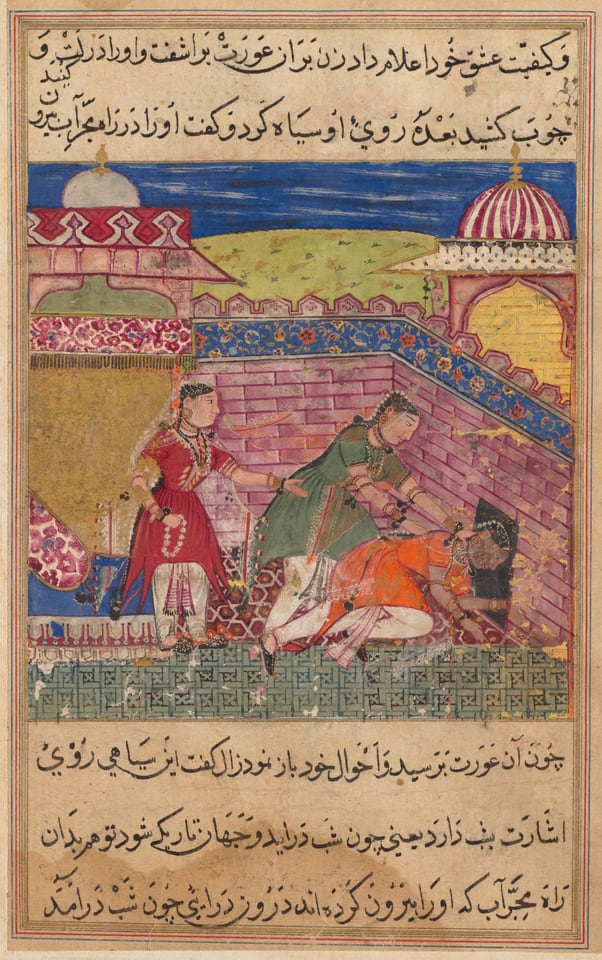
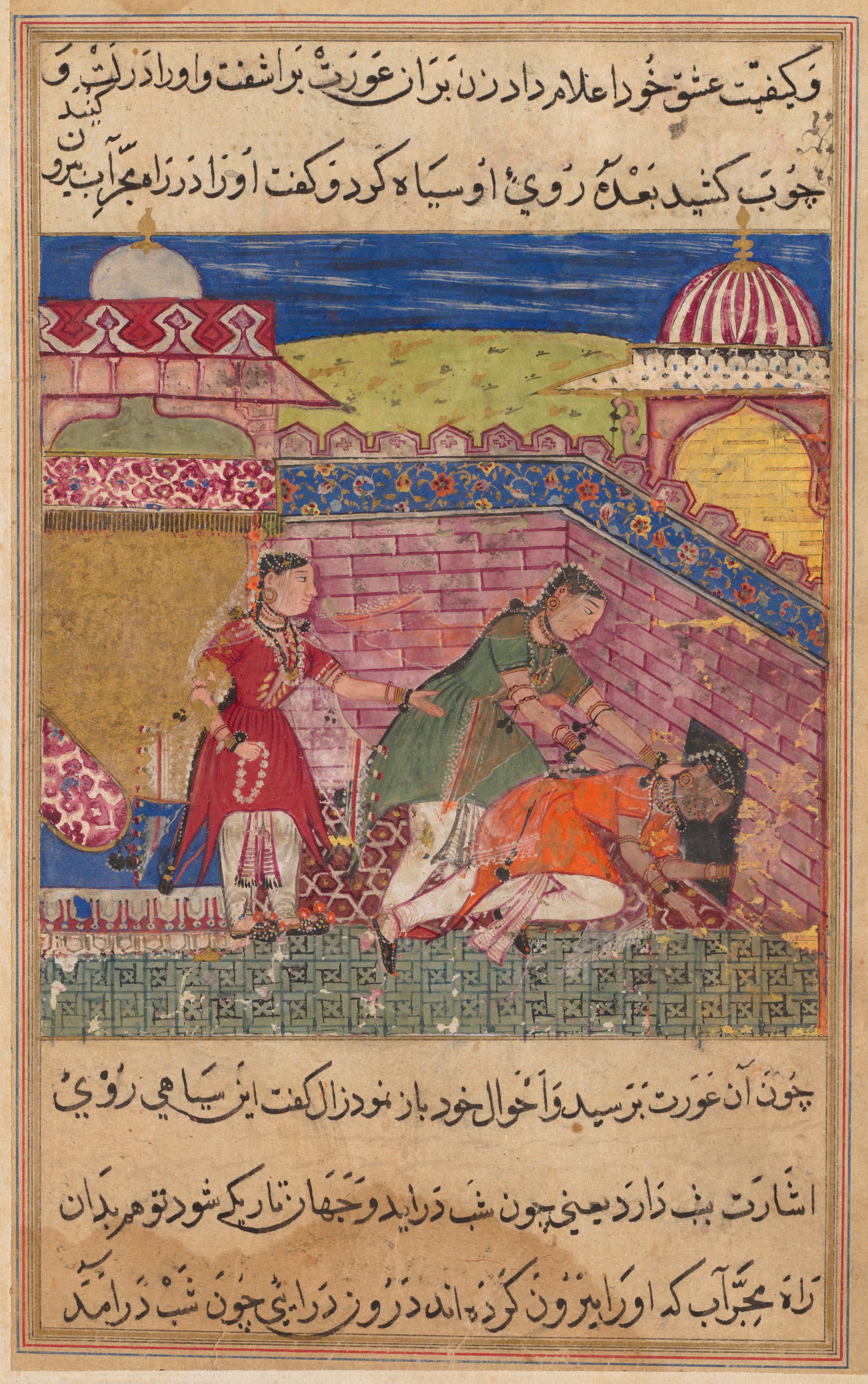
The deceitful wife ejects the procuress after blackening her face, from a Tuti-nama (Tales of a Parrot): Eighth Nightc. 1560
The lover of the unfaithful wife sent a female messenger to arrange for their rendezvous. More about this work
About this work
The lover of the unfaithful wife sent a female messenger to arrange for their rendezvous. In a false display of horror, the wily adulteress blackened the face of the messenger as though to disgrace her and threw her out of the house, ordering her to be dumped by the side of a canal. That act, however, was a coded message to her lover to meet at the dark of night at that same location. The Indian artist Shravana added the pink brick wall to lend a sense of depth and dimensionality to the scene.
Text from the Cleveland Museum of Art.
How it was made
- Opaque watercolour
- Watercolour made opaque with white or chalk and laid in flat, even layers. Persian and Indian painters ground their colours from minerals, applied them with the finest brushes and burnished the finished page.
- Tempera
- Pigment bound with egg yolk. It dries in minutes and can’t be blended wet, so painters built up form with fine, hatched strokes. It was Europe’s main panel technique before oil.
- Ink on paper
- Ink made from soot and animal glue, ground with water on an inkstone. A single brush can give a hair-fine line or a broad wash, and nothing can be corrected.
Shravana
Indian, active 1550s–c.1600
Rights and the museum’s record
Public domain. The Cleveland Museum of Art has dedicated this image to the public domain under CC0, so anyone may copy, adapt and use it, for any purpose, without asking. Our prints and files are reproductions made from the museum’s image; the museum doesn’t endorse them.
- Object number
- 1962.279.67.b
- Credit
- Courtesy of the Cleveland Museum of Art
- Type
- Painting
- Department
- Indian and Southeast Asian Art
- Licence
- CC0 1.0 Universal
- Museum record
- See it on the museum’s site
Report this work
Close in colour