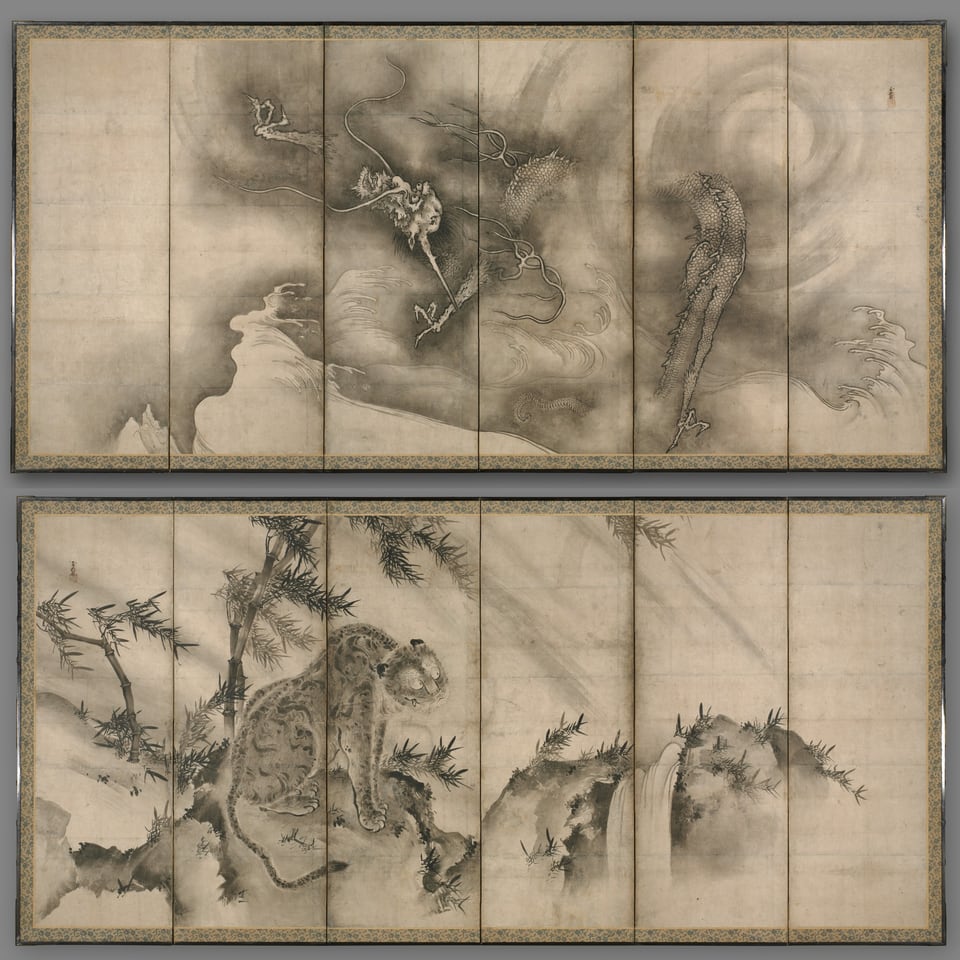
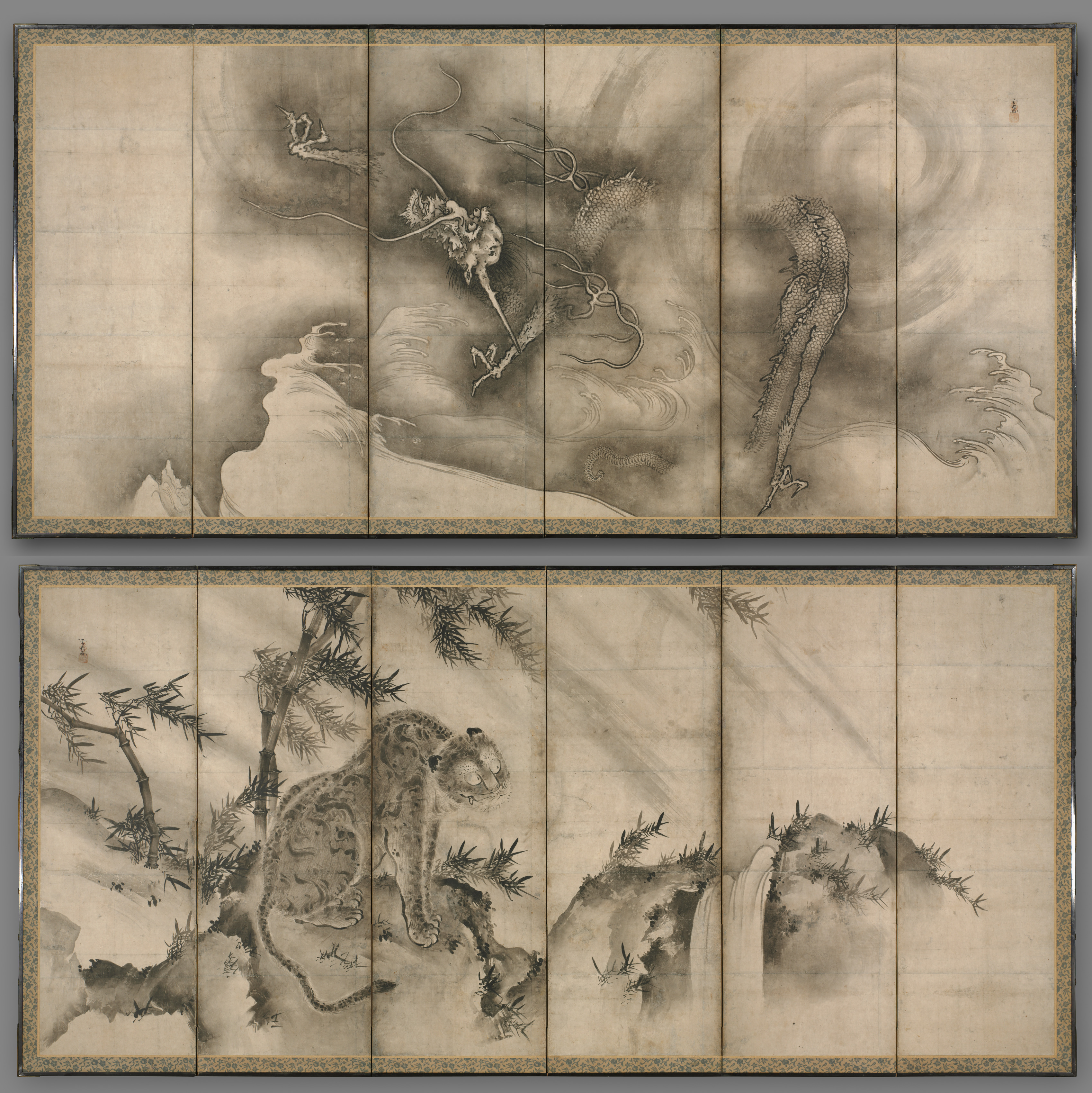
Dragon and Tigerc. 1546–56
A tiger sits in a bamboo grove whipped with fierce wind, while a dragon claws through clouds above rough waves. More about this work
About this work
A tiger sits in a bamboo grove whipped with fierce wind, while a dragon claws through clouds above rough waves. Tiger and dragon are Chinese cosmological symbols of the balancing forces in the world, yin (the feminine aspect) and yang (the masculine aspect). The tiger's roar is also said to generate wind, and the dragon clouds. The screens may have originally been meant to express the fluctuating nature of the world as envisioned in the practice of military divination, or forecasting, based on the Yijing ( Book of Changes ).
Text from the Cleveland Museum of Art.
How it was made
- Folding screen
- Panels joined by paper hinges, so the screen stands by itself in a zigzag. The picture runs across every panel, and screens were often made in pairs.
- Ink on paper
- Ink made from soot and animal glue, ground with water on an inkstone. A single brush can give a hair-fine line or a broad wash, and nothing can be corrected.
Sesson Shūkei
ca. 1504–ca. 1589
Sesson was a Zen monk who worked in the provinces of eastern Japan, far from the capital at Kyoto. He admired the ink painter Sesshū and developed a vigorous, highly personal style of monochrome ink painting, marked by windswept landscapes, swirling water and lively figures. His Dragon and Tiger screens show his taste for dramatic movement. He also wrote a short treatise on painting addressed to his pupils.
Written by Ochre Editions.
Rights and the museum’s record
Public domain. The Cleveland Museum of Art has dedicated this image to the public domain under CC0, so anyone may copy, adapt and use it, for any purpose, without asking. Our prints and files are reproductions made from the museum’s image; the museum doesn’t endorse them.
- Object number
- 1959.136
- Credit
- Courtesy of the Cleveland Museum of Art
- Type
- Painting
- Department
- Japanese Art
- Licence
- CC0 1.0 Universal
- Museum record
- See it on the museum’s site
Report this work
More by Sesson Shūkei
All their works
Close in colour