Birds and Flowerslate 1500s
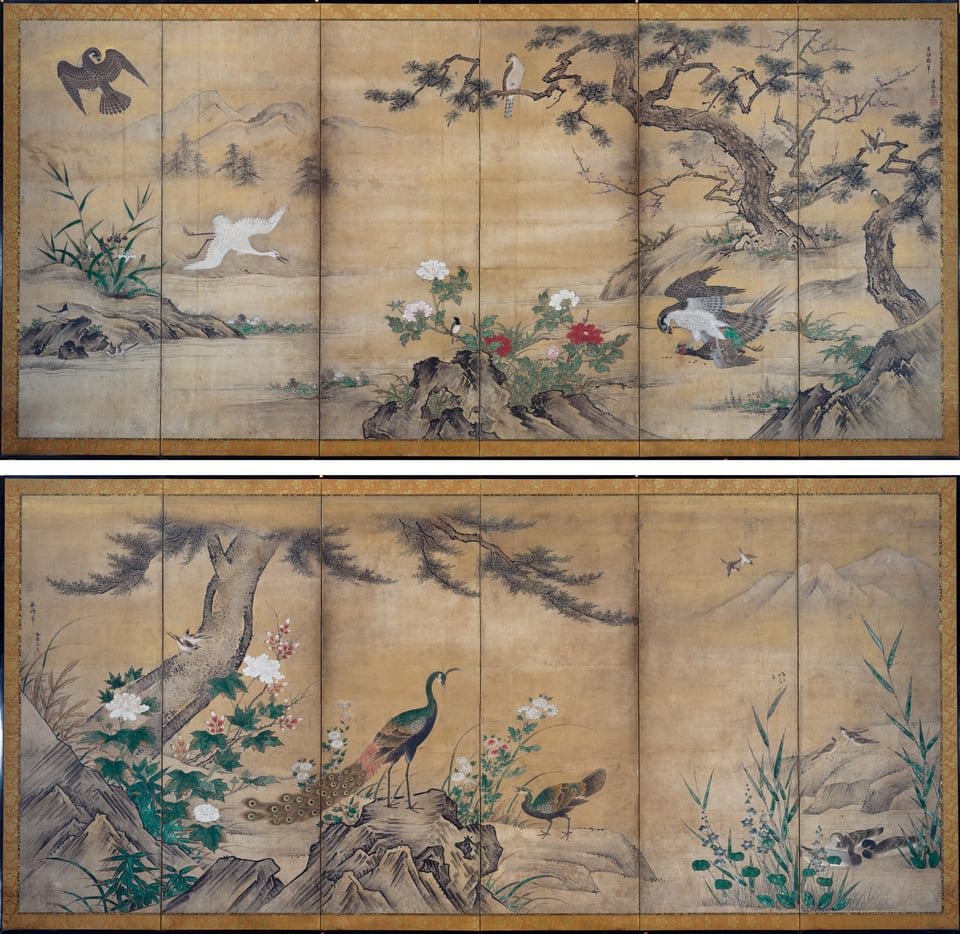
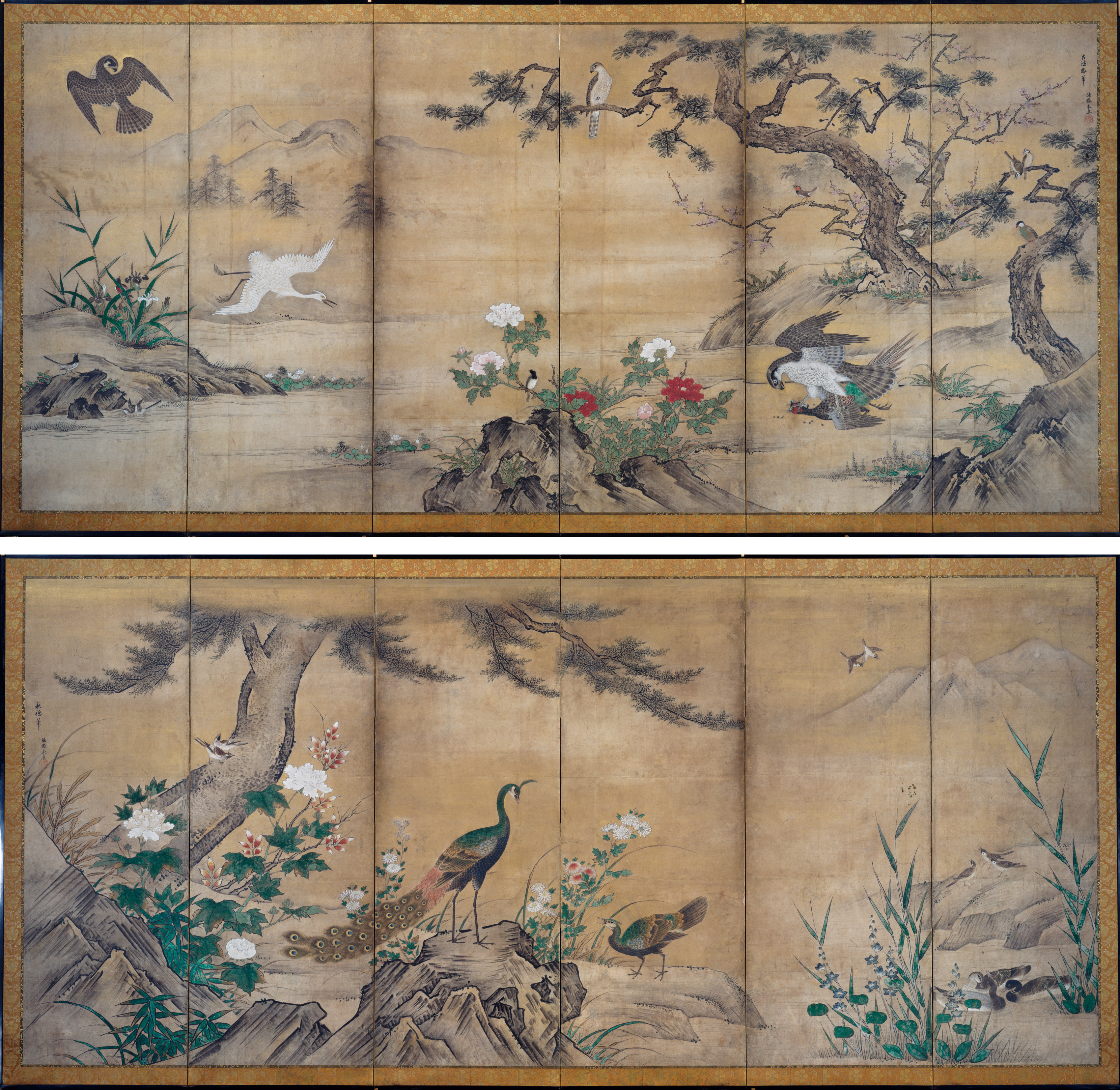
The landscape depicted in this pair of screens follows a seasonal progression from right to left, starting with the blossoming plum of early spring and ending with late autumn peonies. More about this work
About this work
The landscape depicted in this pair of screens follows a seasonal progression from right to left, starting with the blossoming plum of early spring and ending with late autumn peonies. A variety of smaller birds are positioned throughout the scene, and a trio of swimming ducks is bracketed by early summer irises and early autumn bellflowers at the center. While some raptors (birds of prey) terrorize a pheasant and an egret (a waterfowl) to the right, a peacock and peahen converse to the left. Hawks are associated with military prowess, while the peafowl suggest cultural prestige.
Text from the Cleveland Museum of Art.
How it was made
- Folding screen
- Panels joined by paper hinges, so the screen stands by itself in a zigzag. The picture runs across every panel, and screens were often made in pairs.
- Ink on paper
- Ink made from soot and animal glue, ground with water on an inkstone. A single brush can give a hair-fine line or a broad wash, and nothing can be corrected.
Kano Mitsunobu
Japanese, 1565–1608
Mitsunobu was the eldest son of Kanō Eitoku and led the Kanō school after his father’s death in 1590. He painted decorative screens and wall paintings for the great castles and residences of the Momoyama period, but moved away from his father’s monumental, forceful style towards softer, more delicate compositions with refined detail and a gentler, more lyrical mood.
Written by Ochre Editions.
Rights and the museum’s record
Public domain. The Cleveland Museum of Art has dedicated this image to the public domain under CC0, so anyone may copy, adapt and use it, for any purpose, without asking. Our prints and files are reproductions made from the museum’s image; the museum doesn’t endorse them.
- Object number
- 1948.128
- Credit
- Courtesy of the Cleveland Museum of Art
- Type
- Painting
- Department
- Japanese Art
- Licence
- CC0 1.0 Universal
- Museum record
- See it on the museum’s site
Report this work
Close in colour