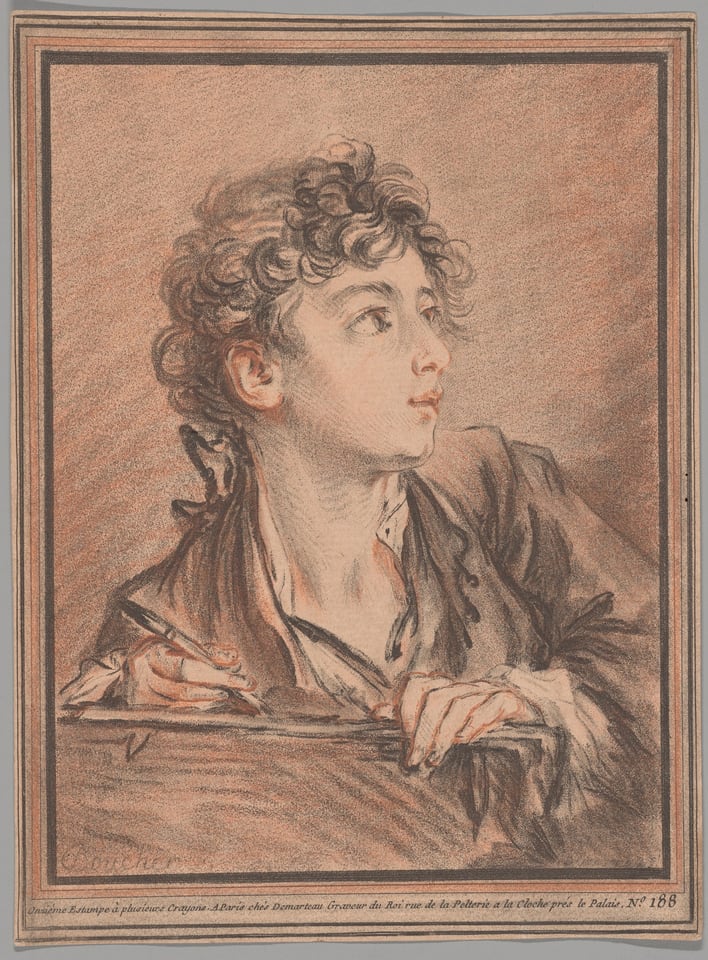
The Young Draftsman1750/70
Gilles Demarteau made this in 1750/70, aged about 21. It is now at the Art Institute of Chicago. More about this work
About this work
A work made of crayon manner engraving in red and black on cream laid paper.
Description from the Art Institute of Chicago.
Gilles Demarteau made this in 1750/70, aged about 21. It is now at the Art Institute of Chicago.
How it was made
- Engraving
- Lines cut directly into a metal plate with a steel burin, which makes them swell and taper. It took years to master, and for centuries it was how paintings travelled as pictures.
- Laid paper
- Handmade on a mould of close-set wires, which leave fine parallel lines you can see when the sheet is held to the light.
Gilles Demarteau
French, 1729–1776
Rights and the museum’s record
Public domain. The Art Institute of Chicago has dedicated this image to the public domain under CC0, so anyone may copy, adapt and use it, for any purpose, without asking. Our prints and files are reproductions made from the museum’s image; the museum doesn’t endorse them.
- Object number
- 2022.156
- Credit
- Courtesy of the Art Institute of Chicago
- Type
- Department
- Prints and Drawings
- Licence
- CC0 1.0 Universal
- Museum record
- See it on the museum’s site
Report this work
Close in colour