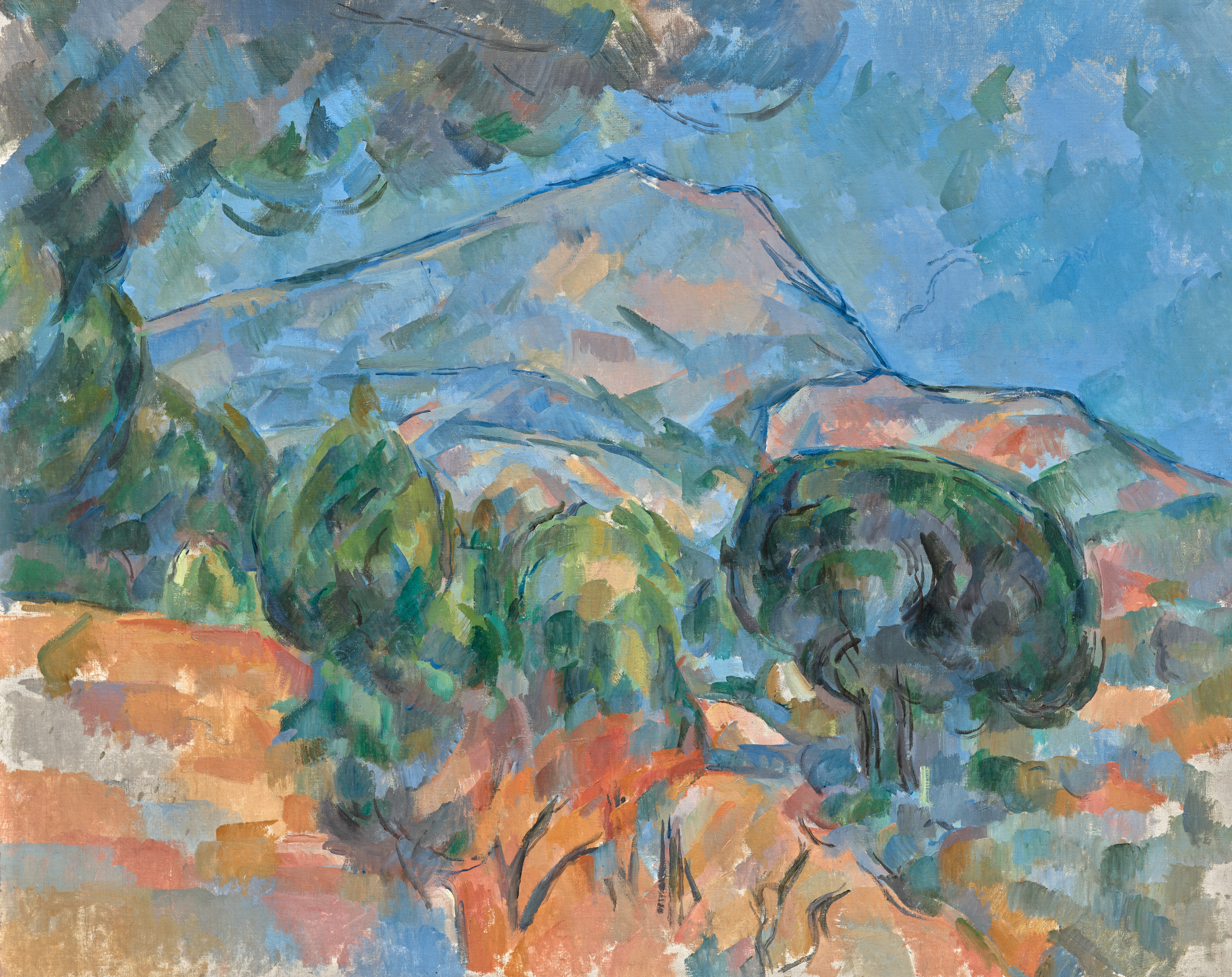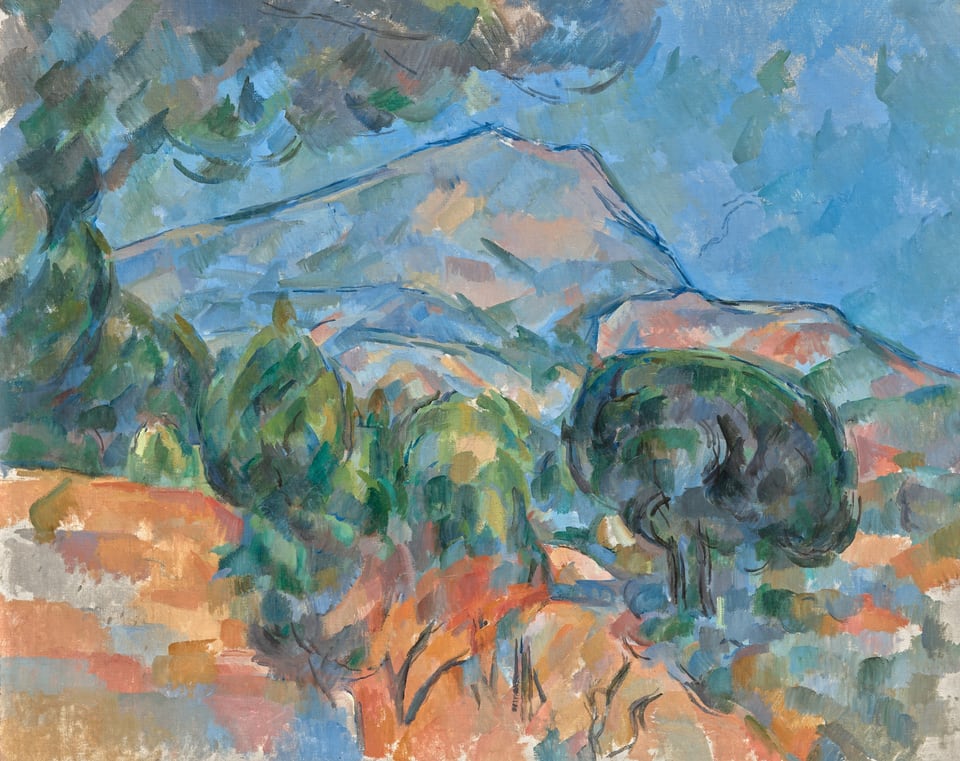
Mount Sainte-Victoirec. 1904
During the last 20 years of his life, Cezanne repeatedly painted Mount Sainte-Victoire near his home in Aix-en-Provence in southern France. More about this work
About this work
During the last 20 years of his life, Cezanne repeatedly painted Mount Sainte-Victoire near his home in Aix-en-Provence in southern France. Cezanne painted this view from life at one of his favorite sites, a small road that led from Aix eastward toward Mount Sainte-Victoire. He set up his easel at the edge of the road where he could see two umbrella pines and the mountain towering over the scene. A branch of one of the pines extends from the left of the canvas across the sky, echoing the slope of the mountain, linking the near and the far.
Text from the Cleveland Museum of Art.
How it was made
- Oil paint
- Pigment ground in a drying oil, usually linseed. It dries slowly, so painters could blend on the canvas, build up thin translucent glazes, and rework a picture over weeks. Canvas replaced wooden panels in the 1500s because it is lighter and can be rolled.
Paul Cézanne
French, 1839–1906 · Born and died in Aix-en-Provence.
Cézanne divided his life between Paris and his native Aix-en-Provence. Encouraged by his schoolfriend Émile Zola and later by Pissarro, with whom he painted at Pontoise and Auvers in the 1870s, he showed at the first and third Impressionist exhibitions. He then withdrew to Provence and worked towards a more structured art, building form from patches of colour in still lifes, bathers and repeated views of Mont Sainte-Victoire. Younger painters, Picasso and Braque among them, saw him as a founder of modern painting.
Written by Ochre Editions.
Post-Impressionism
Artists who kept Impressionism's colour but pushed towards structure, symbol and feeling.
Rights and the museum’s record
Public domain. The Cleveland Museum of Art has dedicated this image to the public domain under CC0, so anyone may copy, adapt and use it, for any purpose, without asking. Our prints and files are reproductions made from the museum’s image; the museum doesn’t endorse them.
- Object number
- 1958.21
- Credit
- Courtesy of the Cleveland Museum of Art
- Type
- Painting
- Department
- Modern European Painting and Sculpture
- Licence
- CC0 1.0 Universal
- Museum record
- See it on the museum’s site