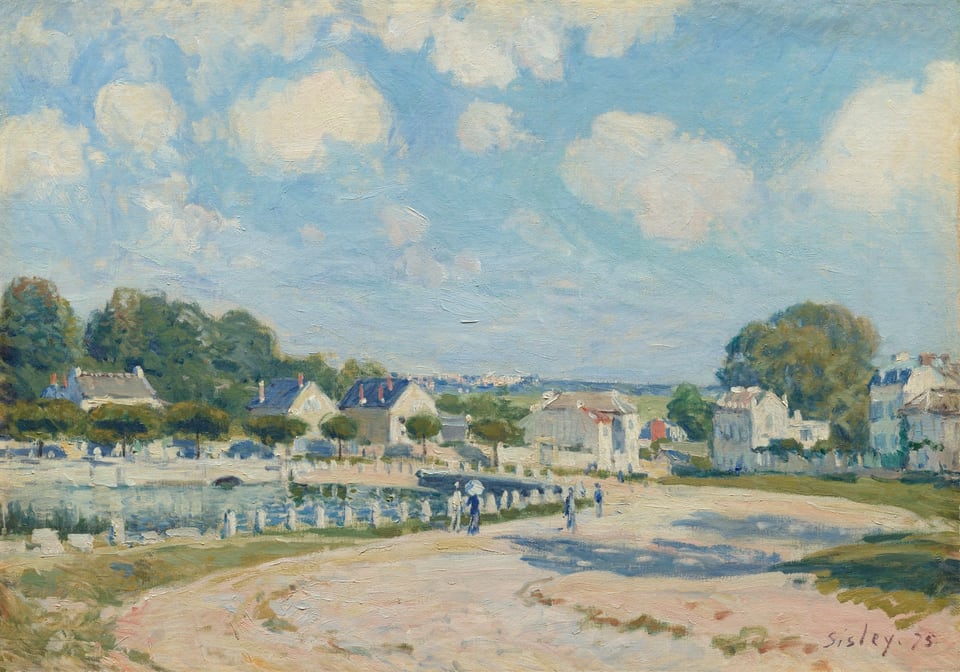
Watering Place at Marly1875
In 1875 Alfred Sisley moved to the French village of Marly-le-Roi. More about this work

About this work
In 1875 Alfred Sisley moved to the French village of Marly-le-Roi. His home flanked the pool, or “watering place,” featured on the left of this canvas, which had once been the water gardens of King Louis XIV's country retreat. Sisley faithfully depicted landscapes throughout his career, spending most of his life painting in the villages along the Seine River, in the region referred to as the cradle of Impressionism.
Text from the Art Institute of Chicago.
What you’re looking at
A work made of oil on canvas.
Description from the Art Institute of Chicago.
How it was made
- Oil paint
- Pigment ground in a drying oil, usually linseed. It dries slowly, so painters could blend on the canvas, build up thin translucent glazes, and rework a picture over weeks. Canvas replaced wooden panels in the 1500s because it is lighter and can be rolled.
Alfred Sisley
British
Impressionism
Painters in 1870s Paris who worked quickly, often outdoors, to catch light as it changed.
Rights and the museum’s record
Public domain. The Art Institute of Chicago has dedicated this image to the public domain under CC0, so anyone may copy, adapt and use it, for any purpose, without asking. Our prints and files are reproductions made from the museum’s image; the museum doesn’t endorse them.
- Object number
- 1971.875
- Credit
- Courtesy of the Art Institute of Chicago
- Type
- Painting
- Department
- Painting and Sculpture of Europe
- Licence
- CC0 1.0 Universal
- Museum record
- See it on the museum’s site
Report this work
Close in colour