Blue Morning1909
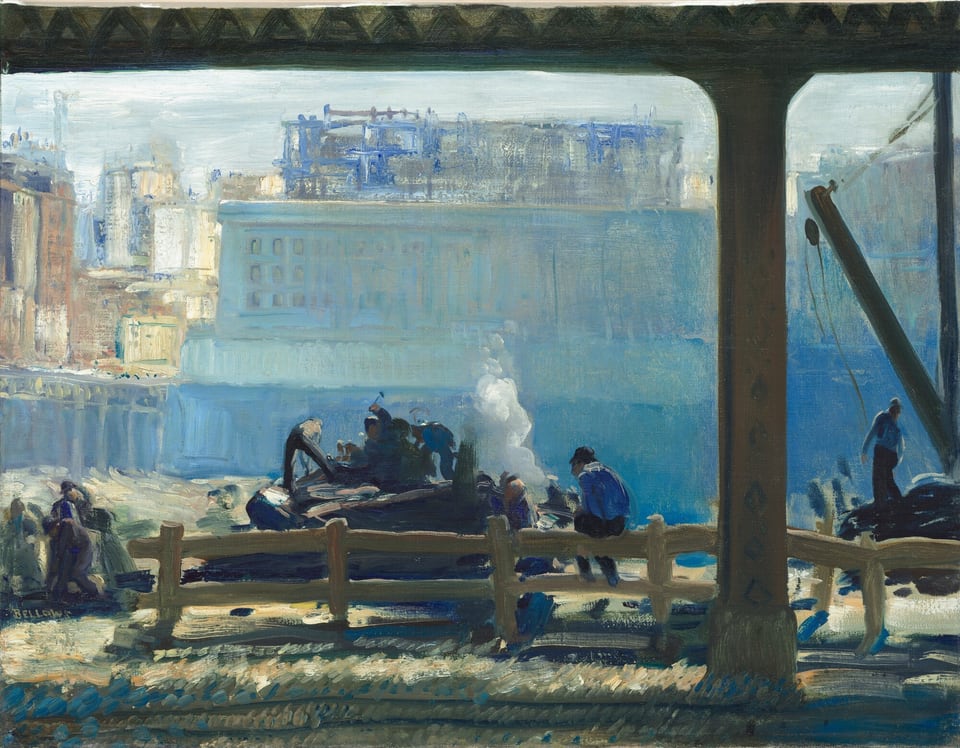
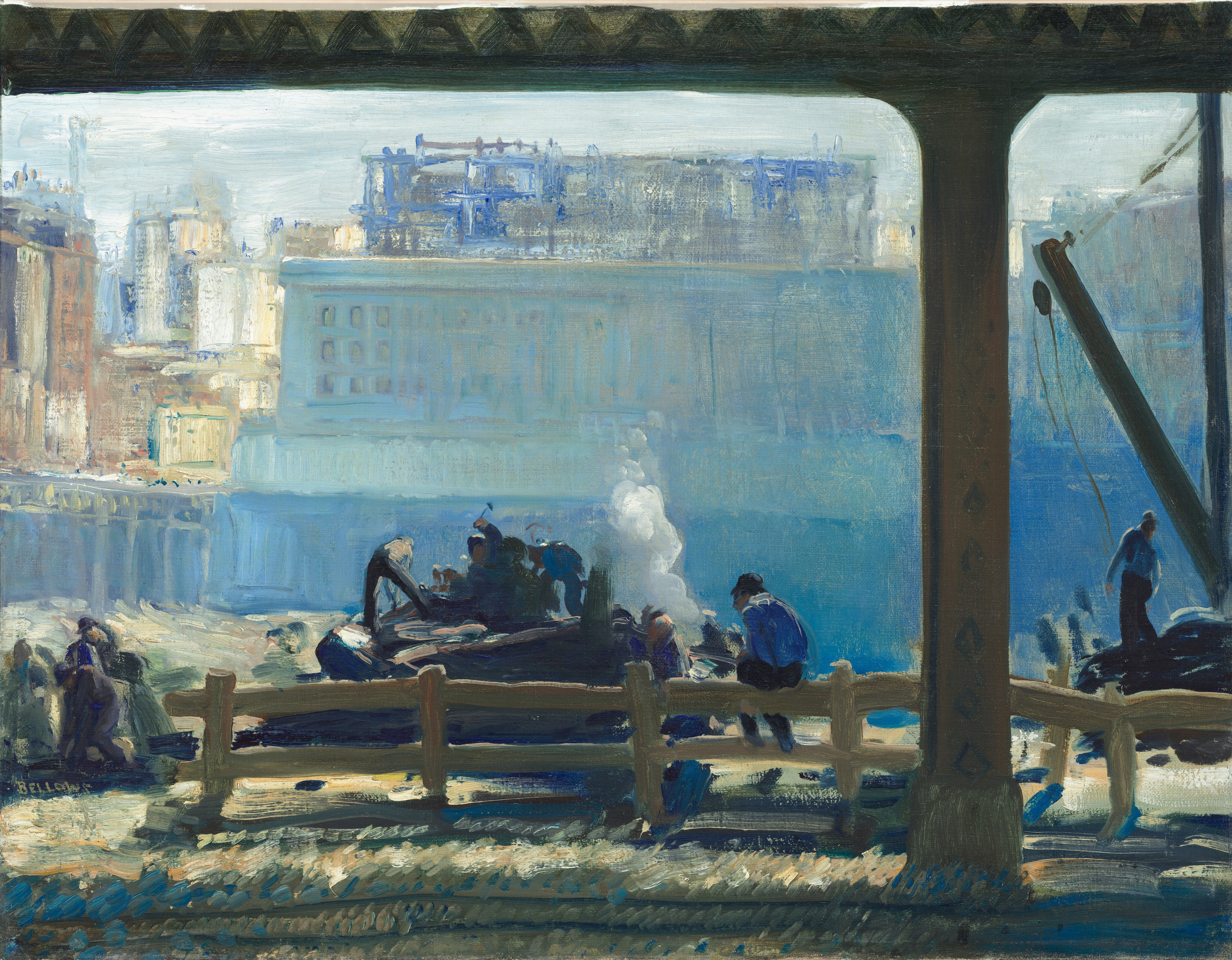
Workmen hammer and haul behind a wooden fence beneath the iron column of an elevated railway, while beyond them the ground drops into a vast excavation and the pale blue façade of a building rises in the haze. More about this work
About this work
Workmen hammer and haul behind a wooden fence beneath the iron column of an elevated railway, while beyond them the ground drops into a vast excavation and the pale blue façade of a building rises in the haze. Bellows painted the scene in 1909 at the site of Pennsylvania Station in Manhattan, then being dug out of the heart of the city, one of several pictures he made of the project. The canvas is keyed to shimmering blues, with broad, quick strokes catching the morning light and the scale of the modern city in the making.
Written by Ochre Editions.
What you’re looking at
From under an elevated train track, we look at a cluster of people hammering and working on the far side of a wooden fence, all against a silvery-blue building that fills most of the background in this horizontal painting. The scene is loosely painted mostly in tones of hazy and saturated blues, so many of the details are indistinct. About a quarter of the way in from the right edge of the composition, a thin iron column holds up the train platform. The column nearly spans the height of the painting, and the track it supports runs across the top edge of the canvas. At the foot of the column, along the bottom edge, are two parallel tracks embedded in an area otherwise painted with short, diagonal strokes in topaz blue, olive green, and straw yellow. Just beyond the tracks, the split-rail wooden fence runs across most of the painting, though there is an opening at the left edge of the canvas. A man sits with his back to us on the railing to our right of center. He wears a dark cap, a lapis-blue shirt, and navy-blue pants. Several men work on or near a mound-shaped form, perhaps a piece of machinery, just beyond the fence, near the center of the painting. One man holds a hammer high overhead while another reaches down or strikes the mound with his feet planted wide. More people work together to our left, and a man to our right stands near a crane. The people and these areas are painted with broad strokes and touches of cobalt blue, charcoal gray, khaki brown, and a few swipes of shell pink and bright white. A puff of white smoke billows up behind the central group, before the land drops precipitously away. The chasm is painted with shimmering tones of aquamarine and cerulean blue. A sky-blue, rectangular building perches at the far edge. A few windows are outlined in royal blue to our left but the rest of the building is loosely painted with long, vertical strokes so no architectural details can be made out. Behind this structure are more city buildings, suggested with strokes of muted rust red, parchment and bright white, and cobalt blue. The ice-blue sky fills the band between the top of the buildings and the train track running overhead. The artist signed his name near the lower left corner, “BELLOWS.”
Description from the National Gallery of Art.
How it was made
- Oil paint
- Pigment ground in a drying oil, usually linseed. It dries slowly, so painters could blend on the canvas, build up thin translucent glazes, and rework a picture over weeks. Canvas replaced wooden panels in the 1500s because it is lighter and can be rolled.
George Bellows
American, 1882–1925
Bellows left Ohio State University to study in New York with Robert Henri and became the most celebrated of the younger realists around him. He painted the city with vigorous brushwork: tenement children, the excavation for Pennsylvania Station, Hudson River docks and, most famously, illegal prize fights such as Stag at Sharkey’s. He took up lithography in 1916 and became one of its leading American practitioners. He died at forty-two of a ruptured appendix.
Written by Ochre Editions.
Rights and the museum’s record
Public domain. The National Gallery of Art has dedicated this image to the public domain under CC0, so anyone may copy, adapt and use it, for any purpose, without asking. Our prints and files are reproductions made from the museum’s image; the museum doesn’t endorse them.
- Object number
- 1963.10.82
- Credit
- Courtesy National Gallery of Art, Washington
- Type
- Painting
- Licence
- CC0 1.0 Universal
- Museum record
- See it on the museum’s site
Report this work
More by George Bellows
All their works
Close in colour