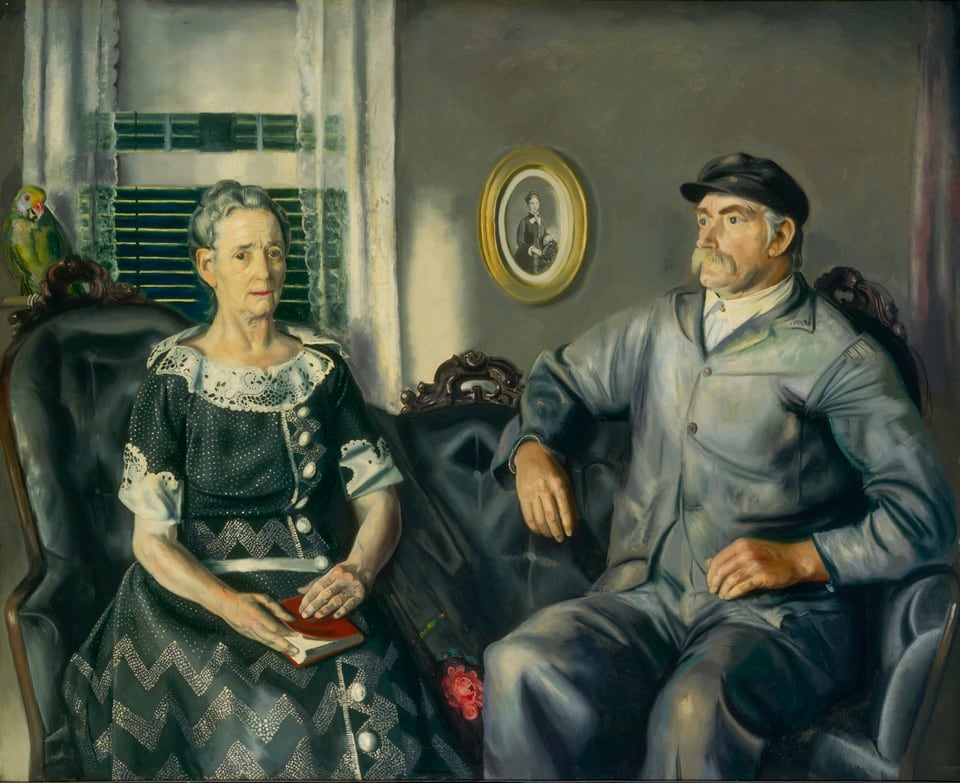
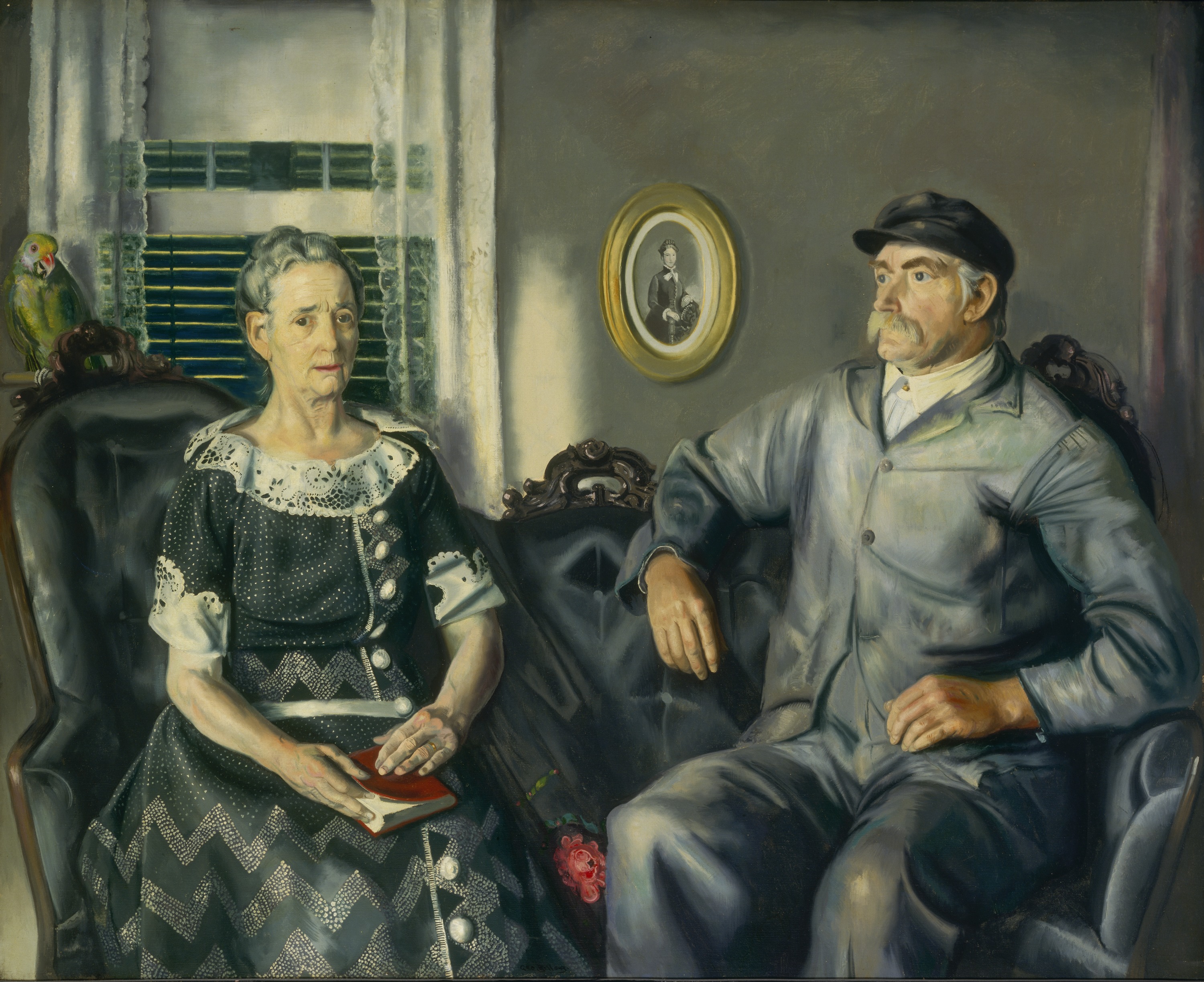
Mr. and Mrs. Phillip Wase1924
George Bellows spent summers in Woodstock, New York, where Mrs. Wase worked as a cleaning woman and her husband was a gardener. More about this work
About this work
George Bellows spent summers in Woodstock, New York, where Mrs. Wase worked as a cleaning woman and her husband was a gardener. Bellows chose to show the couple stiffly posed and strangely detached from one another. Mrs. Wase’s face shows the worries of a lifetime, and Mr. Wase stares off into the distance, as if thinking of another time or place. Between them, a portrait, perhaps of Mrs. Wase as a bride, hangs on the wall. Their clothes match the shadowy gray of the parlor. Bellows painted suggestions of a brilliantly green summer day beyond the closed shutters, as if to emphasize the distance between youthful optimism and the resignation of old age. The artist experimented with new ways to paint portraits throughout his career, and from 1915 to 1920 he exhibited with the National Association of Portrait Painters, whose mission was to separate from “the tiresomely conventional and perfunctory portrait.” (Myers, “‘The Most Searching Place in the World’: Bellows and Portraiture,” in Quick et al., The Paintings of George Bellows, 1992)
Text from the Smithsonian American Art Museum.
How it was made
- Oil paint
- Pigment ground in a drying oil, usually linseed. It dries slowly, so painters could blend on the canvas, build up thin translucent glazes, and rework a picture over weeks. Canvas replaced wooden panels in the 1500s because it is lighter and can be rolled.
George Bellows
American, 1882–1925
Bellows left Ohio State University to study in New York with Robert Henri and became the most celebrated of the younger realists around him. He painted the city with vigorous brushwork: tenement children, the excavation for Pennsylvania Station, Hudson River docks and, most famously, illegal prize fights such as Stag at Sharkey’s. He took up lithography in 1916 and became one of its leading American practitioners. He died at forty-two of a ruptured appendix.
Written by Ochre Editions.
Rights and the museum’s record
Public domain. The Smithsonian American Art Museum has dedicated this image to the public domain under CC0, so anyone may copy, adapt and use it, for any purpose, without asking. Our prints and files are reproductions made from the museum’s image; the museum doesn’t endorse them.
- Object number
- 1967.39.1
- Credit
- Courtesy of the Smithsonian American Art Museum
- Type
- Painting
- Department
- Painting and Sculpture
- Licence
- CC0 1.0 Universal
- Museum record
- See it on the museum’s site
Report this work
More by George Bellows
All their works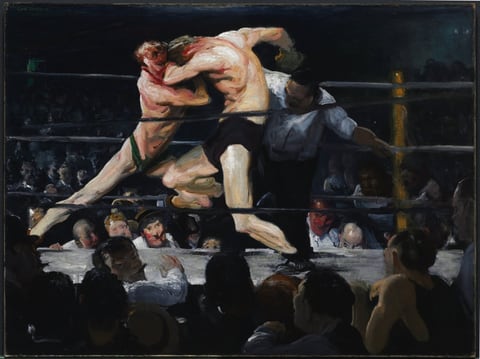
Close in colour