The Lone Tenement1909
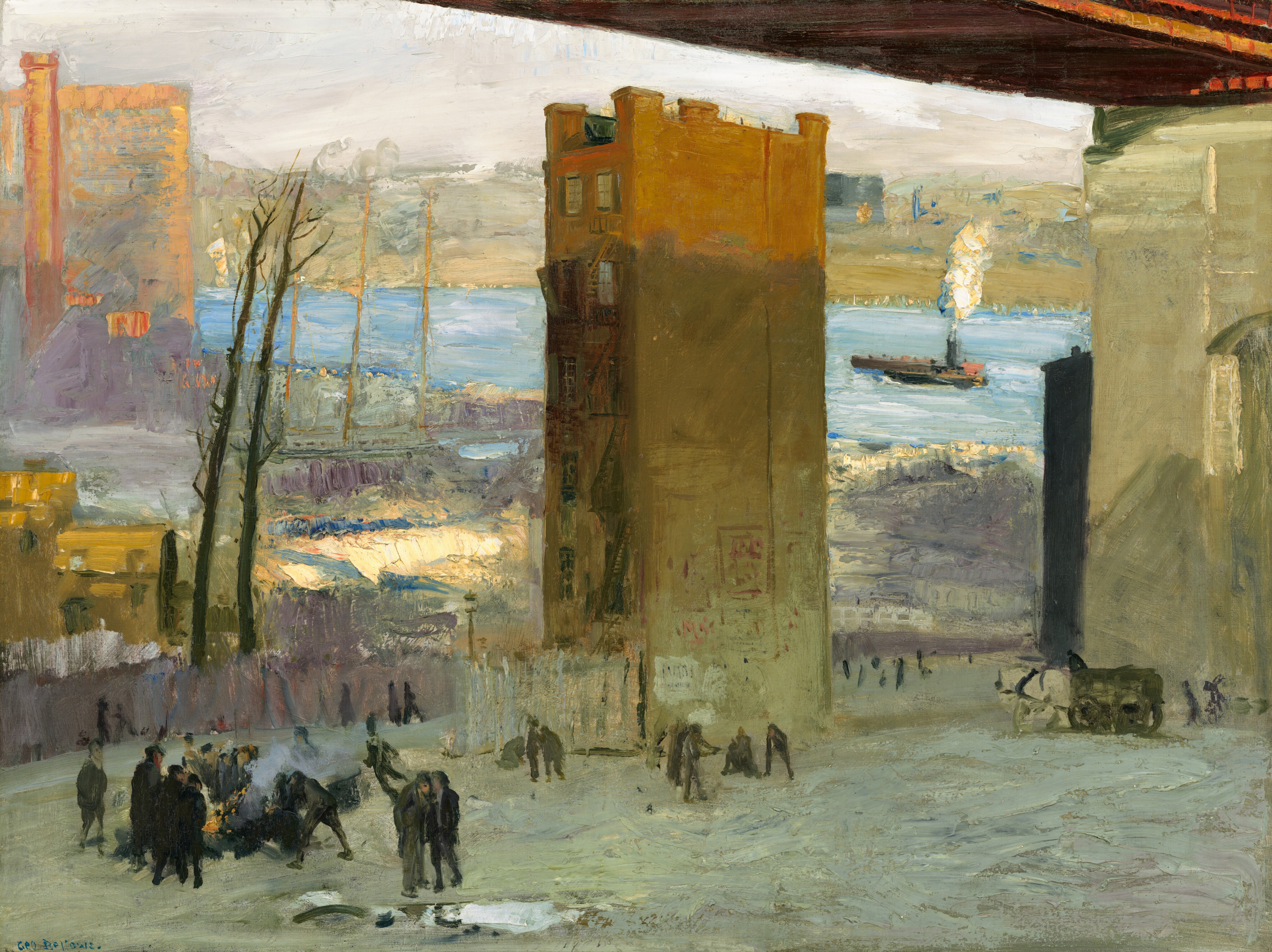
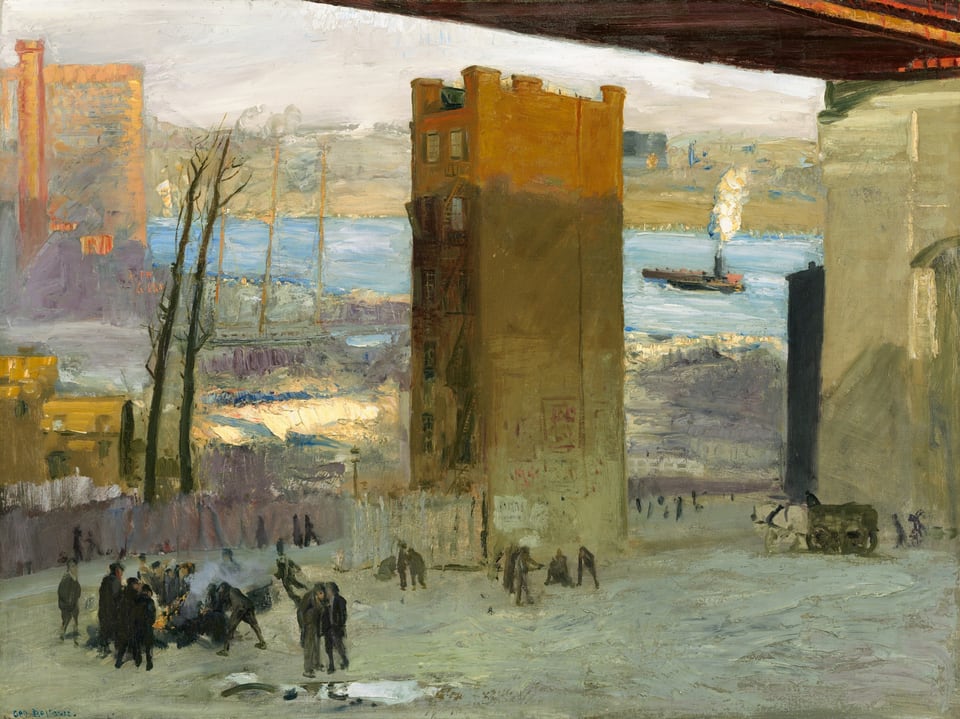
A narrow six-storey tenement stands alone on a cleared lot beneath the massive pier and deck of a bridge, its top floor catching warm sunlight while people gather around a small fire at its foot. More about this work
About this work
A narrow six-storey tenement stands alone on a cleared lot beneath the massive pier and deck of a bridge, its top floor catching warm sunlight while people gather around a small fire at its foot. Beyond, a tugboat puffs white smoke on an icy river. Bellows painted the scene in 1909 beside one of New York’s great East River bridges, and the solitary building, left standing amid demolition, speaks of the poor whose neighbourhoods were swept away by the city’s growth. He painted the rough edges of the city with thick, energetic strokes, much as his friends in the circle of Robert Henri did.
Written by Ochre Editions.
What you’re looking at
A six-story, narrow building stands alone in an otherwise unoccupied lot under the deck of a high bridge, with a river and cityscape in the background in this horizontal painting. Dozens of people, small in scale, are each painted with a few swipes of black and some with peach-colored faces. They gather at the foot of the building and around a fire to our left, near the lower left corner of the composition. The fire is painted with a dash of orange, a few touches of canary yellow, and a smudge of gray smoke. Several more people stand and sit against the building, which has a streetlamp near its entrance. The back end of the building angles away from us to our right, so we see the narrow, front entrance side to our left. Each of the six floors of the building has two windows with fire escape ladders on the narrow side we can see. Some strokes in red and white on the lower levels of the long, flat side of the building suggest signs or posters. The top story glows a warm sienna brown in sunlight, while the rest of the building and the scene below are in shadow. More people walk along a grayish-violet fence that encloses the lot beyond the building. The ground is painted thickly with slate gray, pale, sage green, and one smear of white to suggest snow. To our right and a short distance from us, a white horse pulls a carriage near the foot of the bridge. The ivory-white, concrete piling rises up and off the right edge of the canvas and supports the deck of the bridge above. Only a sliver of the brick-red underside of the bridge is visible, skimming the top edge of the painting in the upper right corner. Two twiggy, barren trees grow up beyond the muted purple fence, and the landscape beyond is bright in the sunlight. A terracotta-orange building rises along the left edge of the painting, with the area between it and the lot under the bridge filled with thickly painted patches of butter yellow, amethyst purple, and sage green. Beyond that, an ice-blue river flows across the composition. The shore beyond is lined with patches of beige and tan paint that could be buildings. A black tugboat puffs bright white smoke in the river. The sky above is frosty white. The artist signed the work with dark blue in the lower left corner of the painting, “Geo Bellows.”
Description from the National Gallery of Art.
How it was made
- Oil paint
- Pigment ground in a drying oil, usually linseed. It dries slowly, so painters could blend on the canvas, build up thin translucent glazes, and rework a picture over weeks. Canvas replaced wooden panels in the 1500s because it is lighter and can be rolled.
George Bellows
American, 1882–1925
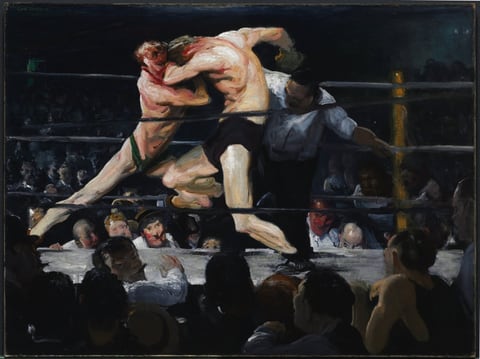
Bellows left Ohio State University to study in New York with Robert Henri and became the most celebrated of the younger realists around him. He painted the city with vigorous brushwork: tenement children, the excavation for Pennsylvania Station, Hudson River docks and, most famously, illegal prize fights such as Stag at Sharkey’s. He took up lithography in 1916 and became one of its leading American practitioners. He died at forty-two of a ruptured appendix.
Written by Ochre Editions.
Rights and the museum’s record
Public domain. The National Gallery of Art has dedicated this image to the public domain under CC0, so anyone may copy, adapt and use it, for any purpose, without asking. Our prints and files are reproductions made from the museum’s image; the museum doesn’t endorse them.
- Object number
- 1963.10.83
- Credit
- Courtesy National Gallery of Art, Washington
- Type
- Painting
- Licence
- CC0 1.0 Universal
- Museum record
- See it on the museum’s site