Inside the Bar1883
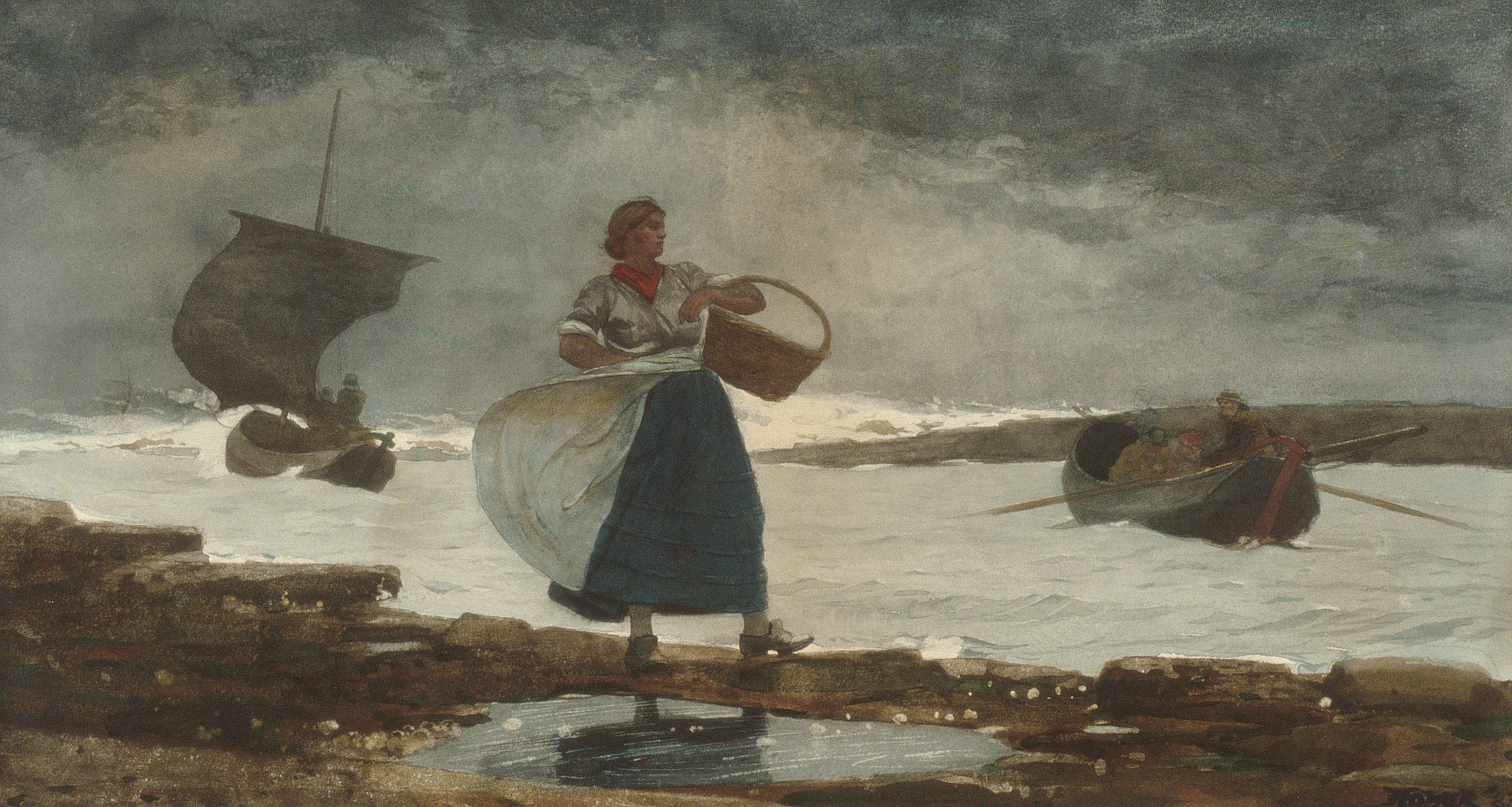
A fisherwoman stands braced against the wind on the shore, while boats struggle to cross the sandbar beyond and storm clouds gather. More about this work
About this work
A fisherwoman stands braced against the wind on the shore, while boats struggle to cross the sandbar beyond and storm clouds gather. Winslow Homer made the watercolour in 1883, drawing on the year and a half he had spent in the fishing village of Cullercoats on England’s North Sea coast, where he was moved by the hard lives and anxious waiting of fishermen’s families. The experience transformed his art, turning it towards the sea and the struggle between people and nature.
Written by Ochre Editions.
How it was made
- Watercolour
- Pigment in gum arabic, thinned with water and laid in transparent washes. Nothing white is painted: the light is the paper showing through.
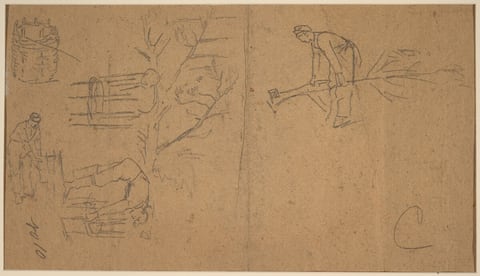
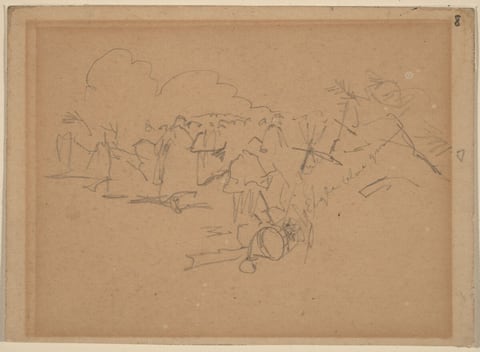
- Graphite
- Pencil. Graphite has been used for drawing since the 1500s; in 1795 Nicolas-Jacques Conté mixed it with clay, so its hardness could be graded.
Winslow Homer
American, 1836–1910 · Born in Boston, Massachusetts; died in Prouts Neck, Maine.
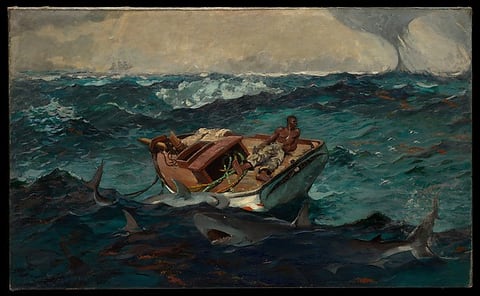
Homer began as an illustrator, covering the Civil War for Harper’s Weekly, and first made his name in painting with scenes of soldiers and country life. A stay at the fishing village of Cullercoats on the English coast in 1881–82 turned him towards the sea, and from 1883 he lived at Prouts Neck, Maine, painting the Atlantic in all weathers. He was also a fluent watercolourist in the Adirondacks, Canada and the Caribbean, and The Gulf Stream draws on those southern journeys.
Written by Ochre Editions.
Rights and the museum’s record
Public domain. The Met has dedicated this image to the public domain under CC0, so anyone may copy, adapt and use it, for any purpose, without asking. Our prints and files are reproductions made from the museum’s image; the museum doesn’t endorse them.
- Object number
- 54.183
- Credit
- Courtesy of The Metropolitan Museum of Art
- Type
- Watercolor
- Department
- The American Wing
- Licence
- CC0 1.0 Universal
- Museum record
- See it on the museum’s site