Hound and Hunter1892
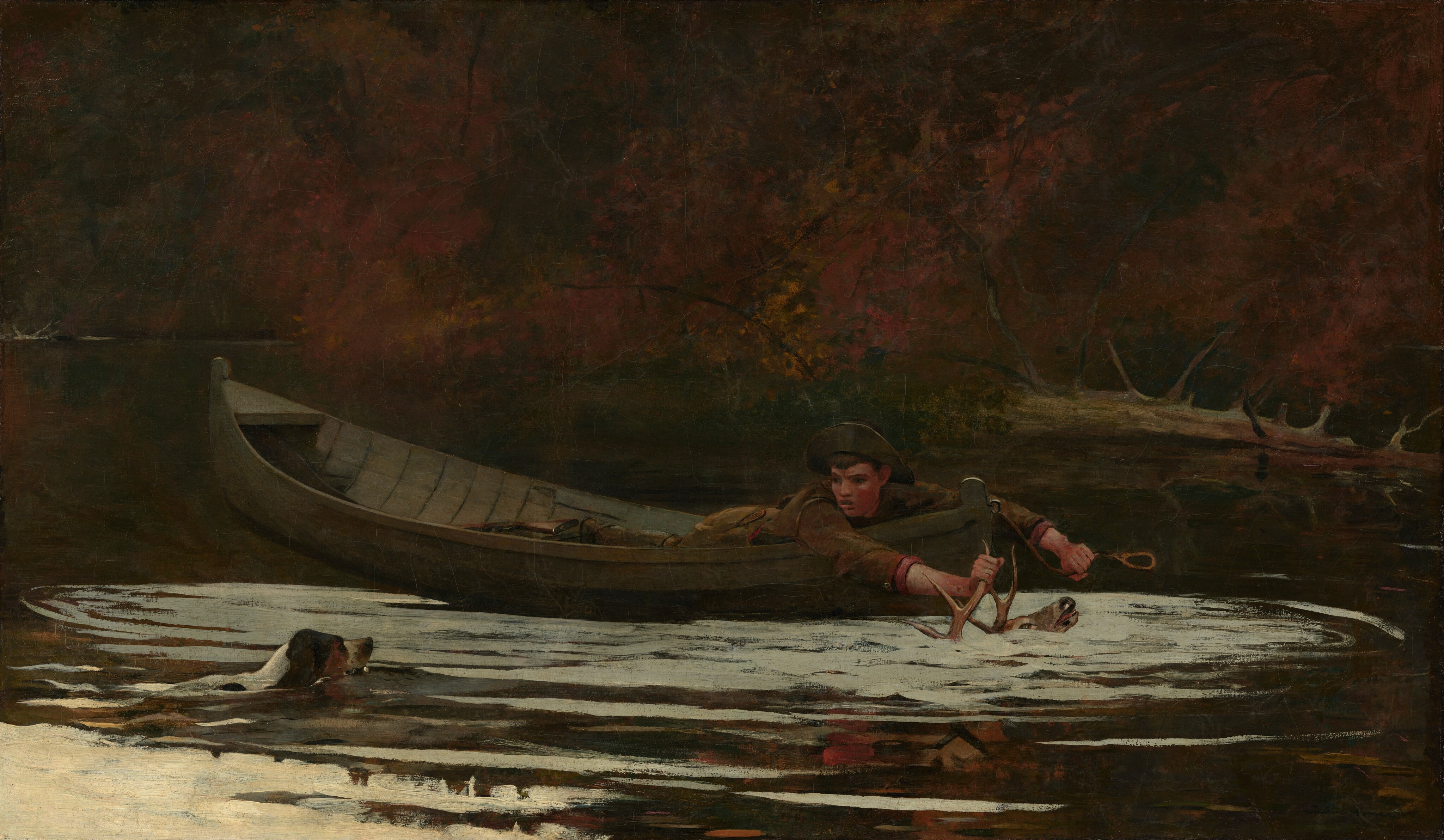
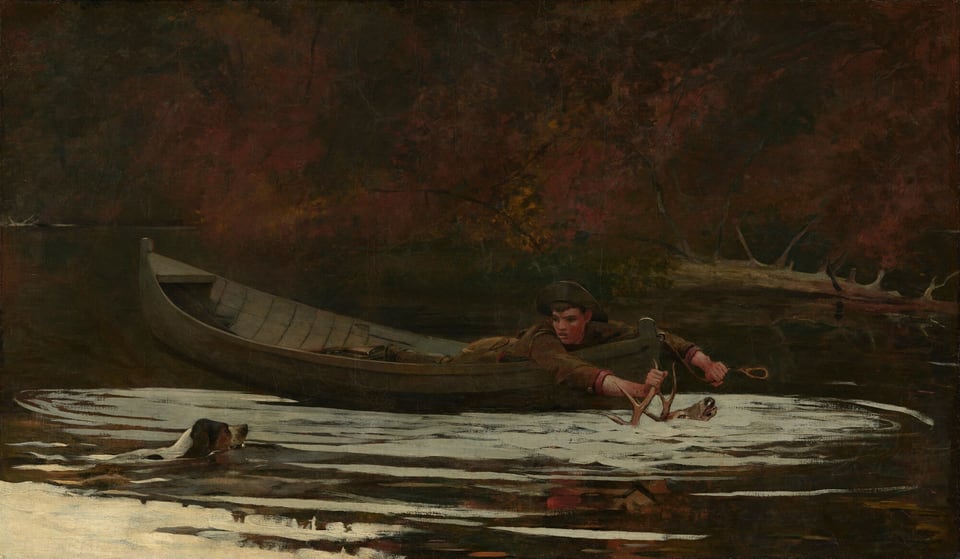
A young hunter lies across the stern of a rowboat, gripping the antler of a deer submerged in the water with one hand and holding a rope with the other, while he turns to shout at his hound swimming towards them. More about this work
About this work
A young hunter lies across the stern of a rowboat, gripping the antler of a deer submerged in the water with one hand and holding a rope with the other, while he turns to shout at his hound swimming towards them. Behind, the trees of the Adirondack forest blaze red and gold. Winslow Homer painted the scene in 1892, and its depiction of hounding, driving deer into water where they could be killed easily, troubled some viewers; Homer maintained that the deer was already dead. The thick, swirling paint of the water and the boy’s open-mouthed face give the moment raw energy.
Written by Ochre Editions.
What you’re looking at
A young man with a peachy, ruddy complexion lies on his stomach in a wooden rowboat on a river, reaching forward to grasp the horn of a stag almost completely submerged in the rippling water with one hand. On the opposite riverbank, gold, rust, and scarlet-red trees span the width of this horizontal painting. The boy’s arms straddle the stern of the boat so one holds the antler with his right hand, closer to us, while the other clutches a rope with a loop at the end. He turns his face, mouth agape and cheeks flushed, over his right shoulder to look to our left, at a dog swimming toward the boat. The dog has white and caramel-brown markings, with dark brown ears. The boy wears earth-brown clothing and the front of his wide-brimmed hat is pushed up to reveal dark eyes and sable-brown bangs and brows. The stag and dog are between us and the boat, and are surrounded by thick brushstrokes of parchment white to create ripples in the forest-green water. Only the open muzzle, part of the eye, and the tips of the stag’s antlers are above the water’s surface. To our right, a bare, fallen tree lies along the far riverbank parallel to the boat. The boat and water fill the lower half of the scene and the autumn trees fill the upper half. The artist has signed and dated the painting in the lower right, “Winslow Homer 1892.”
Description from the National Gallery of Art.
How it was made
- Oil paint
- Pigment ground in a drying oil, usually linseed. It dries slowly, so painters could blend on the canvas, build up thin translucent glazes, and rework a picture over weeks. Canvas replaced wooden panels in the 1500s because it is lighter and can be rolled.
Winslow Homer
American, 1836–1910 · Born in Boston, Massachusetts; died in Prouts Neck, Maine.
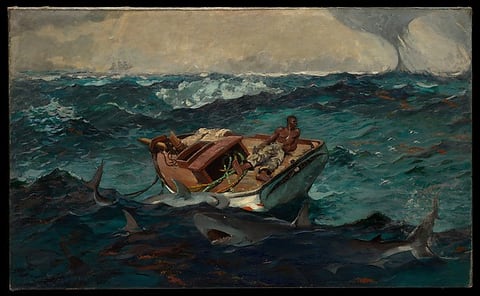
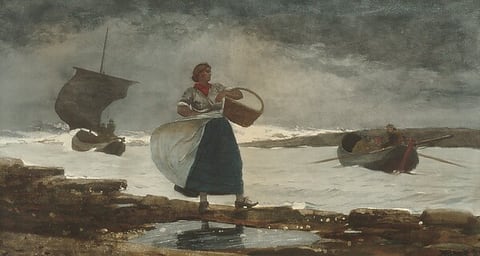
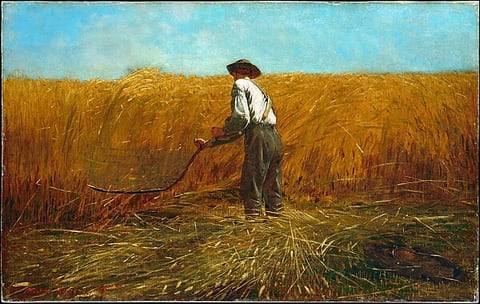
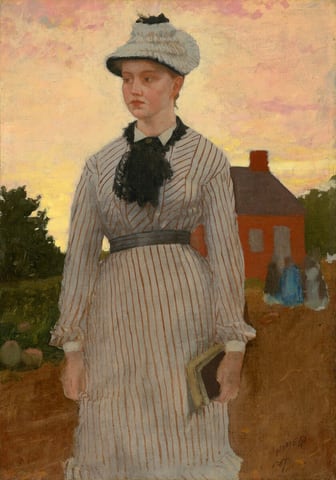
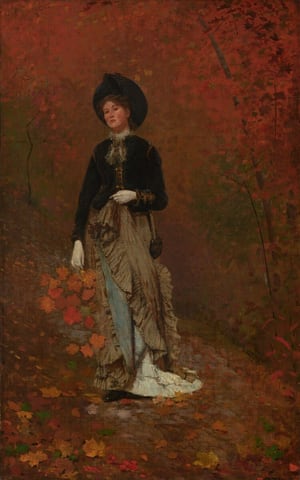
Homer began as an illustrator, covering the Civil War for Harper’s Weekly, and first made his name in painting with scenes of soldiers and country life. A stay at the fishing village of Cullercoats on the English coast in 1881–82 turned him towards the sea, and from 1883 he lived at Prouts Neck, Maine, painting the Atlantic in all weathers. He was also a fluent watercolourist in the Adirondacks, Canada and the Caribbean, and The Gulf Stream draws on those southern journeys.
Written by Ochre Editions.
Rights and the museum’s record
Public domain. The National Gallery of Art has dedicated this image to the public domain under CC0, so anyone may copy, adapt and use it, for any purpose, without asking. Our prints and files are reproductions made from the museum’s image; the museum doesn’t endorse them.
- Object number
- 1947.11.1
- Credit
- Courtesy National Gallery of Art, Washington
- Type
- Painting
- Licence
- CC0 1.0 Universal
- Museum record
- See it on the museum’s site