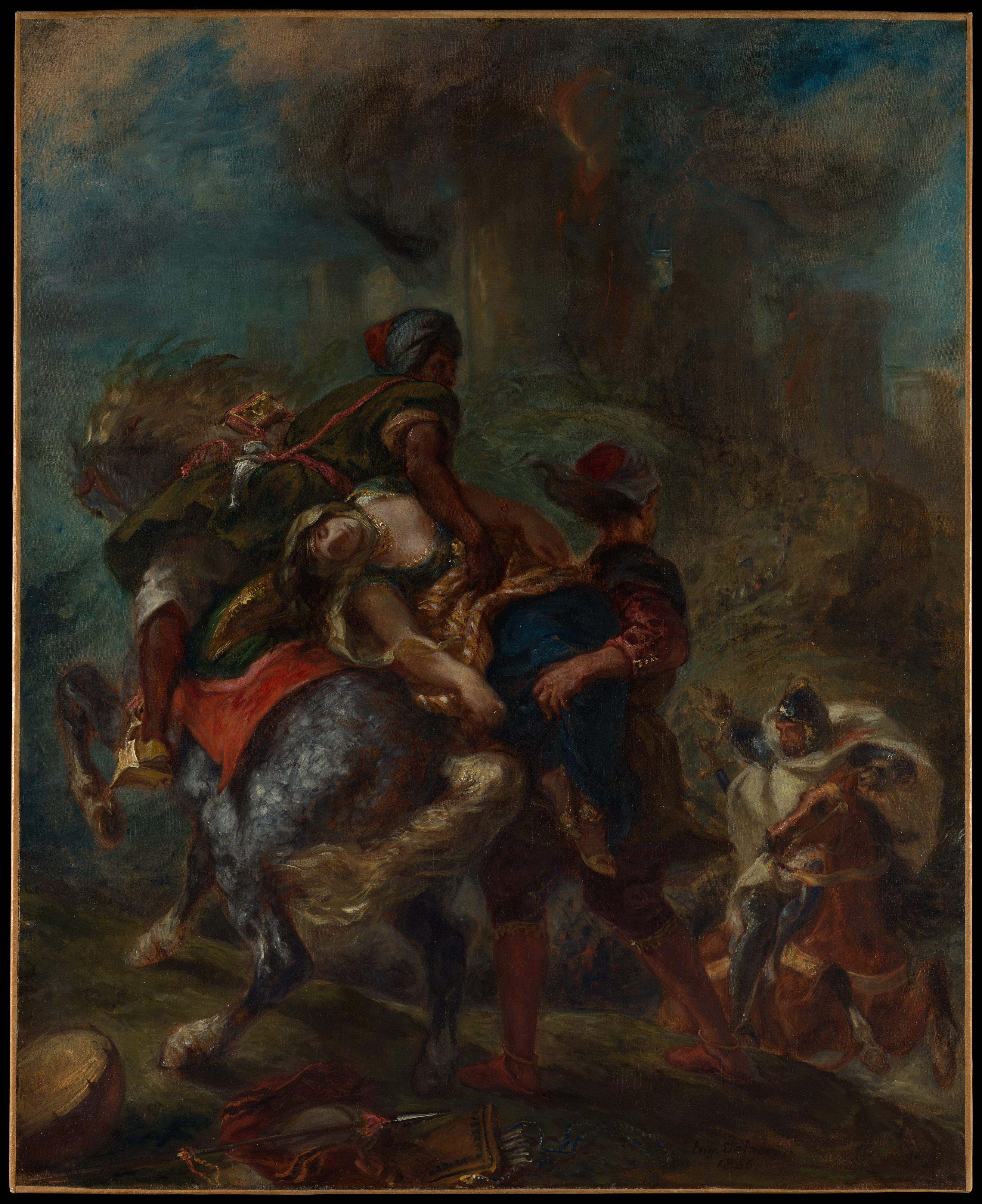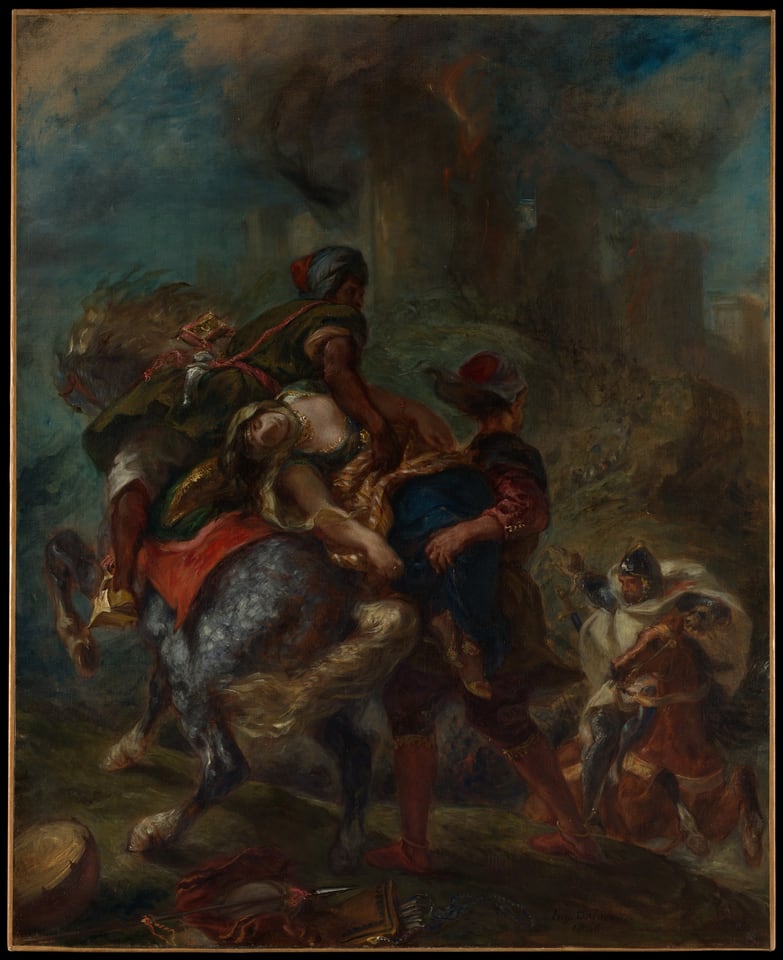
The Abduction of Rebecca1846
In a scene from Sir Walter Scott’s Ivanhoe, two Saracen slaves of the Templar knight Brian de Bois-Guilbert carry off the struggling Jewish heroine Rebecca, while the castle of Torquilstone burns behind them. More about this work
About this work
In a scene from Sir Walter Scott’s Ivanhoe, two Saracen slaves of the Templar knight Brian de Bois-Guilbert carry off the struggling Jewish heroine Rebecca, while the castle of Torquilstone burns behind them. Delacroix, the leading Romantic painter in France, often turned to Scott, Byron and Shakespeare for subjects charged with violence and passion. The swirl of bodies, horses and smoke is bound together by vivid colour and energetic brushwork. Charles Baudelaire praised the painting when it was shown at the Salon of 1846.
Written by Ochre Editions.
How it was made
- Oil paint
- Pigment ground in a drying oil, usually linseed. It dries slowly, so painters could blend on the canvas, build up thin translucent glazes, and rework a picture over weeks. Canvas replaced wooden panels in the 1500s because it is lighter and can be rolled.
Eugène Delacroix
French, 1798–1863 · Born in Charenton-Saint-Maurice; died in Paris.
Delacroix trained under Pierre-Narcisse Guérin and emerged in the 1820s as the leader of French Romanticism, with dramatic, richly coloured canvases such as The Death of Sardanapalus and Liberty Leading the People. A six-month journey to Morocco and Algeria in 1832 gave him a store of sketches and memories that fed his work for decades. Later he decorated public buildings in Paris, among them the Chapel of the Holy Angels at Saint-Sulpice, and his journal is a key record of his thinking.
Written by Ochre Editions.
Rights and the museum’s record
Public domain. The Met has dedicated this image to the public domain under CC0, so anyone may copy, adapt and use it, for any purpose, without asking. Our prints and files are reproductions made from the museum’s image; the museum doesn’t endorse them.
- Object number
- 03.30
- Credit
- Courtesy of The Metropolitan Museum of Art
- Type
- Paintings
- Department
- European Paintings
- Licence
- CC0 1.0 Universal
- Museum record
- See it on the museum’s site