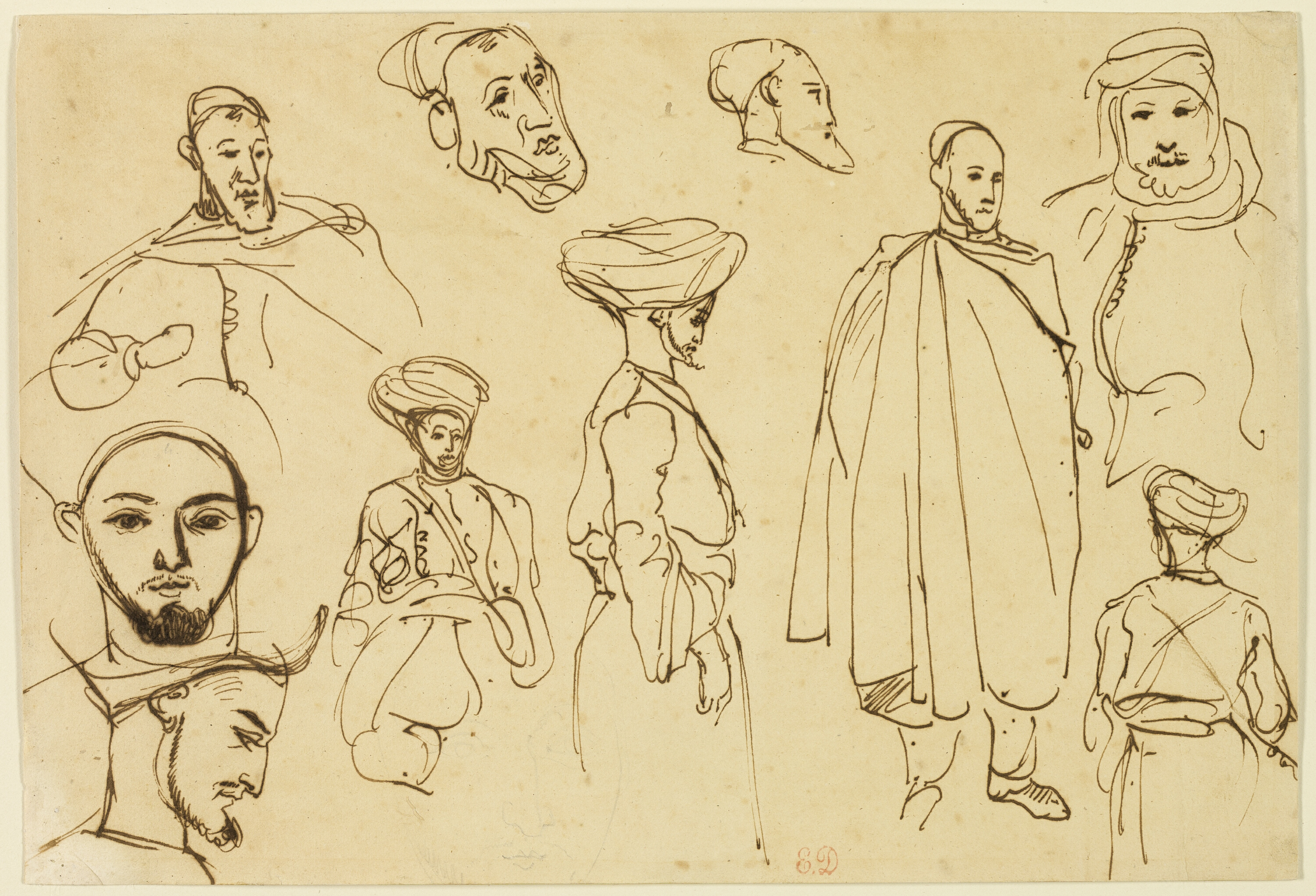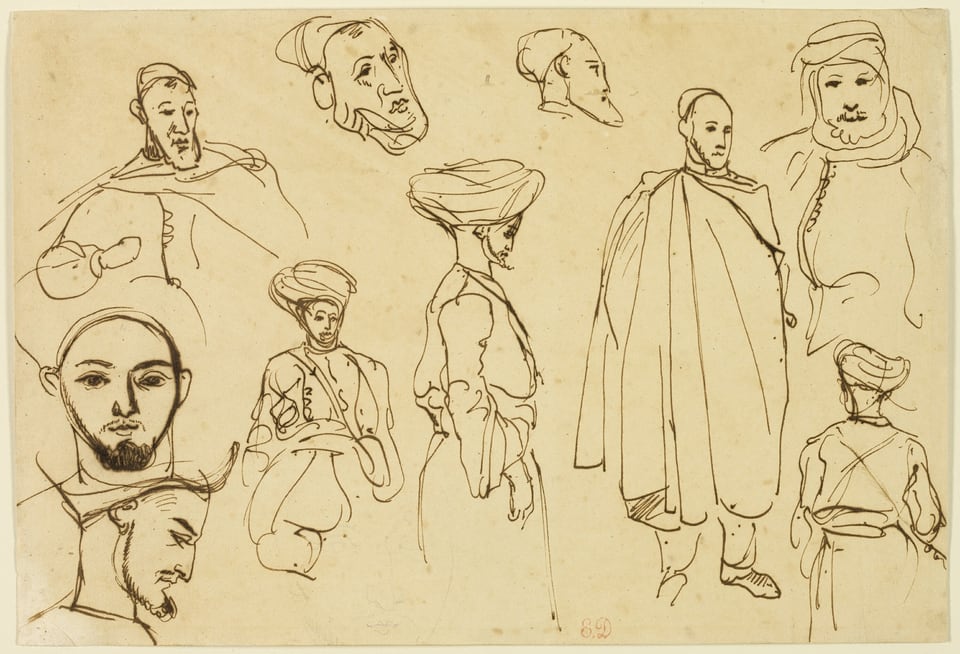
Sketches of Algerian Menc. 1832
Quick pen sketches of men in robes and headdresses fill this sheet, made during or soon after Delacroix’s journey to North Africa in 1832. More about this work
About this work
Quick pen sketches of men in robes and headdresses fill this sheet, made during or soon after Delacroix’s journey to North Africa in 1832. He travelled with a French diplomatic mission to the sultan of Morocco and stopped briefly in Algiers on the way home, filling notebooks and loose sheets with studies of people, costume and gesture. These observations fed his paintings for the rest of his career and changed his approach to colour and light.
Written by Ochre Editions.
What you’re looking at
A work made of pen and brown ink, with traces of graphite, on tan wove paper, laid down on cream wove paper.
Description from the Art Institute of Chicago.
How it was made
- Graphite
- Pencil. Graphite has been used for drawing since the 1500s; in 1795 Nicolas-Jacques Conté mixed it with clay, so its hardness could be graded.
- Pen and ink
- Drawn with a quill or reed pen, often with wash added by brush to model light and shadow.
Eugène Delacroix
French, 1798–1863 · Born in Charenton-Saint-Maurice; died in Paris.
Delacroix trained under Pierre-Narcisse Guérin and emerged in the 1820s as the leader of French Romanticism, with dramatic, richly coloured canvases such as The Death of Sardanapalus and Liberty Leading the People. A six-month journey to Morocco and Algeria in 1832 gave him a store of sketches and memories that fed his work for decades. Later he decorated public buildings in Paris, among them the Chapel of the Holy Angels at Saint-Sulpice, and his journal is a key record of his thinking.
Written by Ochre Editions.
Rights and the museum’s record
Public domain. The Art Institute of Chicago has dedicated this image to the public domain under CC0, so anyone may copy, adapt and use it, for any purpose, without asking. Our prints and files are reproductions made from the museum’s image; the museum doesn’t endorse them.
- Object number
- 1988.141.24
- Credit
- Courtesy of the Art Institute of Chicago
- Type
- Drawing and Watercolor
- Department
- Prints and Drawings
- Licence
- CC0 1.0 Universal
- Museum record
- See it on the museum’s site