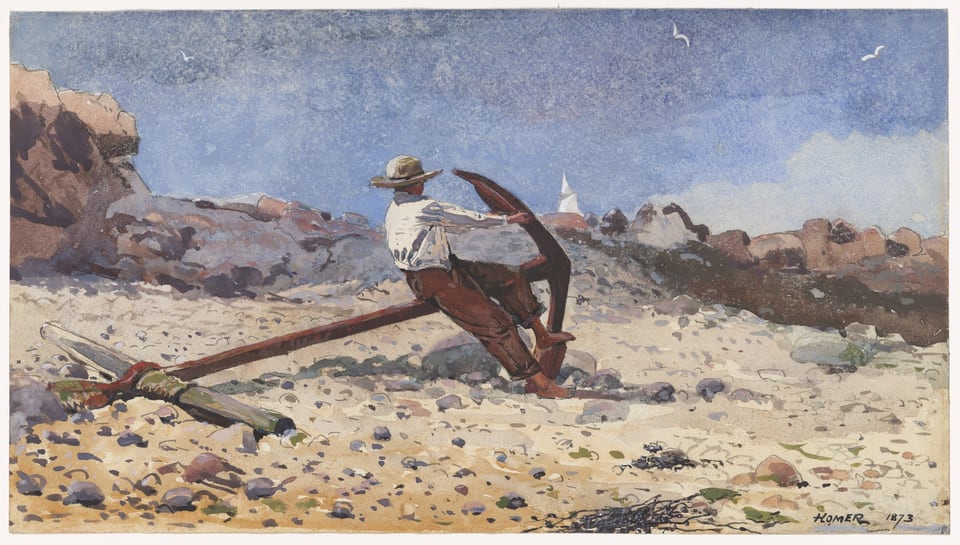
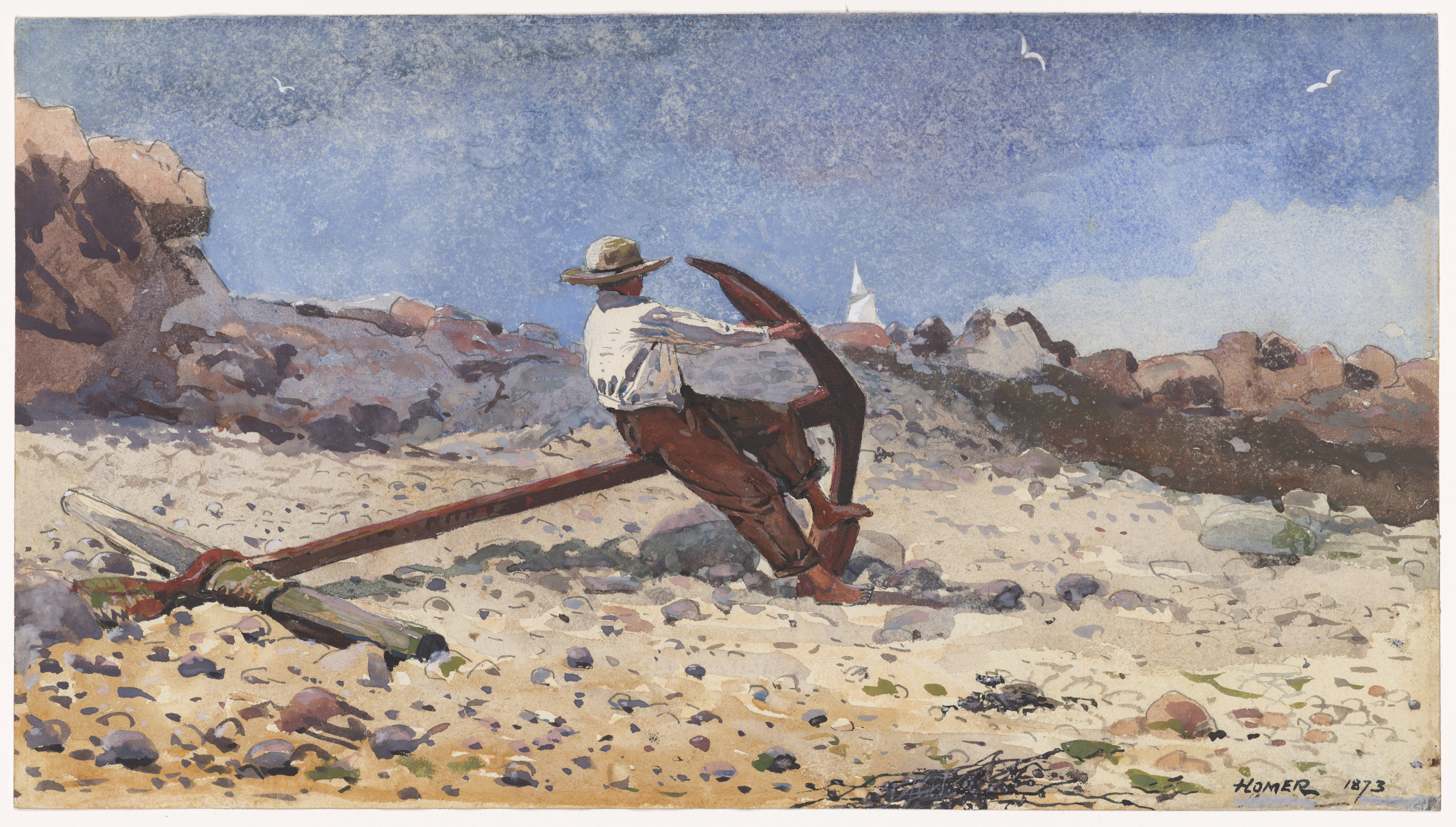
Boy with Anchor1873
In this work from a series of watercolors produced in Gloucester, MA, in the summer of 1873 Winslow Homer evokes the fraught nature of the local fishing industry by focusing not on the perilous work of adults, but rather the children they leave behind. More about this work
About this work
In this work from a series of watercolors produced in Gloucester, MA, in the summer of 1873 Winslow Homer evokes the fraught nature of the local fishing industry by focusing not on the perilous work of adults, but rather the children they leave behind. In Boy with Anchor , the massive anchor pointing toward the sea foreshadows the weight of the boy’s maritime destiny. The work is an early example of Homer's talent for evoking atmospheric effects and his interest in technical variety. Presumably working outdoors, Homer layered fluent washes of blue, gray, and brown transparent watercolor over his graphite underdrawing to flesh out the beach and sky. He built up the hot, pebble-studded surface of the beach by using dense gouache to draw textural detail and created the broken cloud pattern in the sky by lightly blotting his wet blue wash. The picture’s formal tensions between warm and cool colors, outline and wash, and transparency and opacity mirror the emotional tension of the scene.
Text from the Cleveland Museum of Art.
How it was made
- Watercolour
- Pigment in gum arabic, thinned with water and laid in transparent washes. Nothing white is painted: the light is the paper showing through.
- Graphite
- Pencil. Graphite has been used for drawing since the 1500s; in 1795 Nicolas-Jacques Conté mixed it with clay, so its hardness could be graded.
Winslow Homer
American, 1836–1910 · Born in Boston, Massachusetts; died in Prouts Neck, Maine.
Homer began as an illustrator, covering the Civil War for Harper’s Weekly, and first made his name in painting with scenes of soldiers and country life. A stay at the fishing village of Cullercoats on the English coast in 1881–82 turned him towards the sea, and from 1883 he lived at Prouts Neck, Maine, painting the Atlantic in all weathers. He was also a fluent watercolourist in the Adirondacks, Canada and the Caribbean, and The Gulf Stream draws on those southern journeys.
Written by Ochre Editions.
Rights and the museum’s record
Public domain. The Cleveland Museum of Art has dedicated this image to the public domain under CC0, so anyone may copy, adapt and use it, for any purpose, without asking. Our prints and files are reproductions made from the museum’s image; the museum doesn’t endorse them.
- Object number
- 1954.128
- Credit
- Courtesy of the Cleveland Museum of Art
- Type
- Drawing
- Department
- Drawings
- Licence
- CC0 1.0 Universal
- Museum record
- See it on the museum’s site
Report this work
More by Winslow Homer
All their works
Close in colour