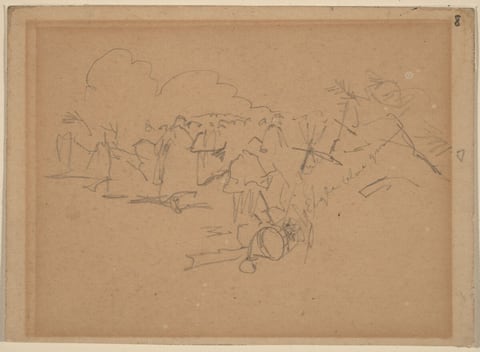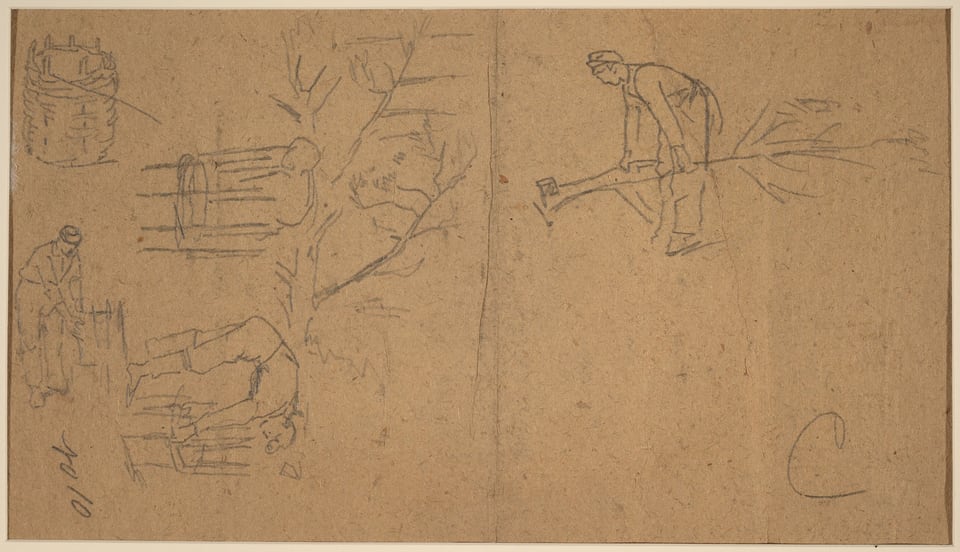
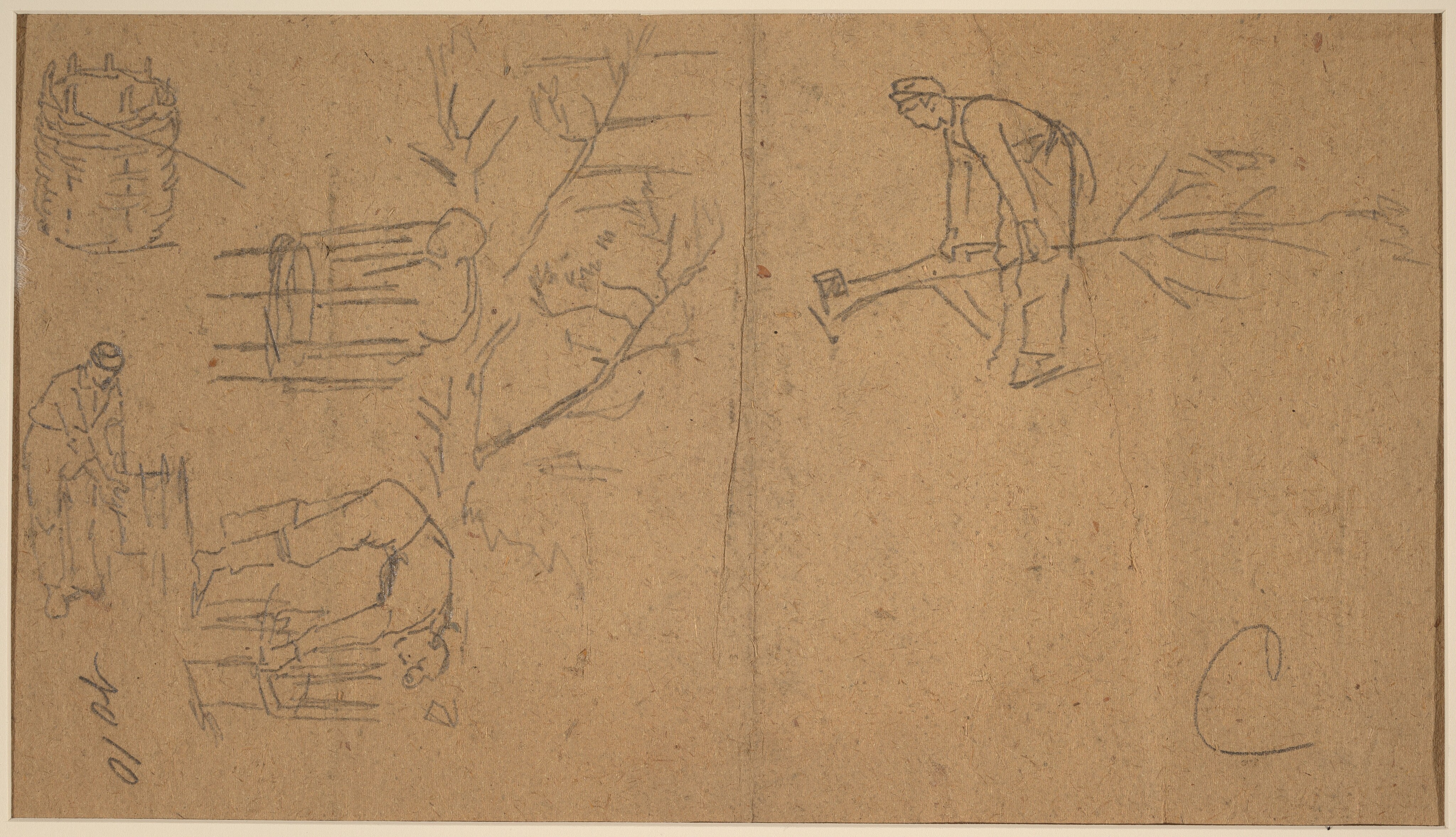
Soldiers felling sapling, and weaving saplings into baskets [verso]1862
Quick pencil sketches catch soldiers at work, felling saplings and weaving them into gabions, the basket-like frames filled with earth that protected artillery positions during sieges. More about this work
About this work
Quick pencil sketches catch soldiers at work, felling saplings and weaving them into gabions, the basket-like frames filled with earth that protected artillery positions during sieges. Winslow Homer made such drawings in 1862 while following the Union army in Virginia as an artist-correspondent for Harper’s Weekly, and they record the daily labour of soldiers rather than battles. These first-hand studies became the basis for illustrations and later for his early paintings.
Written by Ochre Editions.
What you’re looking at
This is a drawing of various sketches related to woodcutting or carpentry. The drawing features several pencil sketches on tan paper. On the left side, there are depictions of a barrel or basket, and beneath it, several outline sketches of figures engaged in activities involving woodwork. The right side of the drawing shows a figure bent over a large beam or branch. The sketches are simple, with minimal detail, capturing the basic form and movement of the figures and objects involved in woodwork-related activities.
Description from the National Gallery of Art.
How it was made
- Graphite
- Pencil. Graphite has been used for drawing since the 1500s; in 1795 Nicolas-Jacques Conté mixed it with clay, so its hardness could be graded.
Winslow Homer
American, 1836–1910 · Born in Boston, Massachusetts; died in Prouts Neck, Maine.
Homer began as an illustrator, covering the Civil War for Harper’s Weekly, and first made his name in painting with scenes of soldiers and country life. A stay at the fishing village of Cullercoats on the English coast in 1881–82 turned him towards the sea, and from 1883 he lived at Prouts Neck, Maine, painting the Atlantic in all weathers. He was also a fluent watercolourist in the Adirondacks, Canada and the Caribbean, and The Gulf Stream draws on those southern journeys.
Written by Ochre Editions.
Rights and the museum’s record
Public domain. The National Gallery of Art has dedicated this image to the public domain under CC0, so anyone may copy, adapt and use it, for any purpose, without asking. Our prints and files are reproductions made from the museum’s image; the museum doesn’t endorse them.
- Object number
- 1996.121.7.b
- Credit
- Courtesy National Gallery of Art, Washington
- Type
- Drawing
- Licence
- CC0 1.0 Universal
- Museum record
- See it on the museum’s site
Report this work
More by Winslow Homer
All their works
Close in colour