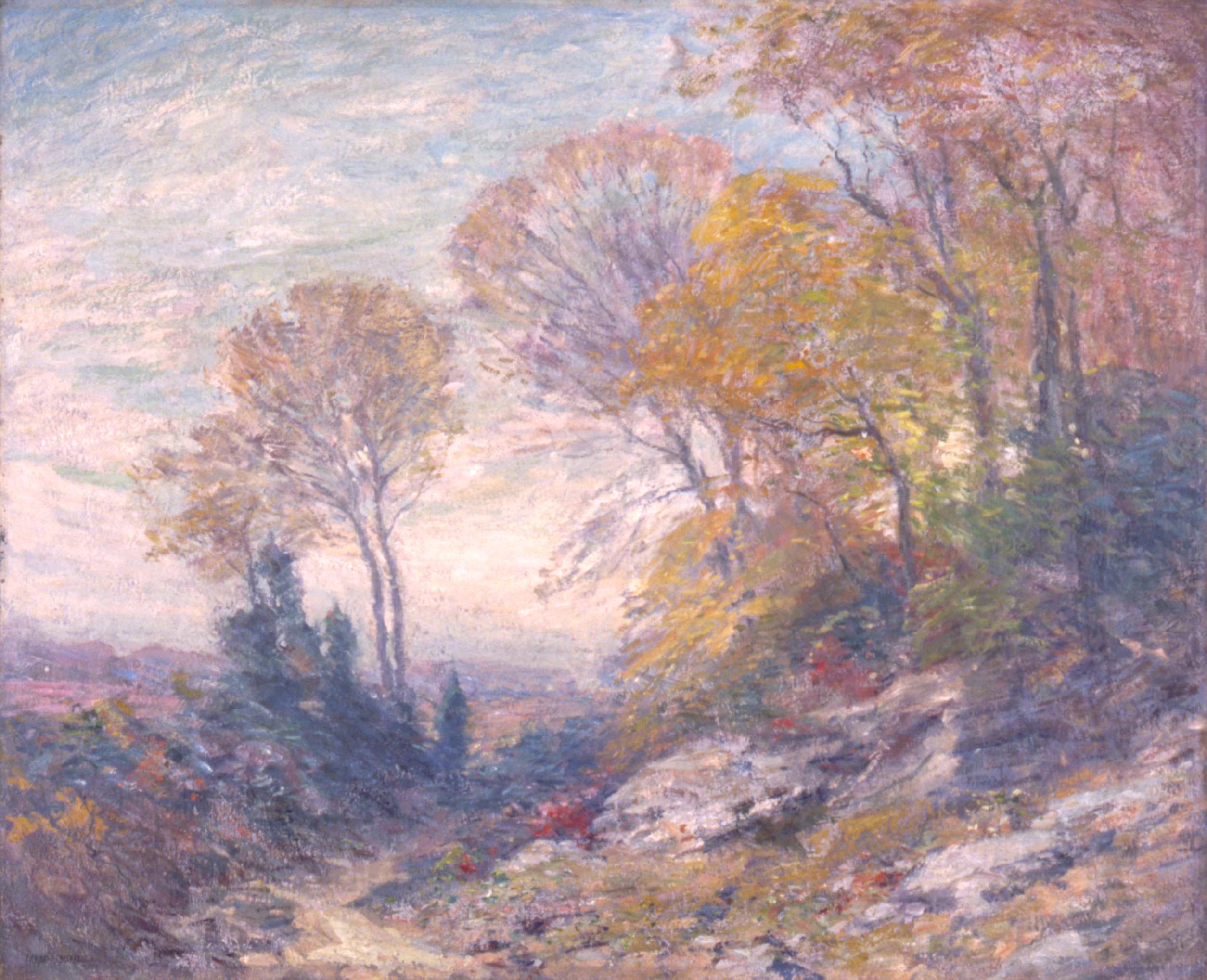
October Morningca. 1910
Frank Bicknell may have painted October Morning during one of his many stays at the artists' colony in Old Lyme, Connecticut. More about this work
About this work
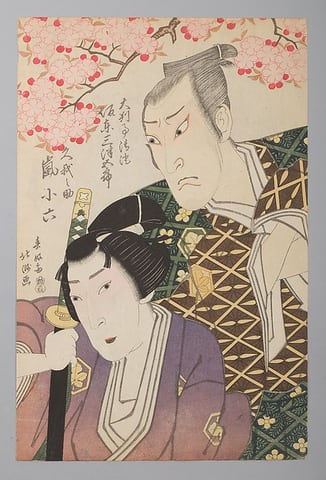
Frank Bicknell may have painted October Morning during one of his many stays at the artists' colony in Old Lyme, Connecticut. In a 1907 letter to Florence Griswold, who rented rooms to artists, he revealed his desire to come to the colony for both inspiration and camaraderie: "Will you stow me away somewhere in the big house about the last week in Septembre? Or the first week of Octobre at the latest? Please do not say no—Put me in the Barn if you will—but come to Lyme I must sometime this Autumn." In this painting, Bicknell captured the moment the sun rises to reveal the country landscape. Soft colors and brushstrokes, combined with the cool morning light, give the painting an otherworldly quality. Lush trees climb a small hill on the right side of the canvas. The left side is open, revealing the mountains in the distance. This asymmetrical arrangement shows the influence of Japanese woodblock prints. American impressionist painters, including Bicknell, studied these prints, experimenting with Japanese perspective and space to create compositions in which the subject was not always at the center.
Text from the Smithsonian American Art Museum.
How it was made
- Oil paint
- Pigment ground in a drying oil, usually linseed. It dries slowly, so painters could blend on the canvas, build up thin translucent glazes, and rework a picture over weeks. Canvas replaced wooden panels in the 1500s because it is lighter and can be rolled.
Frank A. Bicknell
born Augusta, ME 1866-died Essex, CT 1943
Rights and the museum’s record
Public domain. The Smithsonian American Art Museum has dedicated this image to the public domain under CC0, so anyone may copy, adapt and use it, for any purpose, without asking. Our prints and files are reproductions made from the museum’s image; the museum doesn’t endorse them.
- Object number
- 1910.9.15
- Credit
- Courtesy of the Smithsonian American Art Museum
- Type
- Painting
- Department
- Painting and Sculpture
- Licence
- CC0 1.0 Universal
- Museum record
- See it on the museum’s site
Report this work
Close in colour