Unknown maker
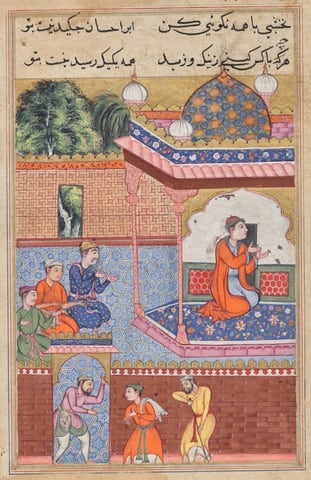
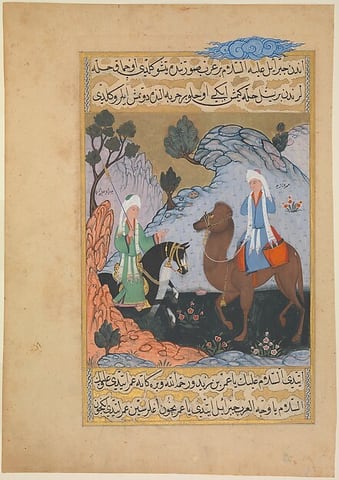
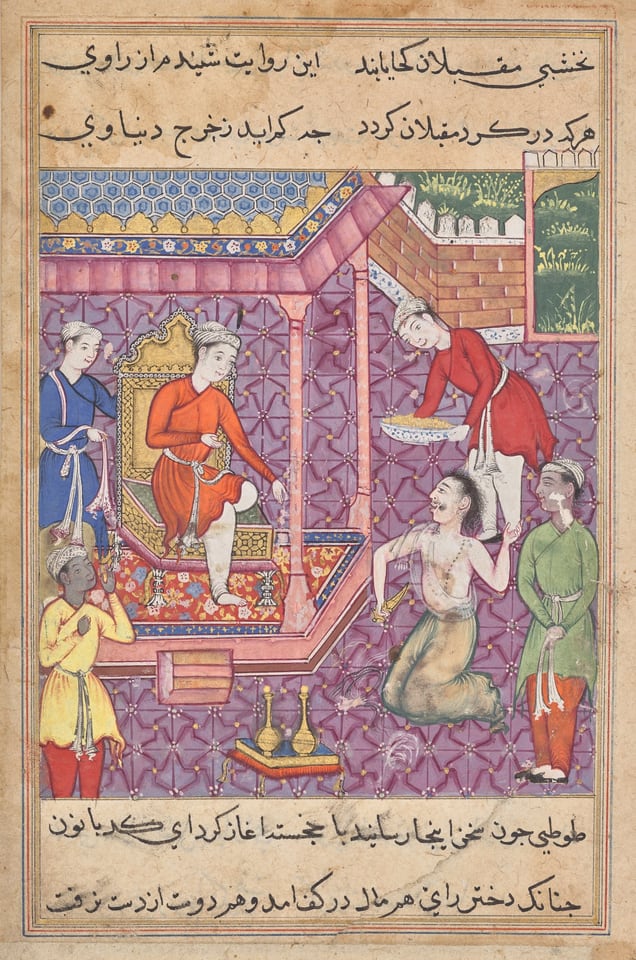
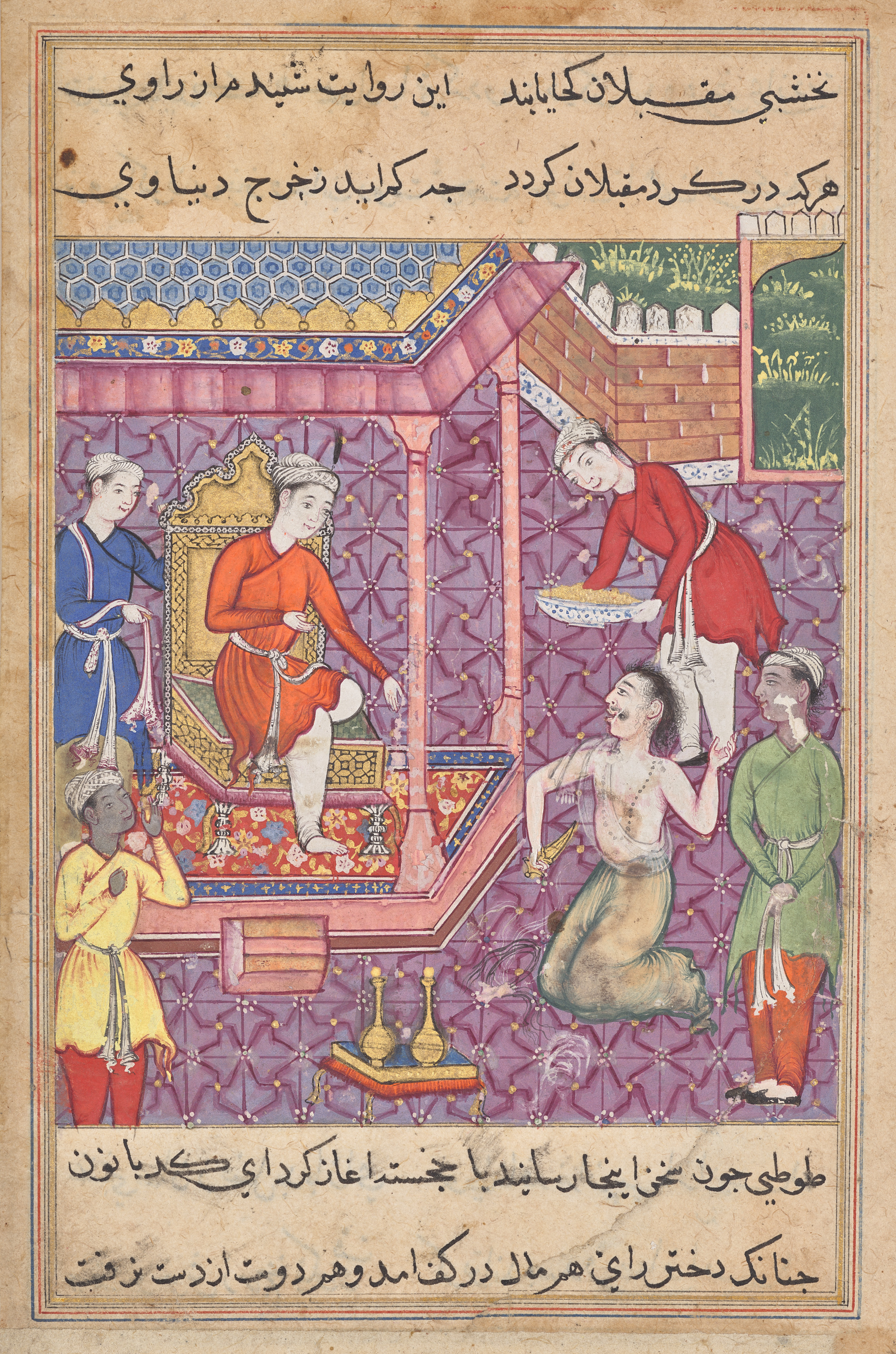
The magician disguised as a Brahman returns to claim his “daughter-in-law,” from a Tuti-nama (Tales of a Parrot): Thirty-fifth Nightc. 1560
The story continues with a ruse to allow the Brahman and the princess to escape the king’s son and live happily ever after. More about this work
About this work
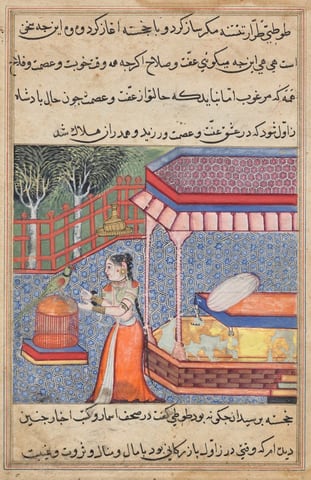
The story continues with a ruse to allow the Brahman and the princess to escape the king’s son and live happily ever after. The magician transformed the lovers into men, so they were able to leave the palace unrecognized. In order to garner a fortune on which they could support themselves, the magician approached the king in the guise of a Brahman to reclaim the woman he had entrusted to the harem and who he said was his daughter-in-law. When the king stated that she has disappeared, the magician in the form of a Brahman acted as though he would stab himself to death. The king assuaged him by paying a large sum of money as compensation for losing the woman. A servant brings a blue-and-white porcelain dish full of gold coins. A different artist painted this page without referencing the appearance of either the king or the magician in the guise of a Brahman from the previous page.
Text from the Cleveland Museum of Art.
How it was made
- Opaque watercolour
- Watercolour made opaque with white or chalk and laid in flat, even layers. Persian and Indian painters ground their colours from minerals, applied them with the finest brushes and burnished the finished page.
- Tempera
- Pigment bound with egg yolk. It dries in minutes and can’t be blended wet, so painters built up form with fine, hatched strokes. It was Europe’s main panel technique before oil.
- Ink on paper
- Ink made from soot and animal glue, ground with water on an inkstone. A single brush can give a hair-fine line or a broad wash, and nothing can be corrected.
Rights and the museum’s record
Public domain. The Cleveland Museum of Art has dedicated this image to the public domain under CC0, so anyone may copy, adapt and use it, for any purpose, without asking. Our prints and files are reproductions made from the museum’s image; the museum doesn’t endorse them.
- Object number
- 1962.279.236.a
- Credit
- Courtesy of the Cleveland Museum of Art
- Type
- Painting
- Department
- Indian and Southeast Asian Art
- Licence
- CC0 1.0 Universal
- Museum record
- See it on the museum’s site
Report this work
Close in colour