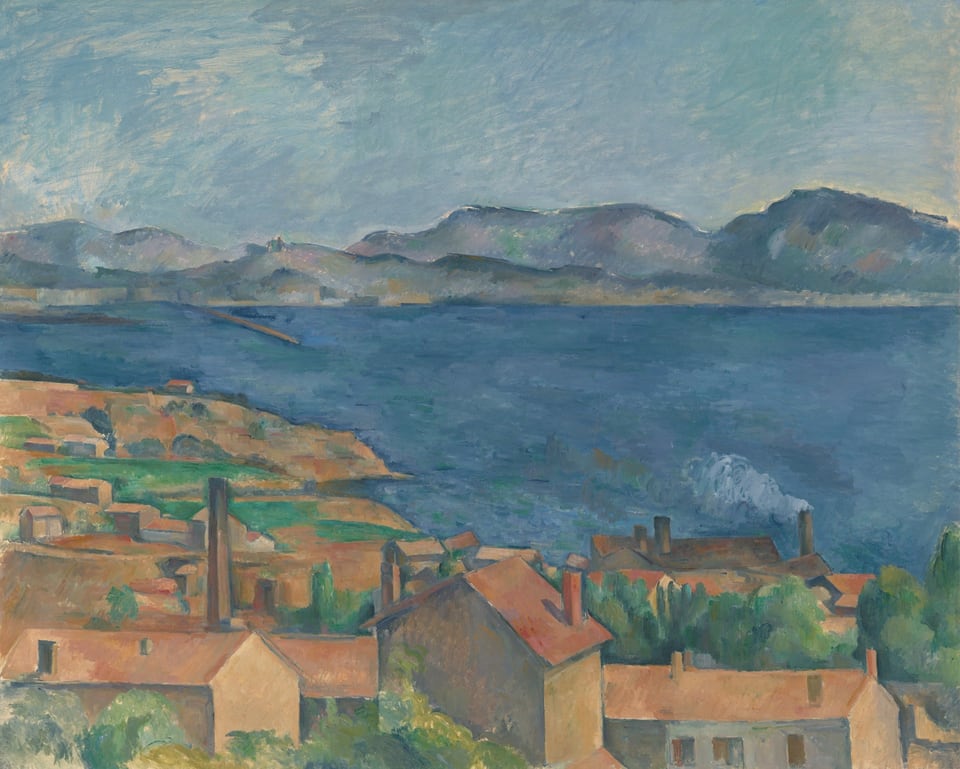
The Bay of Marseille, Seen from L'Estaquec. 1885
From the hills above the village of L’Estaque, the rooftops of tan houses tumble down to the deep blue expanse of the Bay of Marseille, with mountains rising beyond the water. More about this work
About this work
From the hills above the village of L’Estaque, the rooftops of tan houses tumble down to the deep blue expanse of the Bay of Marseille, with mountains rising beyond the water. Cézanne painted this view repeatedly in the 1870s and 1880s, and in a letter he compared the effect of red roofs against the blue sea to a playing card. He builds the scene from blocks of colour and simplified geometric forms, flattening the sea into a single plane, a way of seeing that would deeply influence the Cubists.
Written by Ochre Editions.
What you’re looking at
Impressionist sea landscape, tan houses, blue ocean, distant mountains.
Description from the Art Institute of Chicago.
How it was made
- Oil paint
- Pigment ground in a drying oil, usually linseed. It dries slowly, so painters could blend on the canvas, build up thin translucent glazes, and rework a picture over weeks. Canvas replaced wooden panels in the 1500s because it is lighter and can be rolled.
Paul Cézanne
French, 1839–1906 · Born and died in Aix-en-Provence.
Cézanne divided his life between Paris and his native Aix-en-Provence. Encouraged by his schoolfriend Émile Zola and later by Pissarro, with whom he painted at Pontoise and Auvers in the 1870s, he showed at the first and third Impressionist exhibitions. He then withdrew to Provence and worked towards a more structured art, building form from patches of colour in still lifes, bathers and repeated views of Mont Sainte-Victoire. Younger painters, Picasso and Braque among them, saw him as a founder of modern painting.
Written by Ochre Editions.
Post-Impressionism
Artists who kept Impressionism's colour but pushed towards structure, symbol and feeling.
Rights and the museum’s record
Public domain. The Art Institute of Chicago has dedicated this image to the public domain under CC0, so anyone may copy, adapt and use it, for any purpose, without asking. Our prints and files are reproductions made from the museum’s image; the museum doesn’t endorse them.
- Object number
- 1933.1116
- Credit
- Courtesy of the Art Institute of Chicago
- Type
- Painting
- Department
- Painting and Sculpture of Europe
- Licence
- CC0 1.0 Universal
- Museum record
- See it on the museum’s site
Report this work
More by Paul Cézanne
All their works

Close in colour