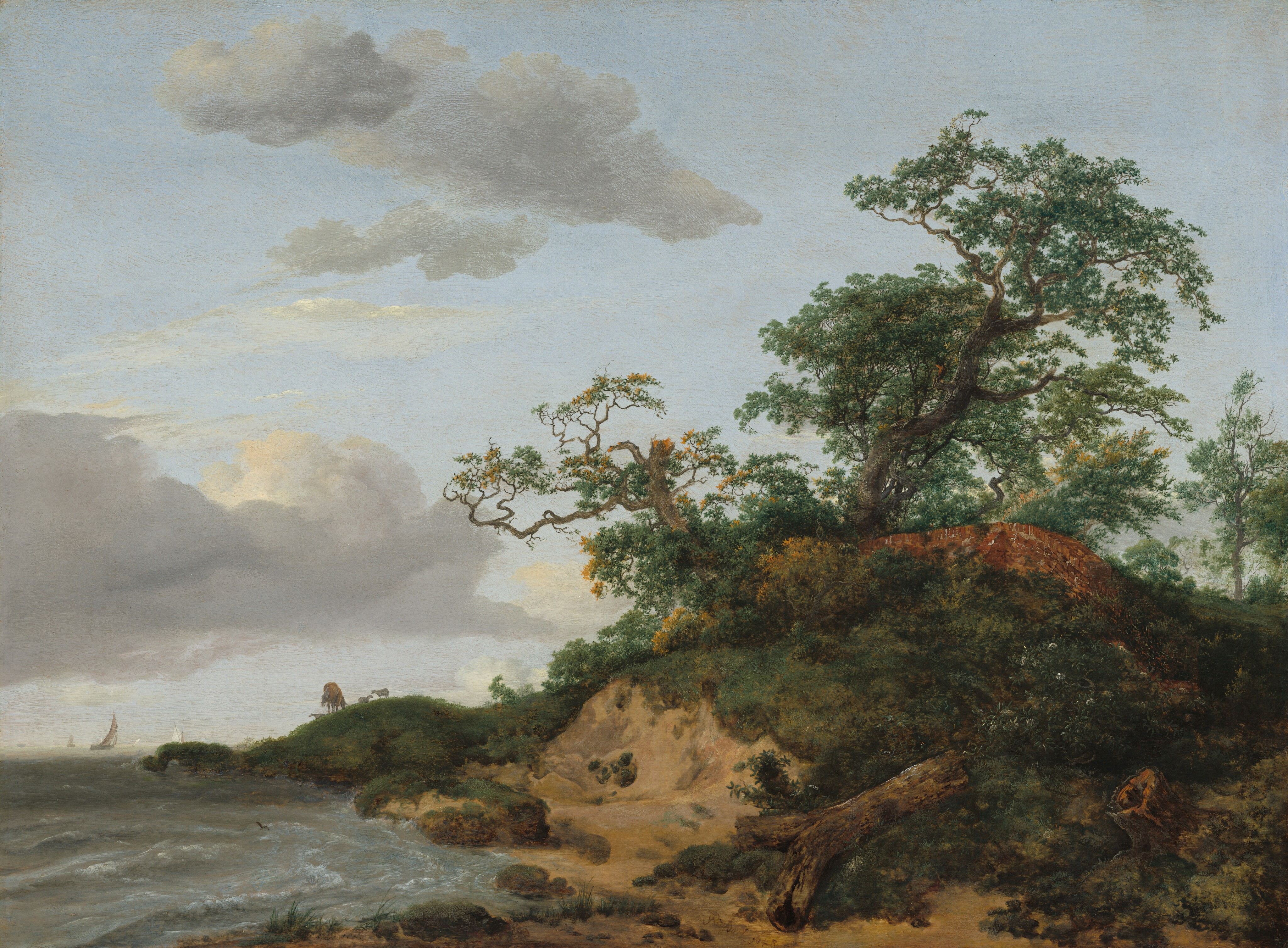
Dunes by the Sea1648
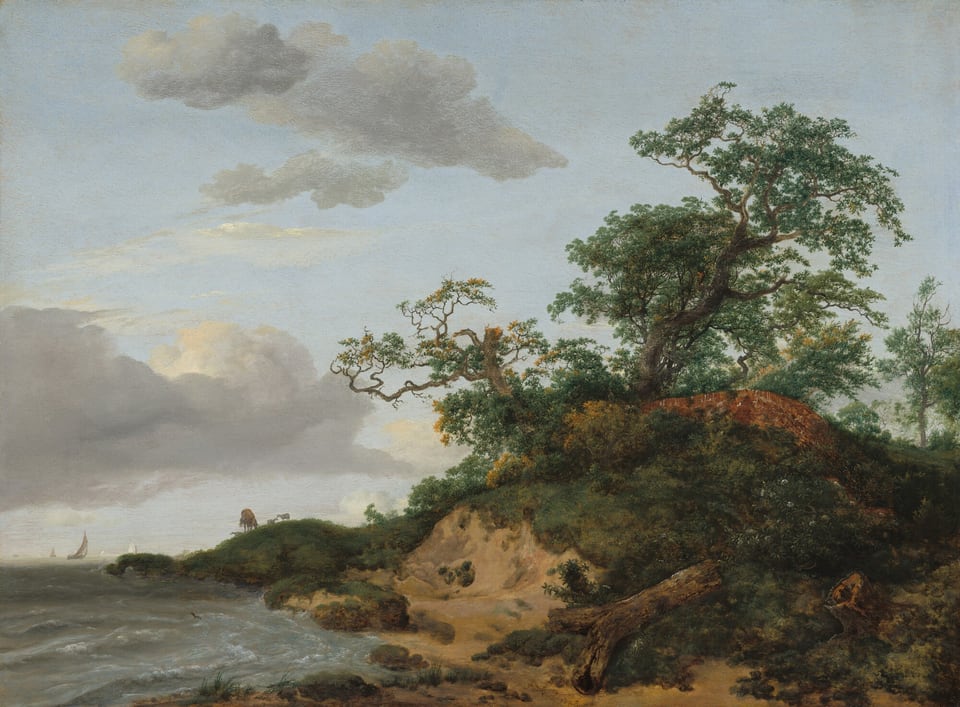
A steep sandy dune, thick with grass, shrubs and broken trees, rises at the right above a curving shore where white ripples swirl in steel-blue water; a red brick wall cuts up through the vegetation, and cattle graze on a distant rise. More about this work
About this work
A steep sandy dune, thick with grass, shrubs and broken trees, rises at the right above a curving shore where white ripples swirl in steel-blue water; a red brick wall cuts up through the vegetation, and cattle graze on a distant rise. Jacob van Ruisdael signed and dated the panel in 1648, when he was only about nineteen or twenty, and it already shows the close study of nature that would make him the most admired Dutch landscape painter of his age. The twisting branches and the sheer edge of the dune give a humble stretch of coast real drama.
Written by Ochre Editions.
What you’re looking at
Water laps at a curving shoreline in front of a steep sandy dune carpeted in grass, shrubs, and trees in this horizontal landscape painting. The dune takes up the lower right quadrant of the composition. A few broken tree trunks are overgrown with vines and plants across the top and down the sloping side of the dune facing us. A red brick wall cuts through the vegetation up the side of the dune and disappears into the shrubbery at the top. The twisting branches and canopies of three large trees reach into the upper right quadrant of the composition. The vegetation stops abruptly along the sheer edge of the dune where it faces the water. The land curves like a backward capital letter C so it almost reaches the left edge of the painting along the horizon, which comes a quarter of the way up the composition. A cow and three more animals, perhaps sheep or more cows, graze or lie on a grassy mound in the distance, and sailboats line the horizon in the deep distance. White ripples swirl in the steel-blue water. The artist signed and dated the lower center, “J Ruisdael . 1648.”
Description from the National Gallery of Art.
How it was made
- Oil on panel
- Oil paint on prepared wooden boards, usually oak in the north and poplar in Italy. The rigid, smooth surface suits fine detail and thin, glowing glazes.
- Oil paint
- Pigment ground in a drying oil, usually linseed. It dries slowly, so painters could blend on the canvas, build up thin translucent glazes, and rework a picture over weeks. Canvas replaced wooden panels in the 1500s because it is lighter and can be rolled.
Jacob van Ruisdael
Dutch, 1628/29–1682 · Born in Haarlem; died in Amsterdam.
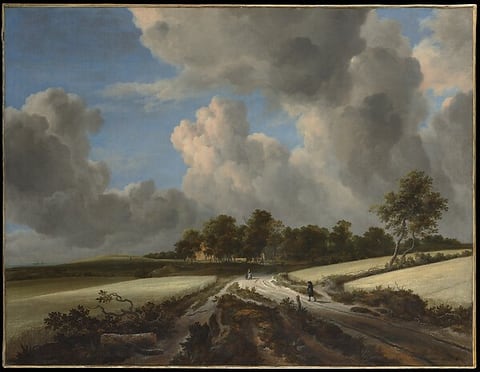
Ruisdael was the leading Dutch landscape painter of the seventeenth century. Probably trained by his father Isaack and his uncle Salomon van Ruysdael in Haarlem, he painted dunes, woods, waterfalls, beaches and wheat fields under towering skies, giving familiar scenery a dramatic, sometimes melancholy weight. He moved to Amsterdam around 1656, and Meindert Hobbema was his pupil. Views such as Wheat Fields show his gift for the low Dutch horizon and the moving clouds above it.
Written by Ochre Editions.
Rights and the museum’s record
Public domain. The National Gallery of Art has dedicated this image to the public domain under CC0, so anyone may copy, adapt and use it, for any purpose, without asking. Our prints and files are reproductions made from the museum’s image; the museum doesn’t endorse them.
- Object number
- 2017.55.1
- Credit
- Courtesy National Gallery of Art, Washington
- Type
- Painting
- Licence
- CC0 1.0 Universal
- Museum record
- See it on the museum’s site
Report this work
More by Jacob van Ruisdael
All their works
Close in colour