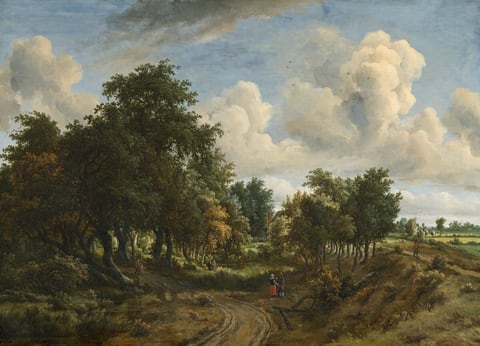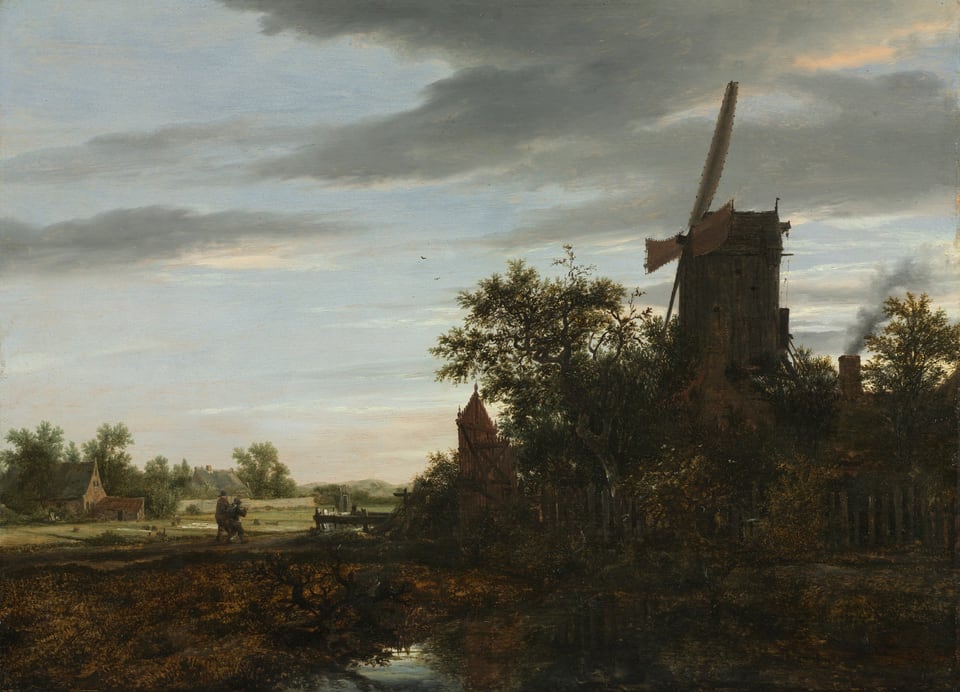
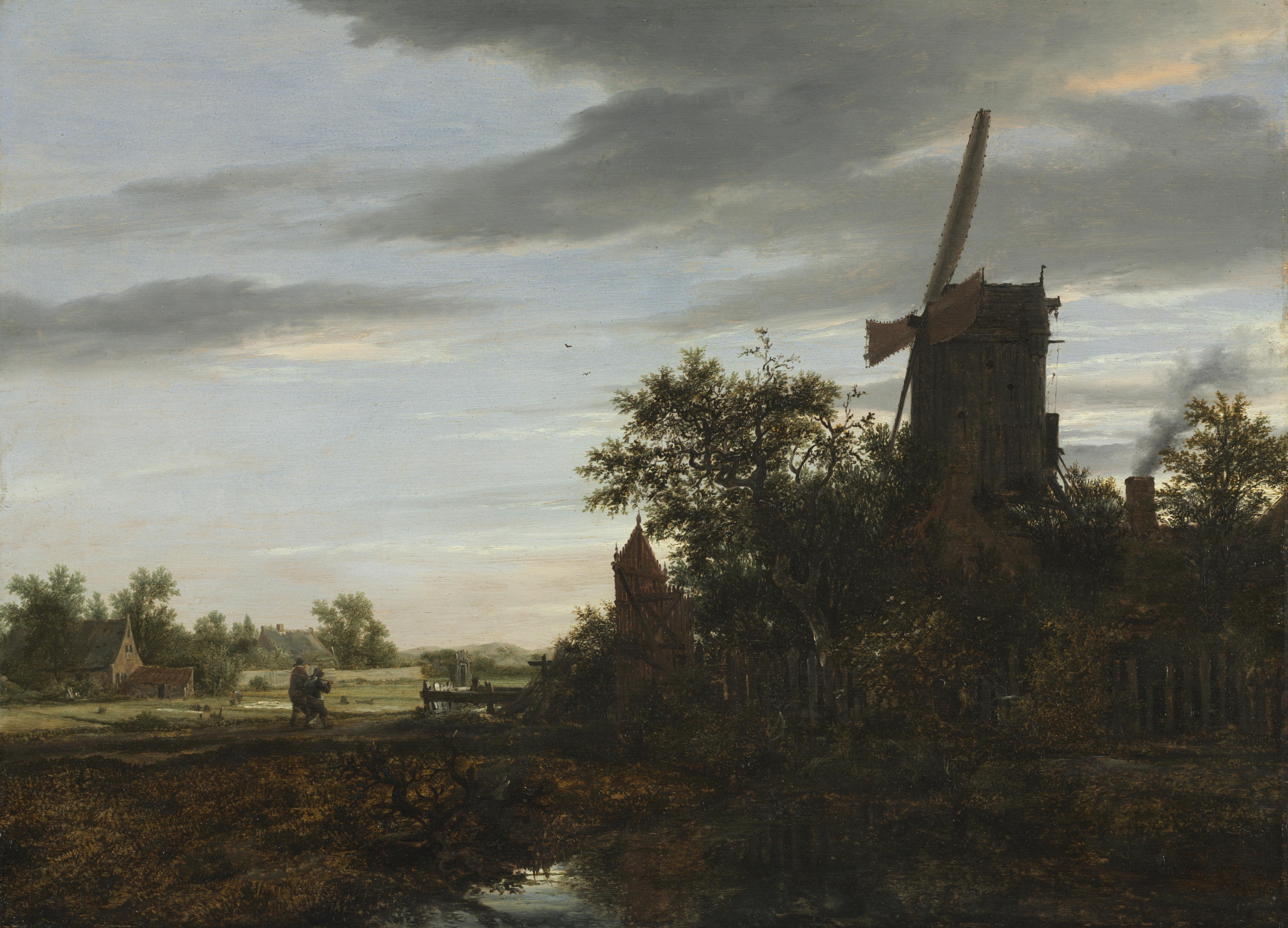
Landscape with a Windmill1646
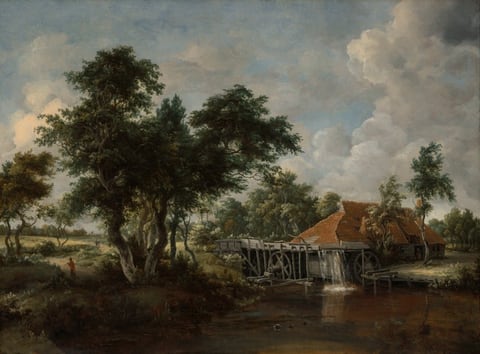
Even this early work by Jacob van Ruisdael—painted while he was still a teenager—shows his unique approach to landscape that made the simplest motifs seem grand and heroic. More about this work
About this work
Even this early work by Jacob van Ruisdael—painted while he was still a teenager—shows his unique approach to landscape that made the simplest motifs seem grand and heroic. Dark forms are massed in the foreground, creating a stark contrast to the expansive, sunlit plain at left.
Text from the Cleveland Museum of Art.
How it was made
- Oil on panel
- Oil paint on prepared wooden boards, usually oak in the north and poplar in Italy. The rigid, smooth surface suits fine detail and thin, glowing glazes.
- Oil paint
- Pigment ground in a drying oil, usually linseed. It dries slowly, so painters could blend on the canvas, build up thin translucent glazes, and rework a picture over weeks. Canvas replaced wooden panels in the 1500s because it is lighter and can be rolled.
Jacob van Ruisdael
Dutch, 1628/29–1682 · Born in Haarlem; died in Amsterdam.
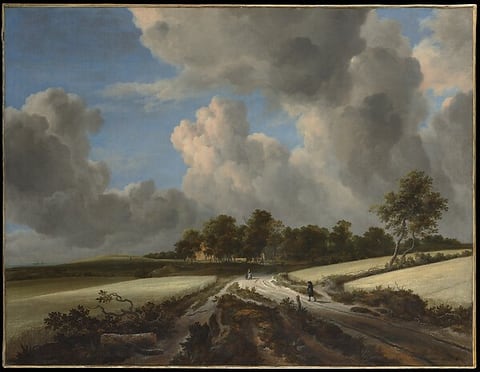
Ruisdael was the leading Dutch landscape painter of the seventeenth century. Probably trained by his father Isaack and his uncle Salomon van Ruysdael in Haarlem, he painted dunes, woods, waterfalls, beaches and wheat fields under towering skies, giving familiar scenery a dramatic, sometimes melancholy weight. He moved to Amsterdam around 1656, and Meindert Hobbema was his pupil. Views such as Wheat Fields show his gift for the low Dutch horizon and the moving clouds above it.
Written by Ochre Editions.
Dutch Golden Age
Seventeenth-century painting from the Dutch Republic: still lifes, interiors, portraits and flat, wide skies.
Rights and the museum’s record
Public domain. The Cleveland Museum of Art has dedicated this image to the public domain under CC0, so anyone may copy, adapt and use it, for any purpose, without asking. Our prints and files are reproductions made from the museum’s image; the museum doesn’t endorse them.
- Object number
- 1967.19
- Credit
- Courtesy of the Cleveland Museum of Art
- Type
- Painting
- Department
- European Painting and Sculpture
- Licence
- CC0 1.0 Universal
- Museum record
- See it on the museum’s site
Report this work
More by Jacob van Ruisdael
All their works
Close in colour