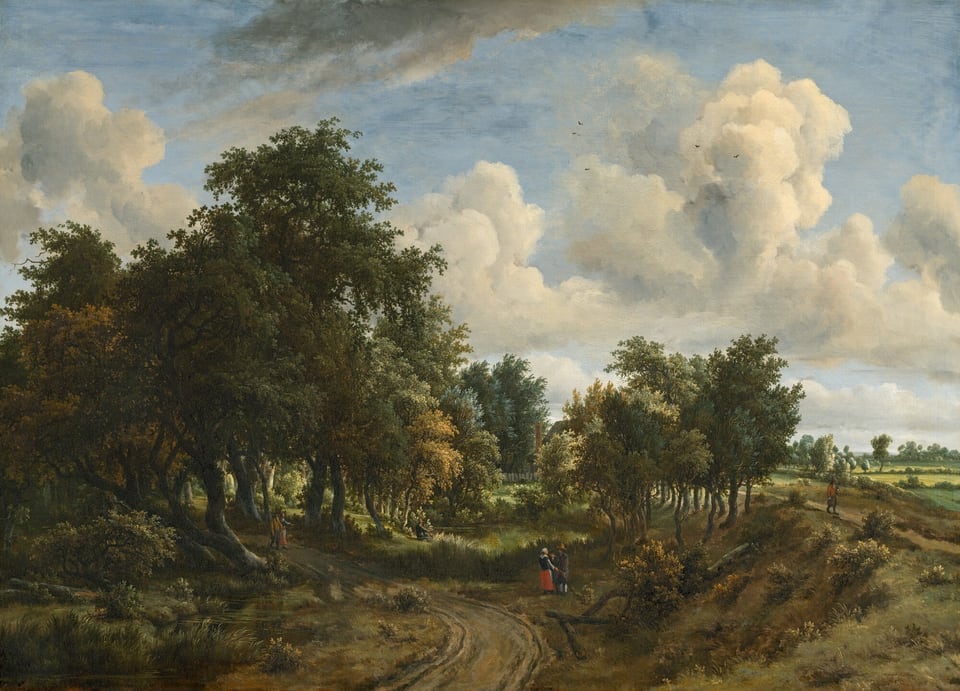
A Wooded Landscape1663
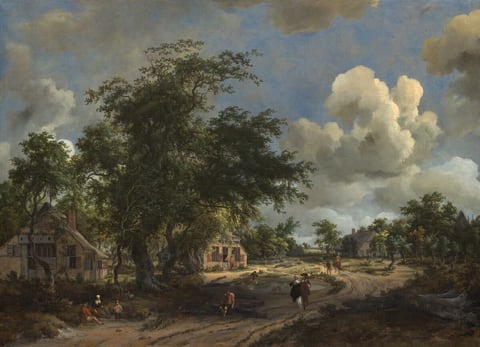
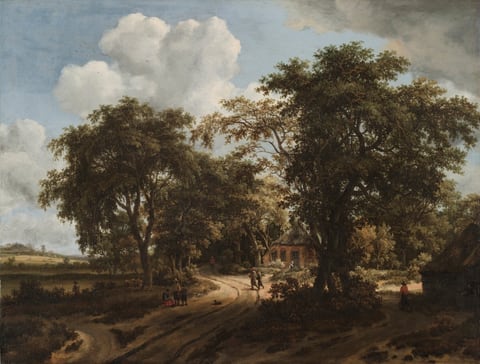
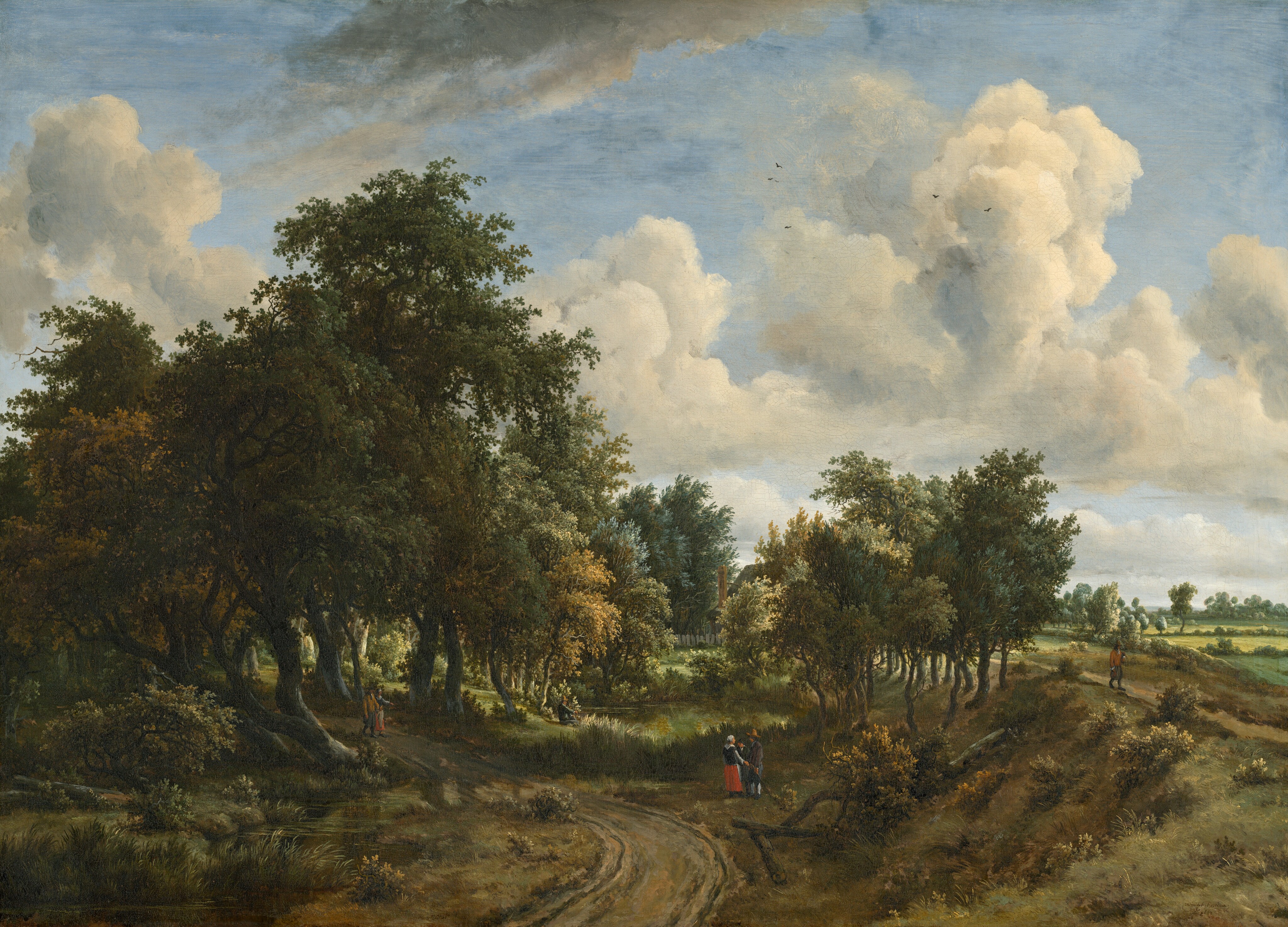
A rutted road curves past a grove of tall trees, whose broad canopies throw deep shade over a stream, while small figures stroll, talk and fish across a sunlit landscape of fields and hedgerows. More about this work
About this work
A rutted road curves past a grove of tall trees, whose broad canopies throw deep shade over a stream, while small figures stroll, talk and fish across a sunlit landscape of fields and hedgerows. Meindert Hobbema signed and dated the canvas in 1663, early in his brief, intense career as a landscape painter; in 1668 he took a post as a wine gauger in Amsterdam and thereafter painted far less. The balance of shadowed woodland and open distance, and the scattered figures that give the scene life, are typical of his finest work.
Written by Ochre Editions.
What you’re looking at
A rutted, dirt road curves from the bottom center of the canvas toward and behind a grove of tall trees to our left, beneath a pale blue sky with fluffy white clouds that fills the top two-thirds of this horizontal landscape painting. The broad, green canopies of the trees to our left create deep shade over twisting trunks, shrubs, and grasses. A narrow stream meandering alongside the road to our left reflects the moss, pine, and sage greens of the leaves. The land rises in a sloping bank to our right, and leads back to open fields with hedgerows that stretch to the horizon. Shorter, more spindly trees cluster along the bank in the distance. Tiny in scale, people are sprinkled throughout the landscape, either singly or in small groups. In the shade of the grove to our left, a man with dark pantaloons, a brown hat and coat, and a walking stick strolls along the road with a woman wearing a red skirt, a dark shirt, and a white apron and cap. Just off the curve of the road to our right, another man with a walking stick, tan hat, and dark gray pantaloons talks to a woman also wearing red, black, and white. Another person, slightly smaller in stature, stands between them. At a pond farther back from this trio, a man with a broad-brimmed hat sits fishing at the edge of the water. Barely visible, a house with a pitched roof, a tall, brick-red chimney, and a white picket fence peeks out from behind the trees beyond the pond. Finally, a man wearing a rust-orange coat, gray pantaloons with white stockings, and a tall hat, carrying a pole propped on his shoulder, walks toward us on a footpath running alongside the fields. Tall, cream-white clouds dot the pale blue sky above, and tiny dots of dark paint suggest flying birds. Soft sunlight pours across the countryside. The artist signed and dated the painting in small script in the lower right corner: “meijndert Hobbema F 1663.”
Description from the National Gallery of Art.
How it was made
- Oil paint
- Pigment ground in a drying oil, usually linseed. It dries slowly, so painters could blend on the canvas, build up thin translucent glazes, and rework a picture over weeks. Canvas replaced wooden panels in the 1500s because it is lighter and can be rolled.
Meindert Hobbema
Dutch, 1638–1709
Hobbema studied with Jacob van Ruisdael in Amsterdam in the late 1650s and became the most accomplished of his followers, painting sunlit woodland, watermills, cottages and country roads. In 1668 he married and took a post as a wine gauger for the city of Amsterdam, after which he painted far less. Long overlooked, his work was keenly collected in Britain in the nineteenth century and influenced English landscape painting.
Written by Ochre Editions.
Rights and the museum’s record
Public domain. The National Gallery of Art has dedicated this image to the public domain under CC0, so anyone may copy, adapt and use it, for any purpose, without asking. Our prints and files are reproductions made from the museum’s image; the museum doesn’t endorse them.
- Object number
- 1937.1.61
- Credit
- Courtesy National Gallery of Art, Washington
- Type
- Painting
- Licence
- CC0 1.0 Universal
- Museum record
- See it on the museum’s site
Report this work
More by Meindert Hobbema
All their works
Close in colour