Wivenhoe Park, Essex1816
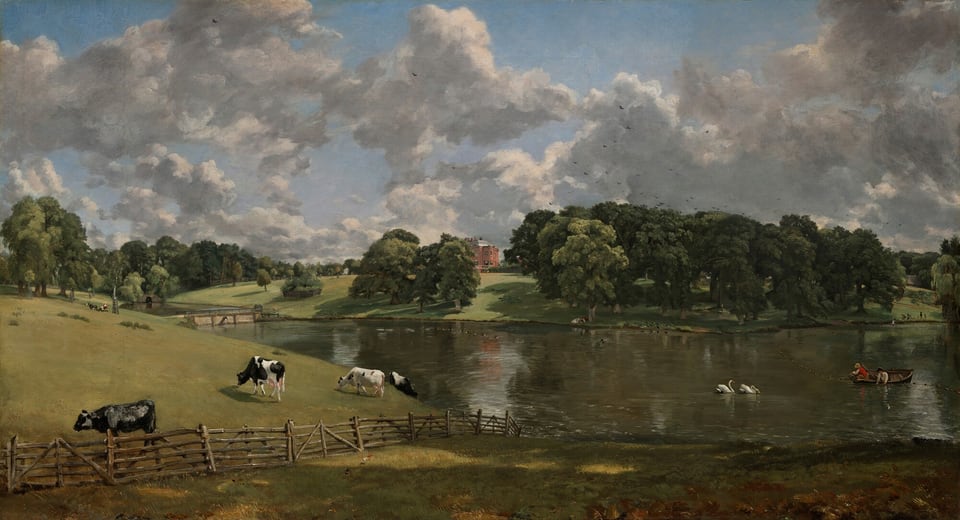
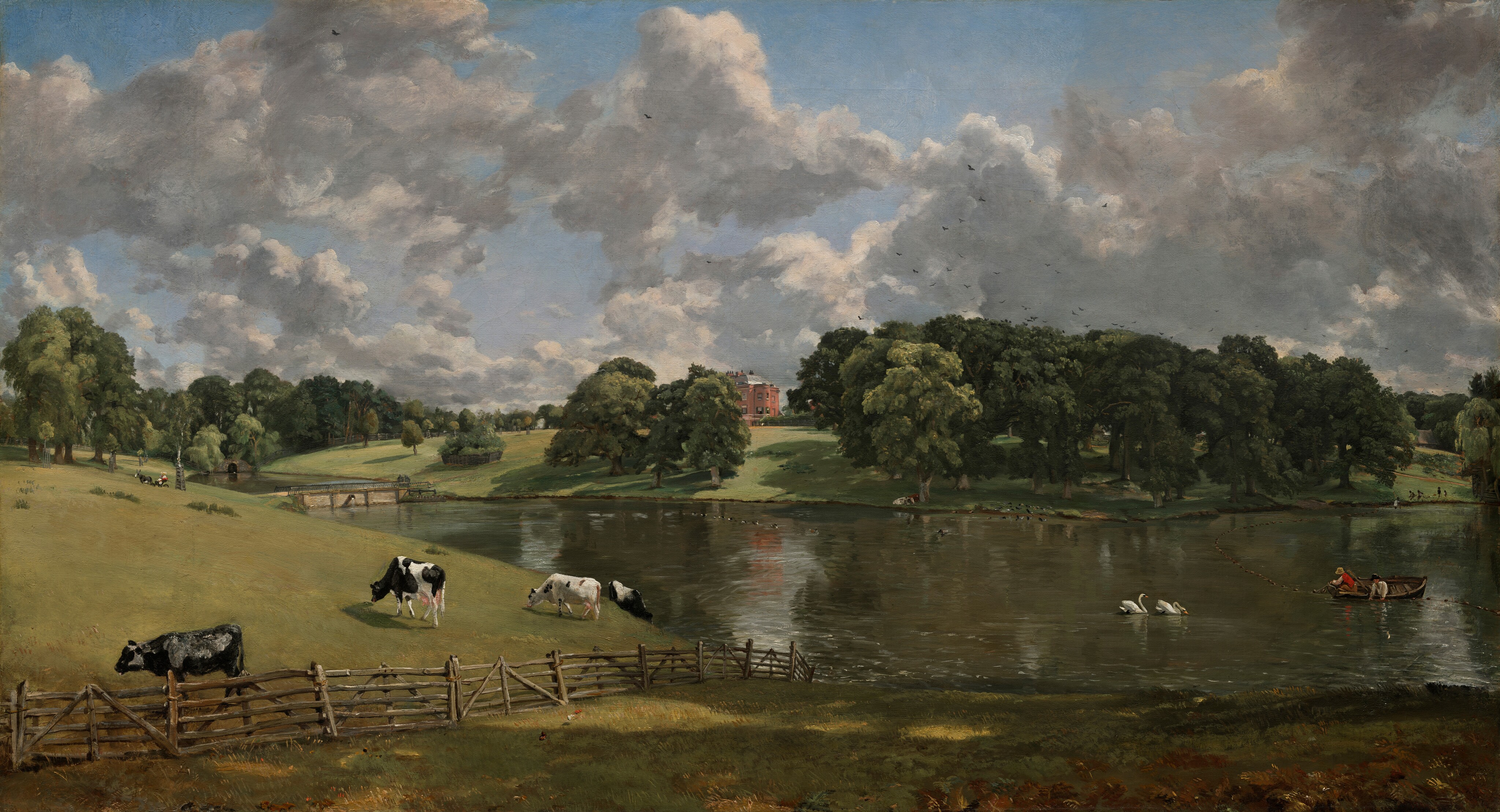
Black and white cows graze beyond a fence, two men haul in a net from a boat near a pair of swans, and a donkey cart crosses a distant bridge, while the brick house of Wivenhoe Park appears through the trees beneath towering summer clouds. More about this work
About this work
Black and white cows graze beyond a fence, two men haul in a net from a boat near a pair of swans, and a donkey cart crosses a distant bridge, while the brick house of Wivenhoe Park appears through the trees beneath towering summer clouds. Constable painted the Essex estate in 1816 for its owner, General Francis Rebow, a friend of his family, and the commission came in the year of the painter’s marriage. The sparkling light and the shadows of passing clouds on the fields capture a bright summer day with remarkable freshness.
Written by Ochre Editions.
What you’re looking at
We look out onto a landscape with low, grassy hills to the left, a lake to the right, and a brick building in the center distance below a sky filled with towering white clouds in this horizontal painting. A wooden fence closer to us crosses the landscape from the lower left corner and disappears where the land slopes down to meet the water at the center of the painting. Several black and white cows graze in the field beyond the fence to our left. Two men in a wooden boat pull in nets on the lake to our right near a pair of swans. The lake crosses the composition in the near distance, disappearing into a culvert farther back. A donkey pulls a small carriage with two people near a bridge that crosses the lake in the distance to our left. The brick manor house is visible through a break in the full, deep green trees that line the horizon, which comes halfway up the composition. The clouds cast noticeable shadows in the brightly sunlit scene.
Description from the National Gallery of Art.
How it was made
- Oil paint
- Pigment ground in a drying oil, usually linseed. It dries slowly, so painters could blend on the canvas, build up thin translucent glazes, and rework a picture over weeks. Canvas replaced wooden panels in the 1500s because it is lighter and can be rolled.
John Constable
English, 1776–1837
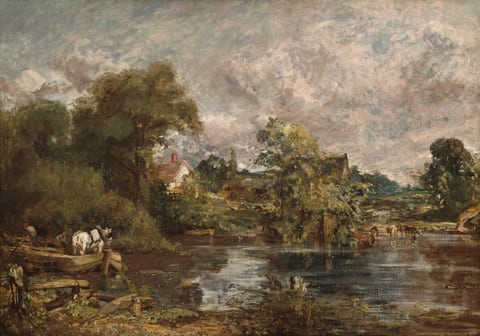
Constable painted the countryside of his native Suffolk, especially the Stour valley around his father’s mills, with an attention to weather and light new to English art. Recognition came slowly; he made full-size oil sketches for his large “six-footers”, and The White Horse won him associate membership of the Royal Academy. He made many of his cloud studies on Hampstead Heath in the early 1820s, and The Hay Wain was admired in France when shown at the Paris Salon of 1824.
Written by Ochre Editions.
Rights and the museum’s record
Public domain. The National Gallery of Art has dedicated this image to the public domain under CC0, so anyone may copy, adapt and use it, for any purpose, without asking. Our prints and files are reproductions made from the museum’s image; the museum doesn’t endorse them.
- Object number
- 1942.9.10
- Credit
- Courtesy National Gallery of Art, Washington
- Type
- Painting
- Licence
- CC0 1.0 Universal
- Museum record
- See it on the museum’s site
Report this work
More by John Constable
All their works
Close in colour