The White Horse1818-1819
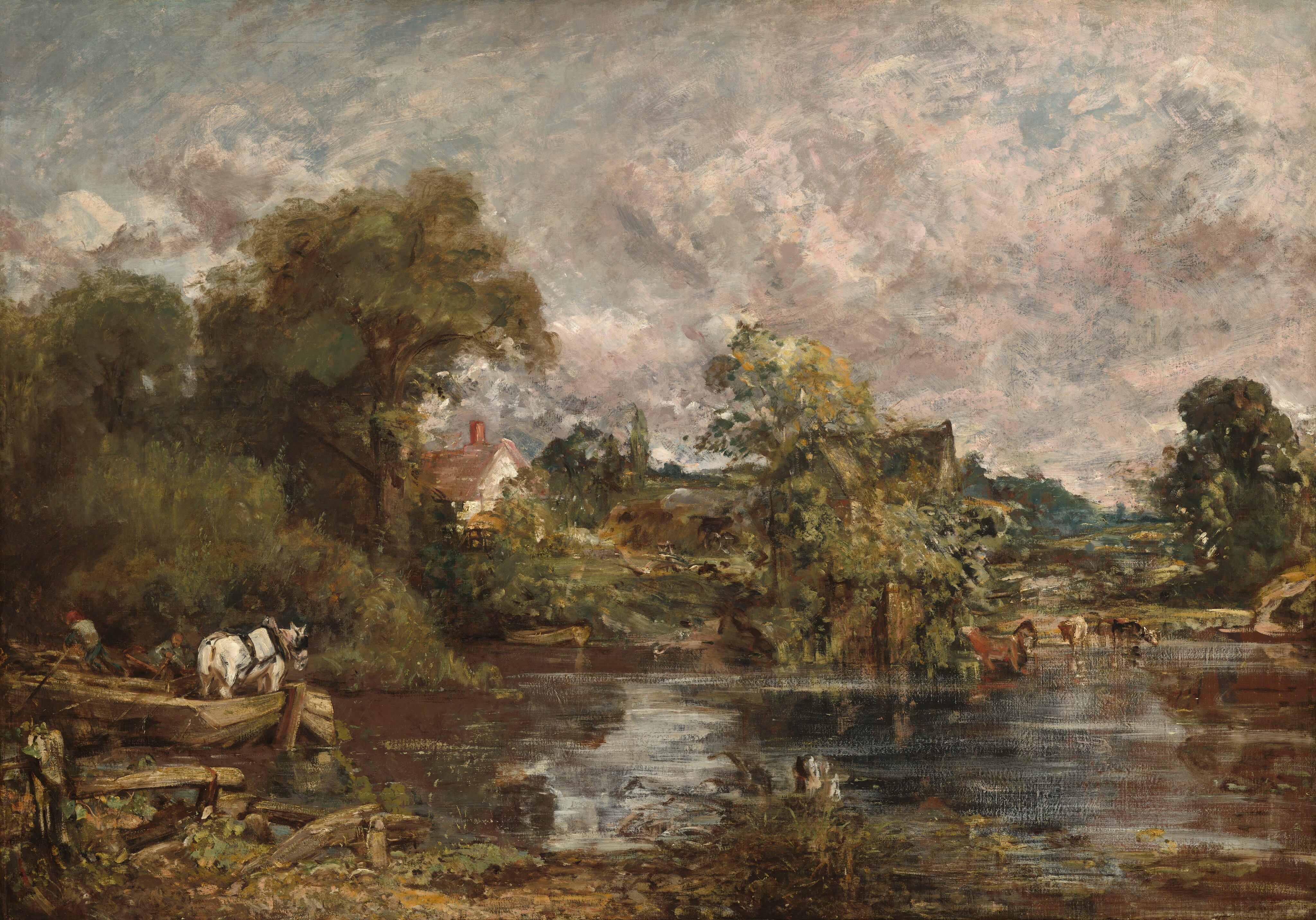
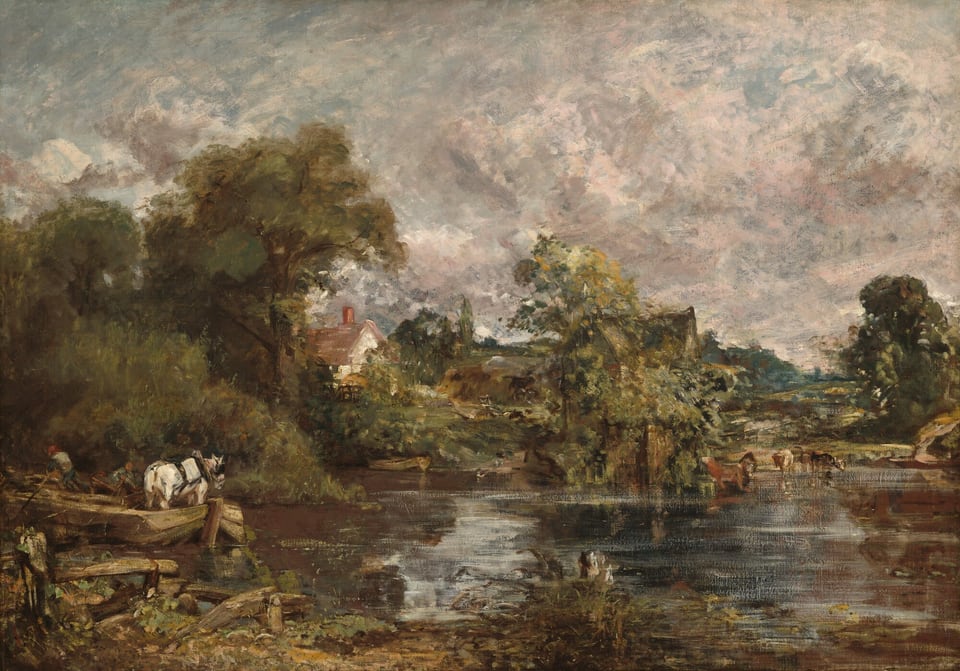
A white horse stands on a barge being poled along the River Stour by two men in red caps, while cows gather at the water’s edge and a cottage nestles among trees under a sky of rolling cloud. More about this work
About this work
A white horse stands on a barge being poled along the River Stour by two men in red caps, while cows gather at the water’s edge and a cottage nestles among trees under a sky of rolling cloud. This canvas is generally regarded as Constable’s full-size sketch for The White Horse, the first of his ‘six-footers’, large paintings of the countryside around his native East Bergholt; the finished picture was shown at the Royal Academy in 1819. Working at full scale let him test the composition and his broken, vigorous brushwork, which here leaves bare canvas glinting in the water.
Written by Ochre Editions.
What you’re looking at
From a grassy riverbank, we look across the placid surface of a river lined along the far bank with trees and farm animals in this horizontal landscape painting. The scene is painted loosely with brushstrokes visible throughout, so some details are difficult to make out. For the surface of the river, russet-brown and steel-gray paint skims lightly across the canvas and leaves some unpainted areas visible, creating the effect of light shimmering on the still water. On our left, a shallow wooden barge is propelled along the stream by two men in red caps with long poles. The boat carries a white horse wearing blinders and a harness. The riverbank beyond is lined with pale, sage-green grass tinged with gold, growing in front of a tangle of darker green trees and bushes. Across the water from us near the middle of the picture, a small rowboat sits in the shallows at the foot of a steep riverbank. Above, a white cottage with a reddish roof and chimney is tucked behind the trees, with a wooden rack full of hay next to it. Nearby, a plow and wheeled cart, highlighted with strokes of white, sit near more mounds of hay. Rocky fields reach into the distance. The vista is blocked to our right by another clump of trees and a rocky outcropping, rising from the stream, to our right of center. The steep, dark roof of a farmhouse is barely visible among the trees. Along the riverside to our right, a small group of cinnamon-brown and cream-white cows stand at water's edge. A rolling pasture stretches behind them to meet blue hills in the distance. Above, in the upper third of the painting, mottled white, pale rose, and gray clouds rolling across a steel-gray sky are reflected in the water below.
Description from the National Gallery of Art.
How it was made
- Oil paint
- Pigment ground in a drying oil, usually linseed. It dries slowly, so painters could blend on the canvas, build up thin translucent glazes, and rework a picture over weeks. Canvas replaced wooden panels in the 1500s because it is lighter and can be rolled.
John Constable
English, 1776–1837
Constable painted the countryside of his native Suffolk, especially the Stour valley around his father’s mills, with an attention to weather and light new to English art. Recognition came slowly; he made full-size oil sketches for his large “six-footers”, and The White Horse won him associate membership of the Royal Academy. He made many of his cloud studies on Hampstead Heath in the early 1820s, and The Hay Wain was admired in France when shown at the Paris Salon of 1824.
Written by Ochre Editions.
Rights and the museum’s record
Public domain. The National Gallery of Art has dedicated this image to the public domain under CC0, so anyone may copy, adapt and use it, for any purpose, without asking. Our prints and files are reproductions made from the museum’s image; the museum doesn’t endorse them.
- Object number
- 1942.9.9
- Credit
- Courtesy National Gallery of Art, Washington
- Type
- Painting
- Licence
- CC0 1.0 Universal
- Museum record
- See it on the museum’s site