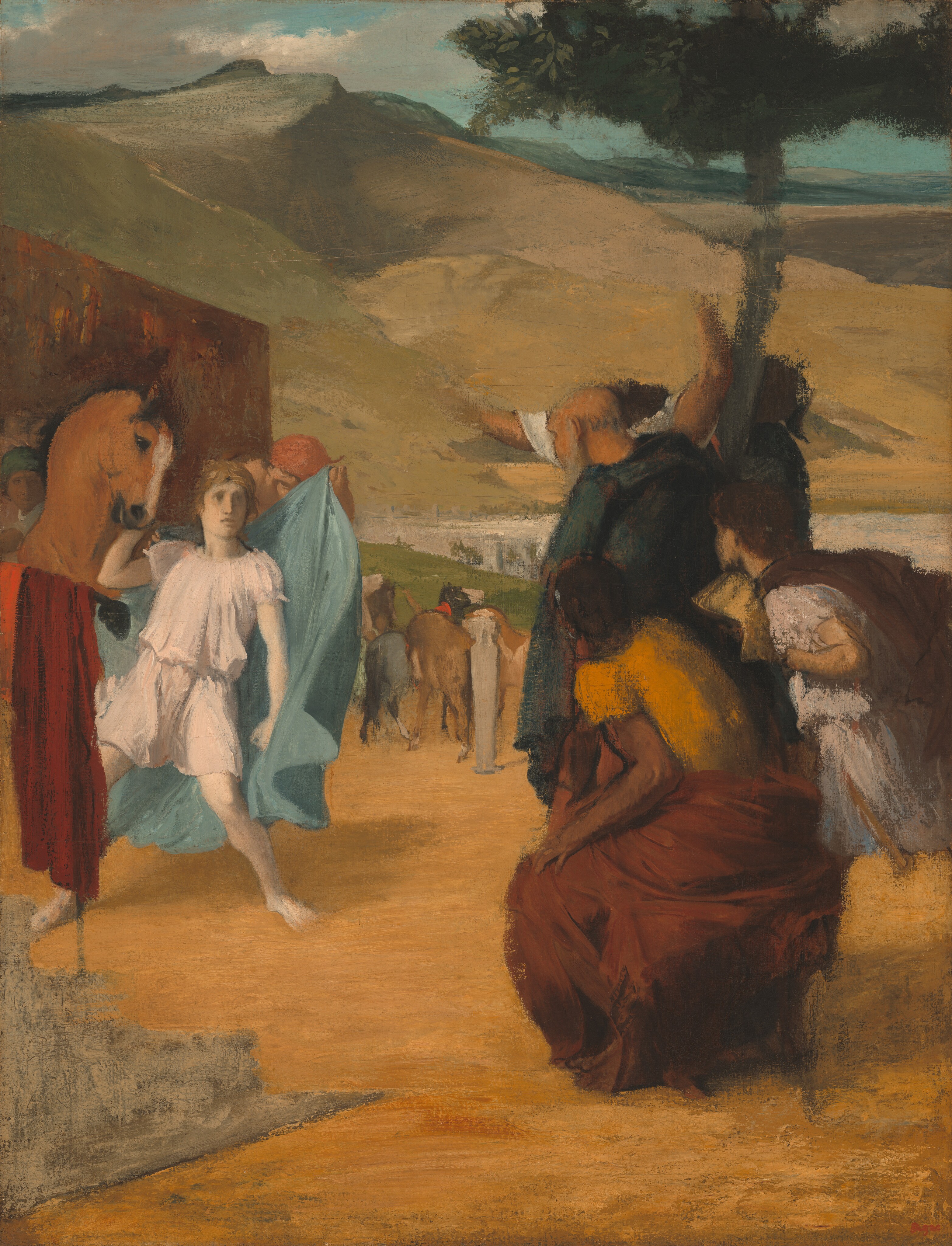
Alexander and Bucephalus1861/1862
The young Alexander raises a hand to the head of the chestnut horse Bucephalus, which no one else at the Macedonian court could master; according to Plutarch, he succeeded by turning the animal towards the sun so that it could not see its own shadow. More about this work
About this work
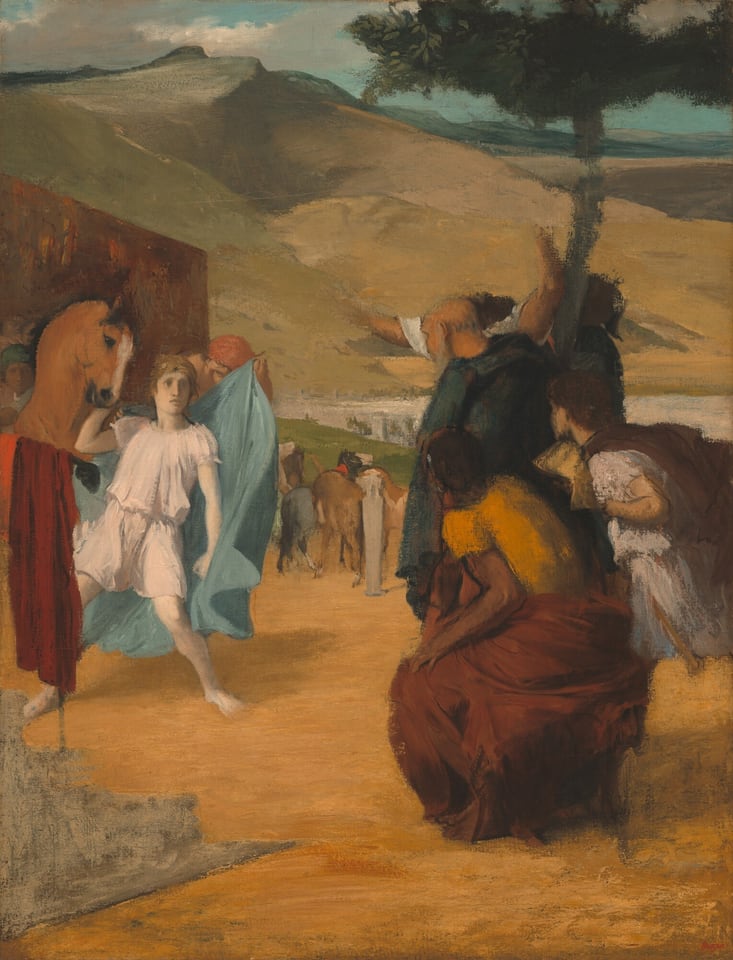
The young Alexander raises a hand to the head of the chestnut horse Bucephalus, which no one else at the Macedonian court could master; according to Plutarch, he succeeded by turning the animal towards the sun so that it could not see its own shadow. Across the way a group gathers under a tree to watch, among them a balding older man. Degas painted it in the early 1860s, when he still hoped to make his name with classical themes. Changes are visible, such as a pair of raised arms whose head has been painted out, and the loose handling hints at the modern painter to come.
Written by Ochre Editions.
What you’re looking at
Two groups of people face off in front of a hilly landscape in this loosely painted, vertical scene. On our left, a pale young man in a white tunic looks with eyes wide and lips parted at a group of three people on our right. The young man's right hand, on our left, is raised to stroke the head of a reddish-brown horse at his right shoulder. He stands with feet planted wide, knees bent, and he curls his left hand into a fist. Behind him, a man holds up a fluttering, light blue cape. A mottled red wall forms a backdrop to this scene on our left. The tight group gathered under a tree on our right stares back at the young man. The trio is made up of a balding, older man, a light-skinned boy also wearing a white tunic, and, closest to us, a brown-skinned woman wearing a marigold-orange shirt and a maroon-red skirt. Behind this group, a pair of pale raised arms suggests a fourth person, but the head is missing or has been painted over. The ground under the people is saffron orange. In the center of the picture, beyond the people, a group of horses stands near a green bank by a river, its surface reflecting white. The far bank is lined with white buildings. Tan and olive-green slopes rise from the opposite riverbank under a pale blue sky with cream-white clouds sweeping along the top edge of the composition. The artist signed his name in red paint in the lower right corner: “Degas.”
Description from the National Gallery of Art.
How it was made
- Oil paint
- Pigment ground in a drying oil, usually linseed. It dries slowly, so painters could blend on the canvas, build up thin translucent glazes, and rework a picture over weeks. Canvas replaced wooden panels in the 1500s because it is lighter and can be rolled.
Edgar Degas
French, 1834–1917 · Born and died in Paris.
Degas trained in the academic tradition, admired Ingres and spent three years in Italy copying earlier art, but turned to modern Paris for his subjects: dancers, racecourses, laundresses, milliners and café singers. He helped organise the Impressionist exhibitions and showed in all but one, yet preferred to call himself a realist. Working from drawing and memory rather than outdoors, he composed with unexpected cropping and viewpoints, and in later years worked mostly in pastel as his eyesight failed.
Written by Ochre Editions.
Impressionism
Painters in 1870s Paris who worked quickly, often outdoors, to catch light as it changed.
Rights and the museum’s record
Public domain. The National Gallery of Art has dedicated this image to the public domain under CC0, so anyone may copy, adapt and use it, for any purpose, without asking. Our prints and files are reproductions made from the museum’s image; the museum doesn’t endorse them.
- Object number
- 1997.57.1
- Credit
- Courtesy National Gallery of Art, Washington
- Type
- Painting
- Licence
- CC0 1.0 Universal
- Museum record
- See it on the museum’s site
Report this work
More by Edgar Degas
All their works