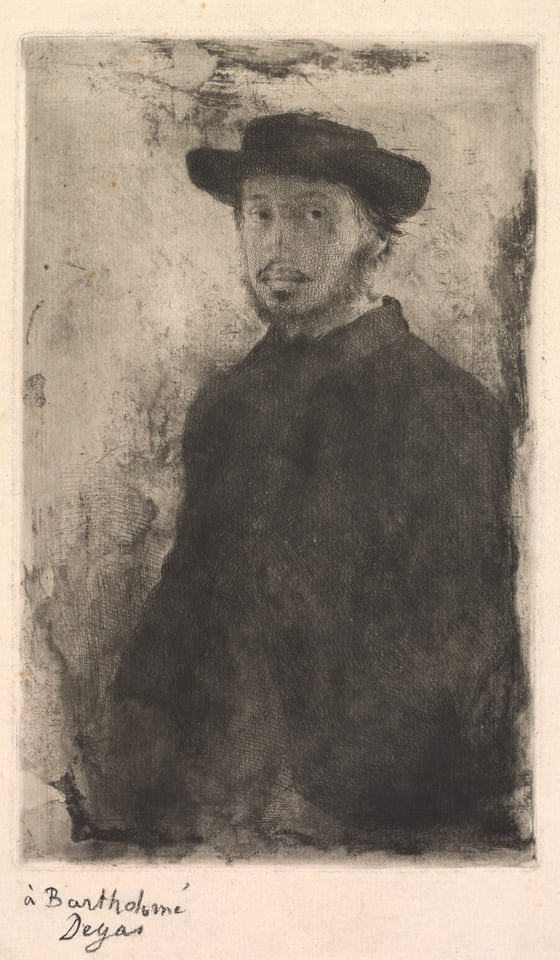
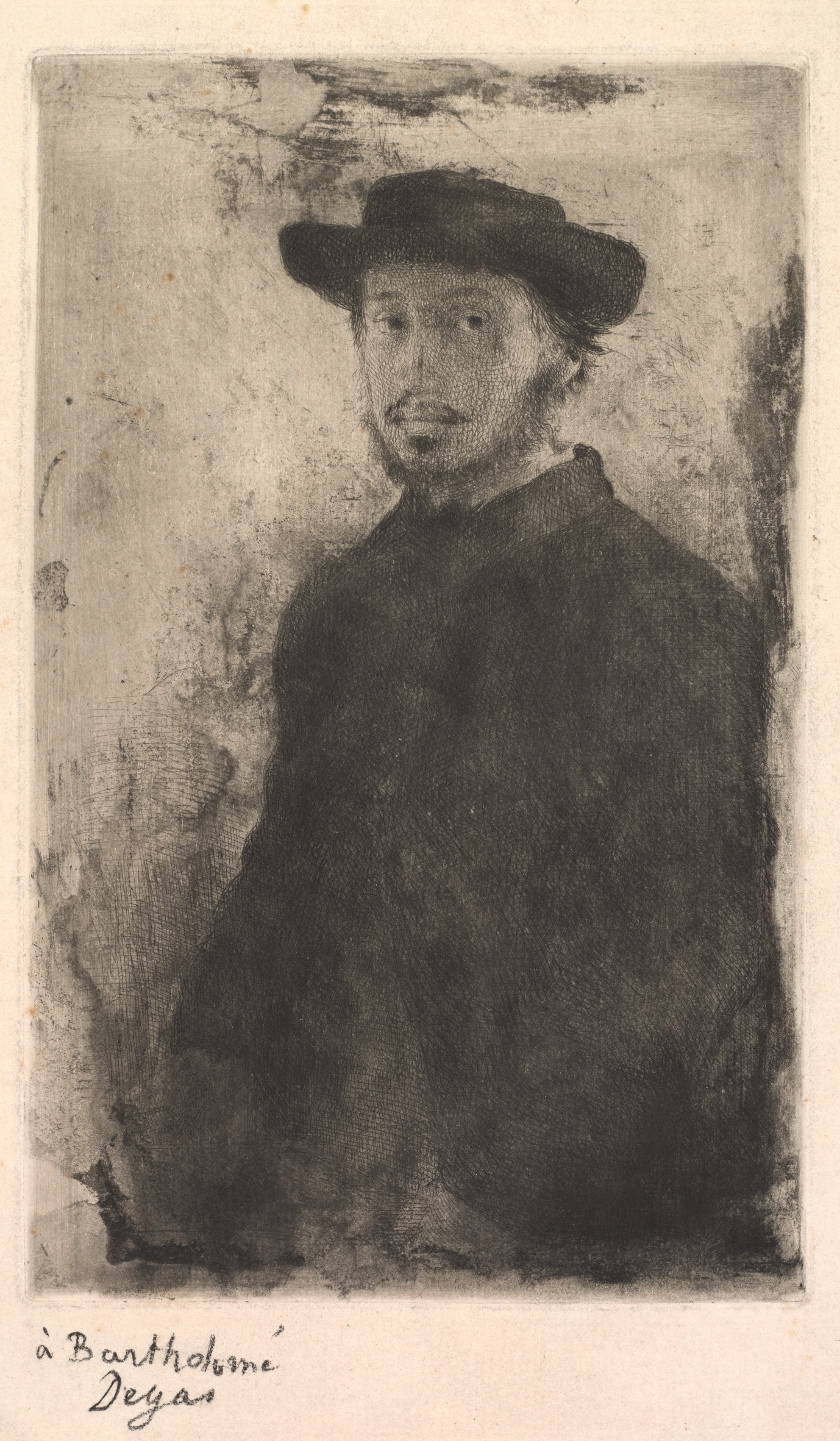
Self-Portrait1857
In the 1850s Degas frequently used himself as a model, but he made only one printed self-portrait. More about this work
About this work
In the 1850s Degas frequently used himself as a model, but he made only one printed self-portrait. Through successive stages of biting the plate and layers of crosshatching, Degas gradually built areas of dark tone. In this impression, Degas added etched lines on the face, hat, and coat and carefully wiped his copper plate to create atmospheric effects. His clearly drawn eyes directly engage the viewer, resulting in a psychologically powerful and intense portrait of the young artist at age 23. This impression was dedicated to his friend, the painter and sculptor Paul Albert Bartholomé.
Text from the Cleveland Museum of Art.
How it was made
- Drypoint
- Lines scratched straight into the plate with a needle throw up a ridge of metal, the burr, which holds ink and prints a soft, furred line. The burr wears down, so early impressions are the richest.
- Etching
- The artist draws with a needle through a waxy coating on a copper plate, and acid bites the exposed lines. The plate is then inked, wiped and printed under pressure, so the line keeps the freedom of drawing.
Edgar Degas
French, 1834–1917 · Born and died in Paris.
Degas trained in the academic tradition, admired Ingres and spent three years in Italy copying earlier art, but turned to modern Paris for his subjects: dancers, racecourses, laundresses, milliners and café singers. He helped organise the Impressionist exhibitions and showed in all but one, yet preferred to call himself a realist. Working from drawing and memory rather than outdoors, he composed with unexpected cropping and viewpoints, and in later years worked mostly in pastel as his eyesight failed.
Written by Ochre Editions.
Impressionism
Painters in 1870s Paris who worked quickly, often outdoors, to catch light as it changed.
Rights and the museum’s record
Public domain. The Cleveland Museum of Art has dedicated this image to the public domain under CC0, so anyone may copy, adapt and use it, for any purpose, without asking. Our prints and files are reproductions made from the museum’s image; the museum doesn’t endorse them.
- Object number
- 2004.87
- Credit
- Courtesy of the Cleveland Museum of Art
- Type
- Department
- Prints
- Licence
- CC0 1.0 Universal
- Museum record
- See it on the museum’s site
Report this work
More by Edgar Degas
All their works
Close in colour