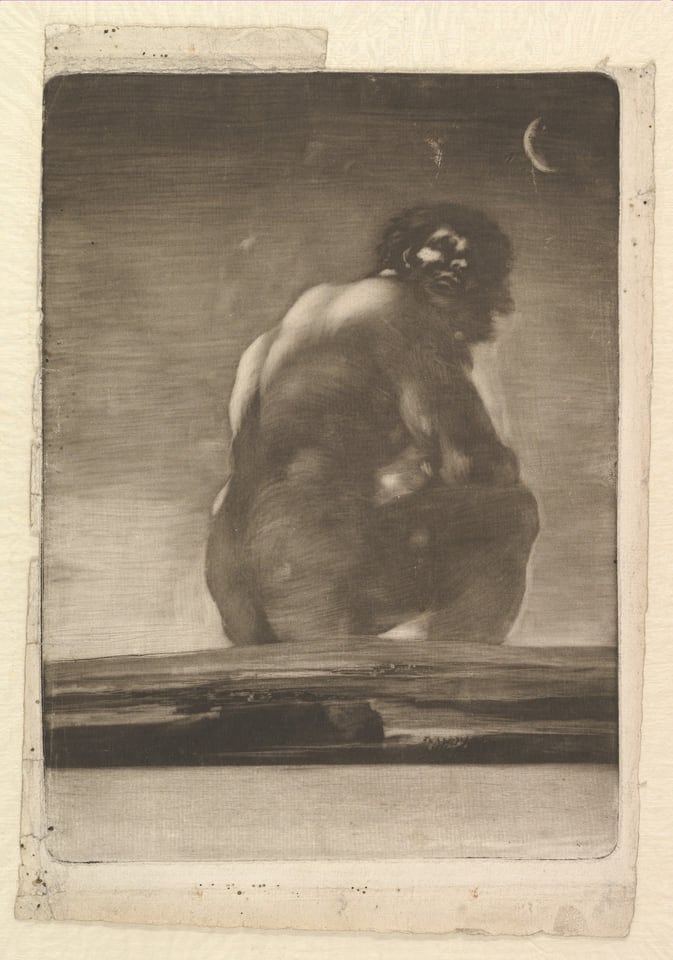
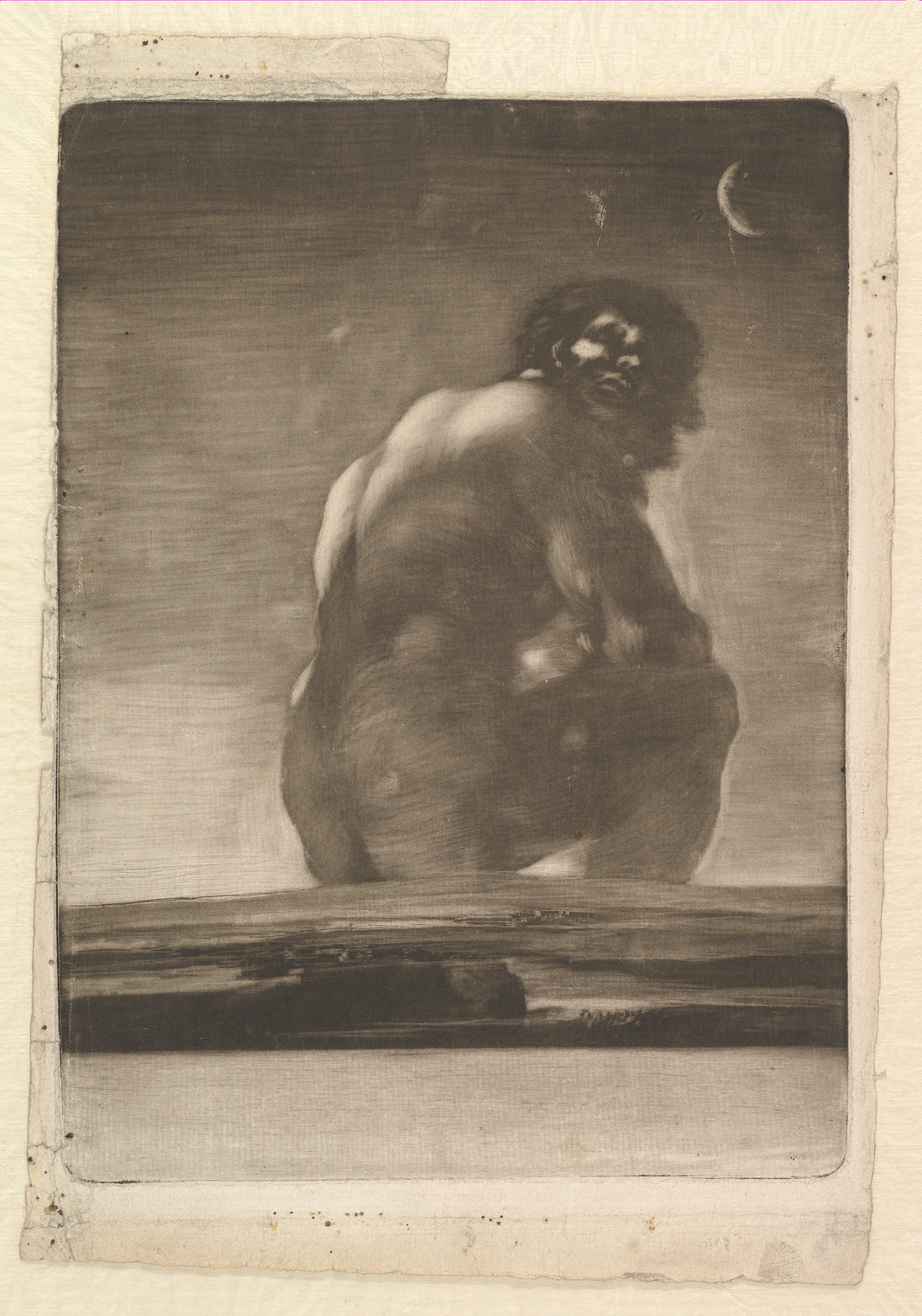
Seated Giantby 1818 (possibly 1814–18)
A colossal nude figure sits on the edge of the world, turning to look back over his shoulder, while a tiny landscape lies at his feet. More about this work
About this work
A colossal nude figure sits on the edge of the world, turning to look back over his shoulder, while a tiny landscape lies at his feet. Goya created the image in burnished aquatint, scraping and polishing light out of a dark tonal ground so that the giant seems to emerge from the night. Only a handful of impressions are known, and its meaning remains open: it has been read as an image of war, of fate or of Spain itself in the troubled years after the Napoleonic invasion.
Written by Ochre Editions.
How it was made
- Aquatint
- Resin dust is fused to the plate and bitten with acid, so the plate prints areas of tone, like a wash, rather than lines.
Francisco Goya
Spanish, 1746–1828 · Born in Fuendetodos; died in Bordeaux.
Goya began with tapestry designs for the royal factory in Madrid and rose to become first painter to the Spanish court under Charles IV. After a serious illness left him deaf in the 1790s, his work grew darker and more personal. His etched series, Los Caprichos and The Disasters of War, satirise folly and record the atrocities of the Peninsular War, and he painted the Black Paintings directly on the walls of his own house. He spent his last years in exile in Bordeaux.
Written by Ochre Editions.
Rights and the museum’s record
Public domain. The Met has dedicated this image to the public domain under CC0, so anyone may copy, adapt and use it, for any purpose, without asking. Our prints and files are reproductions made from the museum’s image; the museum doesn’t endorse them.
- Object number
- 35.42
- Credit
- Courtesy of The Metropolitan Museum of Art
- Type
- Prints
- Department
- Drawings and Prints
- Licence
- CC0 1.0 Universal
- Museum record
- See it on the museum’s site
Report this work
More by Francisco Goya
All their works
Close in colour