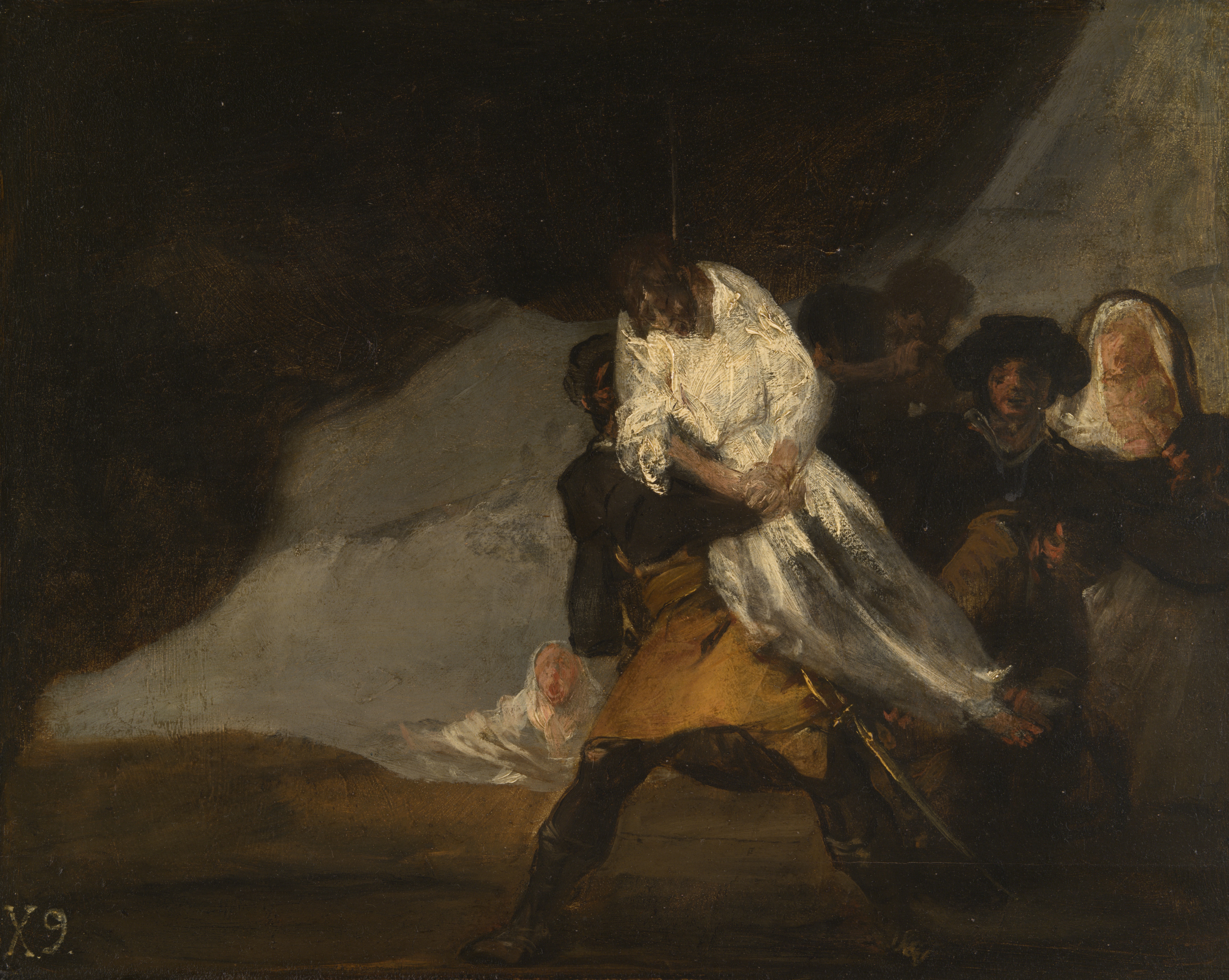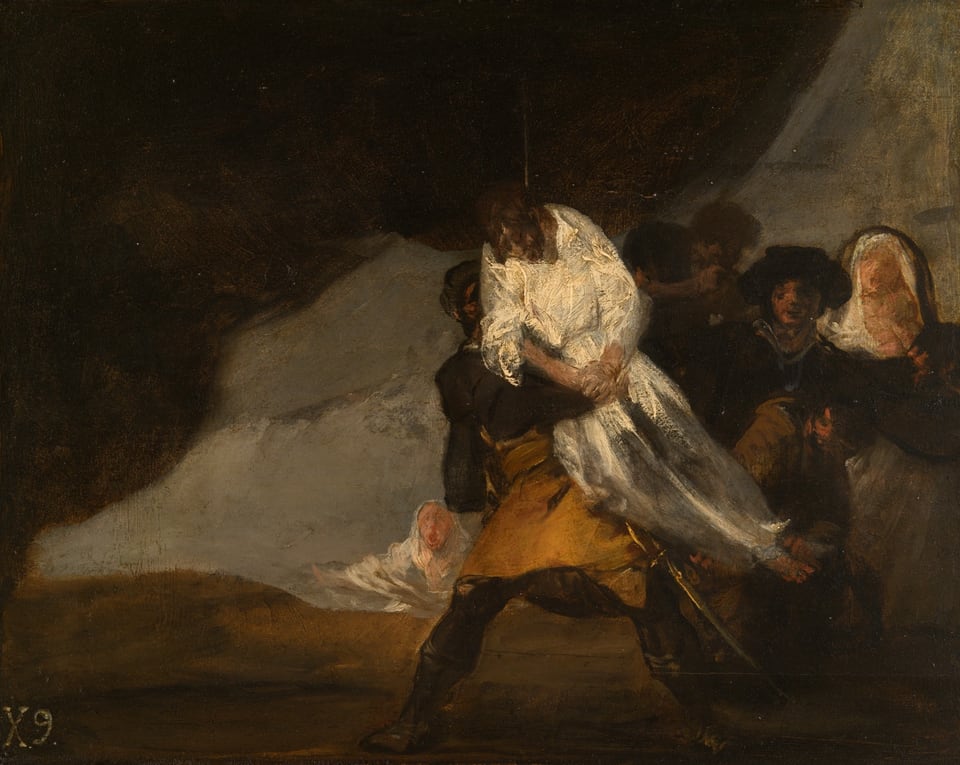
The Hanged Monkc. 1810
A monk hangs lifeless in a desolate mountain setting in this small panel, painted around 1810, when the Peninsular War was tearing Spain apart. More about this work
About this work
A monk hangs lifeless in a desolate mountain setting in this small panel, painted around 1810, when the Peninsular War was tearing Spain apart. In these years Goya made a number of small pictures for himself, alongside the etchings later published as The Disasters of War, recording cruelty committed by all sides. Free of any commission, he could paint with brutal directness, in rapid, sketchy strokes that leave the scene unexplained and all the more disturbing.
Written by Ochre Editions.
What you’re looking at
A work made of oil on panel.
Description from the Art Institute of Chicago.
How it was made
- Oil on panel
- Oil paint on prepared wooden boards, usually oak in the north and poplar in Italy. The rigid, smooth surface suits fine detail and thin, glowing glazes.
- Oil paint
- Pigment ground in a drying oil, usually linseed. It dries slowly, so painters could blend on the canvas, build up thin translucent glazes, and rework a picture over weeks. Canvas replaced wooden panels in the 1500s because it is lighter and can be rolled.
Francisco Goya
Spanish, 1746–1828 · Born in Fuendetodos; died in Bordeaux.
Goya began with tapestry designs for the royal factory in Madrid and rose to become first painter to the Spanish court under Charles IV. After a serious illness left him deaf in the 1790s, his work grew darker and more personal. His etched series, Los Caprichos and The Disasters of War, satirise folly and record the atrocities of the Peninsular War, and he painted the Black Paintings directly on the walls of his own house. He spent his last years in exile in Bordeaux.
Written by Ochre Editions.
Rights and the museum’s record
Public domain. The Art Institute of Chicago has dedicated this image to the public domain under CC0, so anyone may copy, adapt and use it, for any purpose, without asking. Our prints and files are reproductions made from the museum’s image; the museum doesn’t endorse them.
- Object number
- 1936.225
- Credit
- Courtesy of the Art Institute of Chicago
- Type
- Painting
- Department
- Painting and Sculpture of Europe
- Licence
- CC0 1.0 Universal
- Museum record
- See it on the museum’s site
Report this work
More by Francisco Goya
All their works