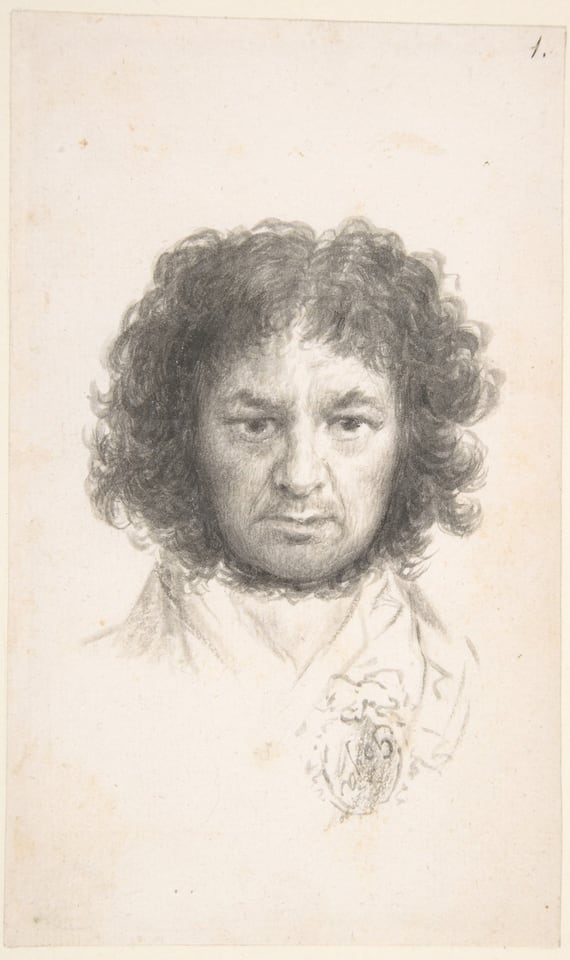
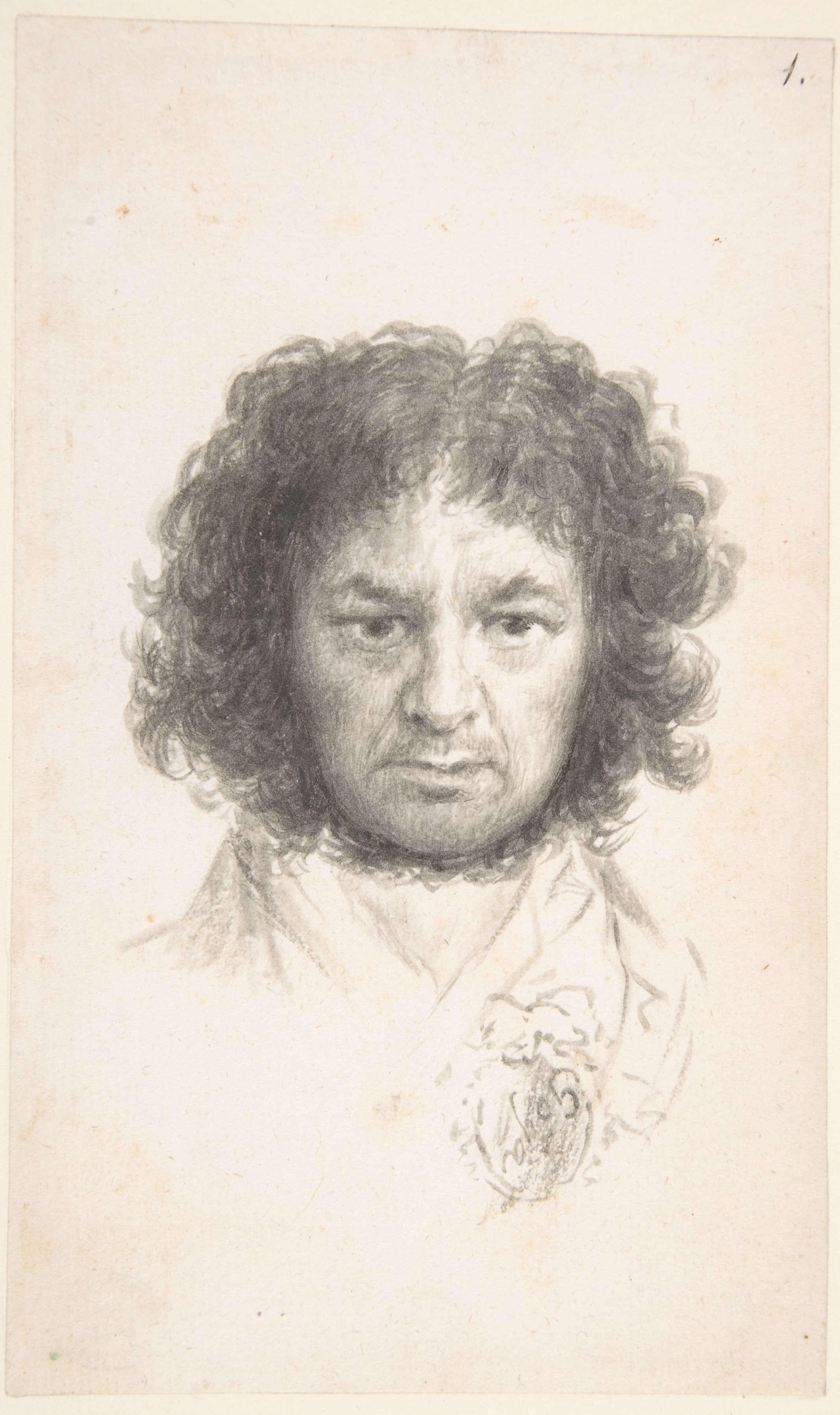
Self-Portraitca. 1796
Goya portrays himself in carbon black ink, drawing with the point of the brush as well as broader strokes, around 1796, a few years after a serious illness left him profoundly deaf. More about this work
About this work
Goya portrays himself in carbon black ink, drawing with the point of the brush as well as broader strokes, around 1796, a few years after a serious illness left him profoundly deaf. He models the face with remarkable economy, letting the white of the paper do much of the work. The frank, searching self-scrutiny anticipates the private albums of drawings he would keep for the rest of his life.
Written by Ochre Editions.
Francisco Goya
Spanish, 1746–1828 · Born in Fuendetodos; died in Bordeaux.
Goya began with tapestry designs for the royal factory in Madrid and rose to become first painter to the Spanish court under Charles IV. After a serious illness left him deaf in the 1790s, his work grew darker and more personal. His etched series, Los Caprichos and The Disasters of War, satirise folly and record the atrocities of the Peninsular War, and he painted the Black Paintings directly on the walls of his own house. He spent his last years in exile in Bordeaux.
Written by Ochre Editions.
Rights and the museum’s record
Public domain. The Met has dedicated this image to the public domain under CC0, so anyone may copy, adapt and use it, for any purpose, without asking. Our prints and files are reproductions made from the museum’s image; the museum doesn’t endorse them.
- Object number
- 35.103.1
- Credit
- Courtesy of The Metropolitan Museum of Art
- Type
- Drawings
- Department
- Drawings and Prints
- Licence
- CC0 1.0 Universal
- Museum record
- See it on the museum’s site
Report this work
More by Francisco Goya
All their works
Close in colour