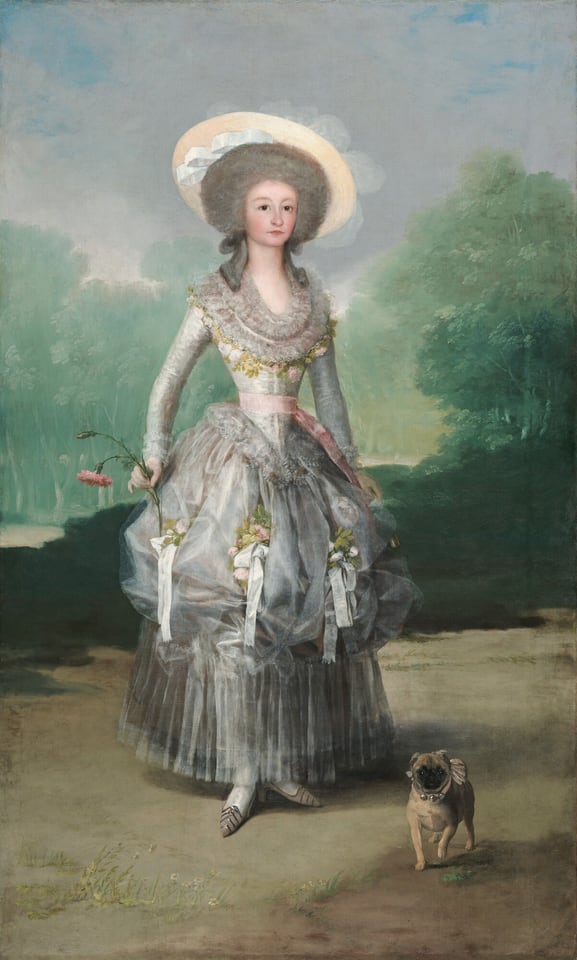
The Marquesa de Pontejosc. 1786
The Marquesa de Pontejos stands in a parklike landscape in a silvery-grey gown puffed and festooned with pink roses and ribbons, a straw hat tilted on her powdered hair, a carnation in one hand and a closed fan in the other. More about this work
About this work
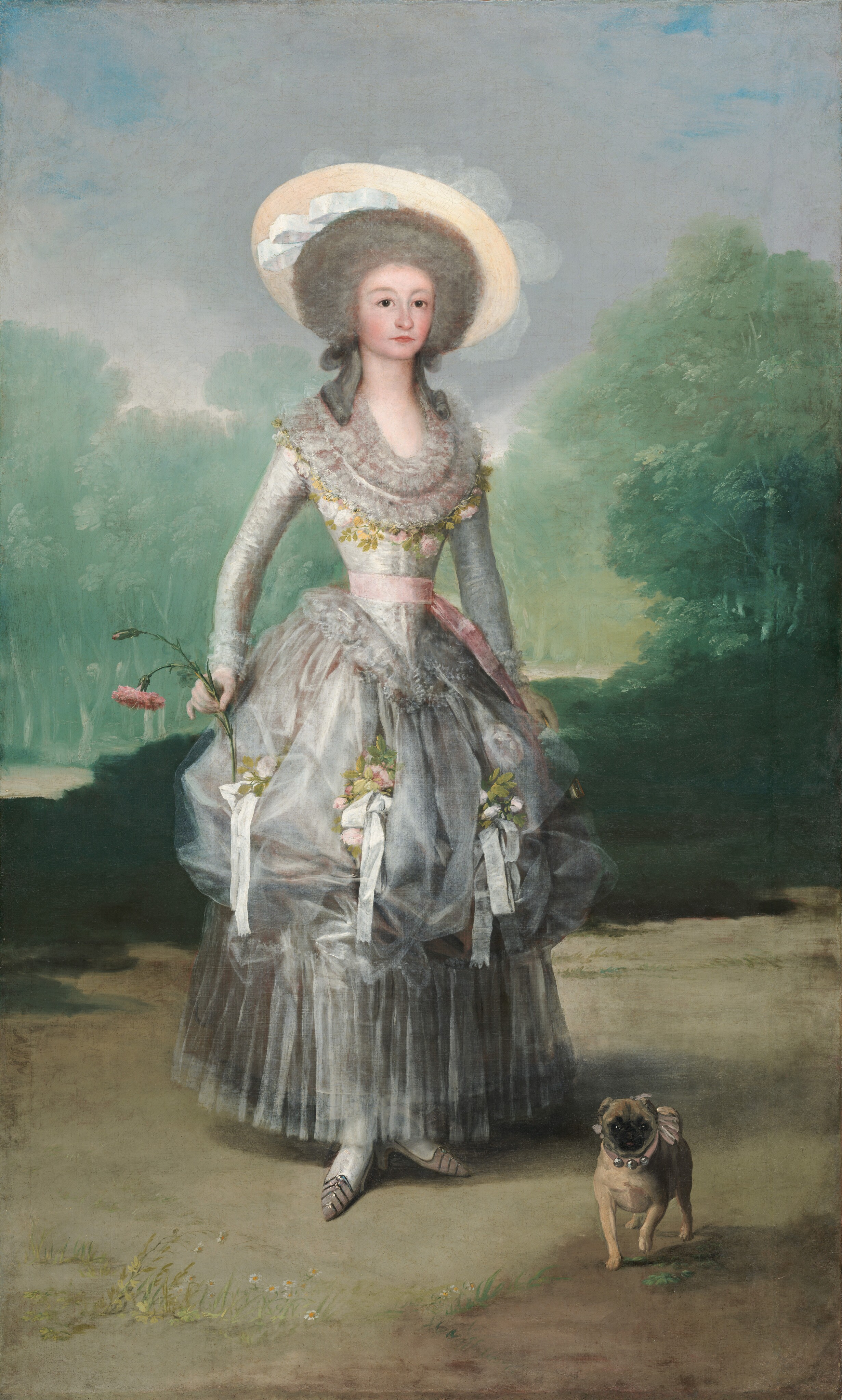
The Marquesa de Pontejos stands in a parklike landscape in a silvery-grey gown puffed and festooned with pink roses and ribbons, a straw hat tilted on her powdered hair, a carnation in one hand and a closed fan in the other. A pug in a pink collar with bells stands at her feet. Goya painted her in the fashionable pastoral manner then popular in France and England, and the delicate, feathery brushwork of the lace and gauze shows his growing assurance as a portraitist. The carnation was traditionally associated with love and betrothal.
Written by Ochre Editions.
What you’re looking at
A woman with pale skin, wearing a silvery-gray dress adorned with white ribbons and light pink roses, stands looking out at us with a small, pug dog by her feet in this vertical portrait painting. The woman’s body is angled slightly to our right but she looks at us with dark eyes under faint, arched brows. Her nose is rounded, her cheeks smooth and flushed, and her pale pink lips are closed. Her face is framed in a cloud of nickel-gray hair, and tendrils curl down over her shoulders. She wears a wide-brimmed straw hat with a white ribbon set on the back of her head and slightly off to one side. The bodice of her dress has a low, curving neck. This area is loosely painted to create the impression of layers of lace. A band of intertwined pale pink roses and delicate green leaves borders the outer edge of the lace. The dress has long, tight sleeves with lace at the cuffs and the notably narrow waist is tied with a blush-pink ribbon. The full, silver skirt is picked up to create a row of puffs, like the top of a muffin, around her knees. Bunches of pink roses and white ribbons are nestled into the puffs, and below, the skirt falls in long, vertical pleats to her ankles. She wears white stockings and pointed, petal-pink shoes. In her left arm, on our right, she holds a closed fan loosely at her side, almost lost behind the skirt. She holds a pink carnation with a full bloom and a bud on a long, curving stem in her other hand, by her hip. A caramel-brown pug with a black face, wearing a pink collar lined with three bells, stands facing us with one front paw lifted, to our right of the woman's feet. The landscape is painted in tones of mint and sage green for grass beneath trees enclosing the space the woman stands in, sand brown for the ground, and icy blue for the sky above.
Description from the National Gallery of Art.
How it was made
- Oil paint
- Pigment ground in a drying oil, usually linseed. It dries slowly, so painters could blend on the canvas, build up thin translucent glazes, and rework a picture over weeks. Canvas replaced wooden panels in the 1500s because it is lighter and can be rolled.
Francisco Goya
Spanish, 1746–1828 · Born in Fuendetodos; died in Bordeaux.
Goya began with tapestry designs for the royal factory in Madrid and rose to become first painter to the Spanish court under Charles IV. After a serious illness left him deaf in the 1790s, his work grew darker and more personal. His etched series, Los Caprichos and The Disasters of War, satirise folly and record the atrocities of the Peninsular War, and he painted the Black Paintings directly on the walls of his own house. He spent his last years in exile in Bordeaux.
Written by Ochre Editions.
Rights and the museum’s record
Public domain. The National Gallery of Art has dedicated this image to the public domain under CC0, so anyone may copy, adapt and use it, for any purpose, without asking. Our prints and files are reproductions made from the museum’s image; the museum doesn’t endorse them.
- Object number
- 1937.1.85
- Credit
- Courtesy National Gallery of Art, Washington
- Type
- Painting
- Licence
- CC0 1.0 Universal
- Museum record
- See it on the museum’s site
Report this work
More by Francisco Goya
All their works
Close in colour