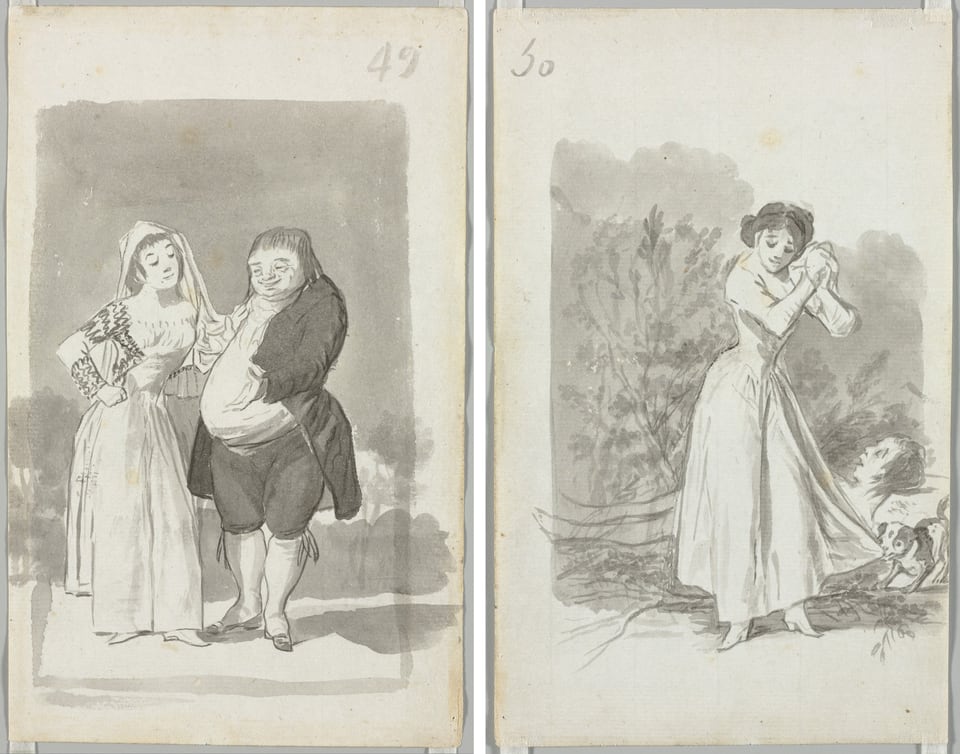
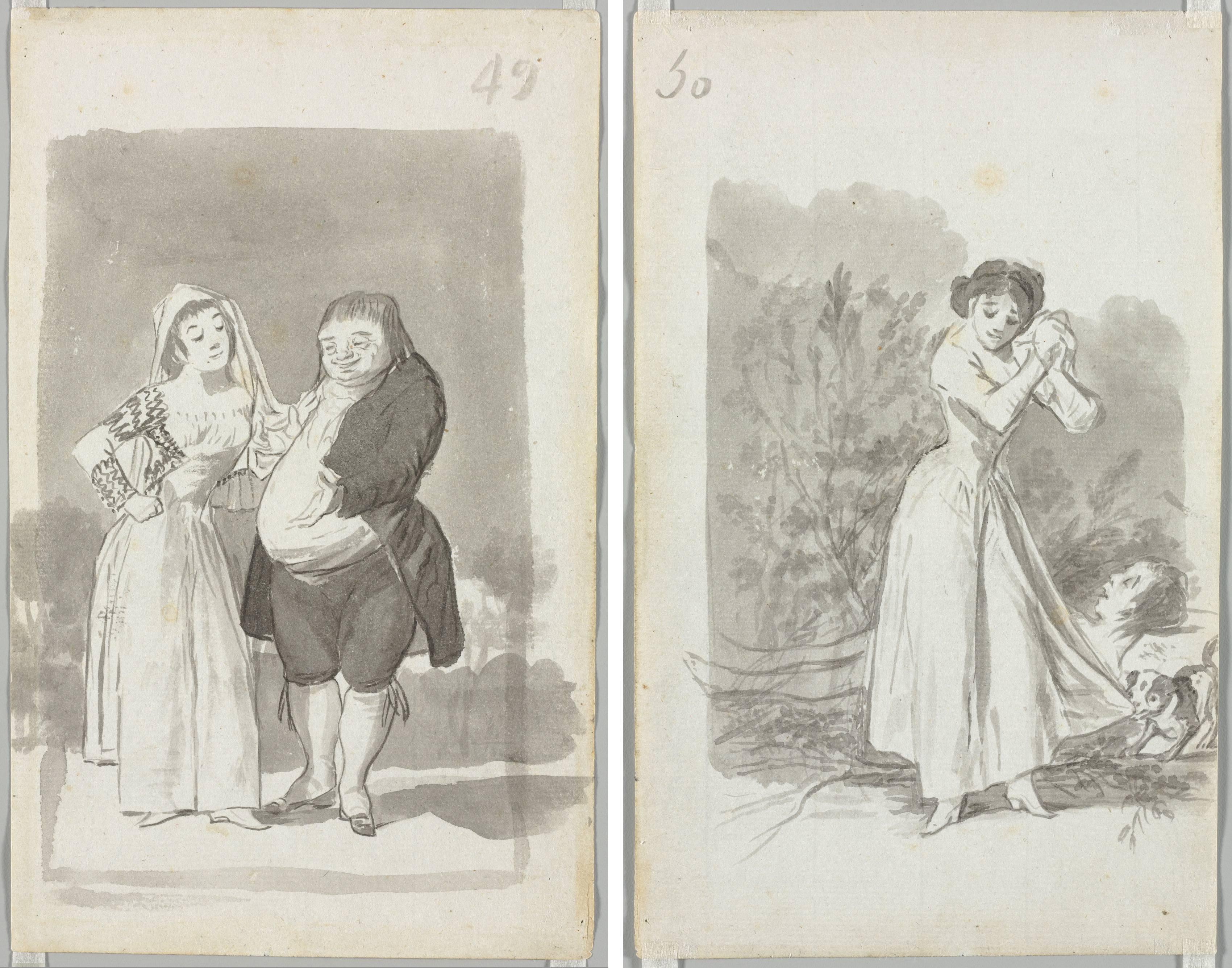
Young Woman (possibly a Sex Worker) with a Man (recto); Young Woman Wringing Her Hands over a Man's Naked Body (verso)1796–97
Among the great figures of the pictorial arts in the West, Francisco de Goya is one of the very few whose work as a graphic artist is arguably even more important than his paintings. More about this work
About this work
Among the great figures of the pictorial arts in the West, Francisco de Goya is one of the very few whose work as a graphic artist is arguably even more important than his paintings. Alongside a prodigious output of prints, he created eight sketchbooks of drawings over the course of 30 years. This double-sided sheet comes from the so-called Album B, or Madrid Album, which, like all of them, was scattered throughout the world in public and private collections after his death. The drawings reveal Goya’s powers of invention and observation, and his biting satire. On the recto side of the sheet, a vulgar encounter between a prostitute and a pot-bellied lecher reveals the bluntness of the Goya’s social criticism. The verso drawing is less easily pinned down, though it follows traditional iconography for representations of Saint Margaret of Cortona, a nobleman’s mistress who repented and entered a convent after her lover’s dog led her to his murdered corpse.
Text from the Cleveland Museum of Art.
How it was made
- Laid paper
- Handmade on a mould of close-set wires, which leave fine parallel lines you can see when the sheet is held to the light.
Francisco Goya
Spanish, 1746–1828 · Born in Fuendetodos; died in Bordeaux.
Goya began with tapestry designs for the royal factory in Madrid and rose to become first painter to the Spanish court under Charles IV. After a serious illness left him deaf in the 1790s, his work grew darker and more personal. His etched series, Los Caprichos and The Disasters of War, satirise folly and record the atrocities of the Peninsular War, and he painted the Black Paintings directly on the walls of his own house. He spent his last years in exile in Bordeaux.
Written by Ochre Editions.
Rights and the museum’s record
Public domain. The Cleveland Museum of Art has dedicated this image to the public domain under CC0, so anyone may copy, adapt and use it, for any purpose, without asking. Our prints and files are reproductions made from the museum’s image; the museum doesn’t endorse them.
- Object number
- 1995.15
- Credit
- Courtesy of the Cleveland Museum of Art
- Type
- Drawing
- Department
- Drawings
- Licence
- CC0 1.0 Universal
- Museum record
- See it on the museum’s site
Report this work
More by Francisco Goya
All their works
Close in colour