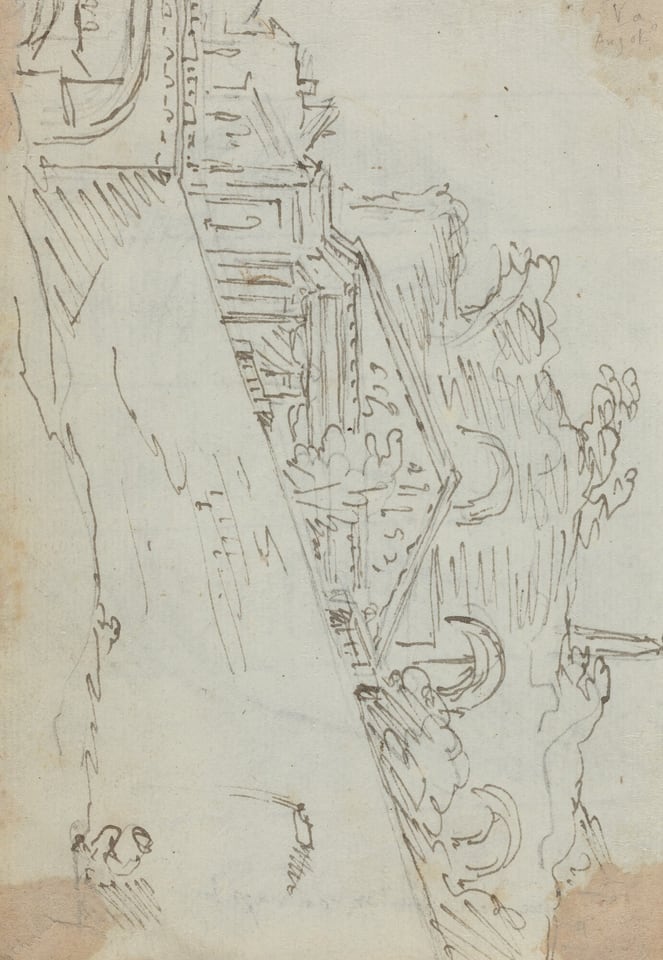
Ancient Ruins on the Bank of the Tiber1752/1756
Augustin Pajou drew this in 1752/1756, aged about 22. It is now at the National Gallery of Art in Washington, DC. More about this work
About this work
The image shows a sketch of an architectural scene with structures lining a road or pathway. The horizon is not clearly defined, and the sketch focuses on architectural details. The drawing features loose, freehand lines outlining buildings and trees, with classical elements like columns and entablatures. The color palette is monochromatic, with light parchment and dark ink strokes creating contrast. Close-up details are lightly shaded for depth, while distant details are less defined. The composition is open and airy, emphasizing architectural features over precision.
Description from the National Gallery of Art.
Augustin Pajou drew this in 1752/1756, aged about 22. It is now at the National Gallery of Art in Washington, DC.
How it was made
- Chalk
- Natural black, red and white chalks. Used together on toned paper they could give the warmth of flesh with very little effort, and they were favourites for studies from life.
- Pen and ink
- Drawn with a quill or reed pen, often with wash added by brush to model light and shadow.
- Laid paper
- Handmade on a mould of close-set wires, which leave fine parallel lines you can see when the sheet is held to the light.
Rights and the museum’s record
Public domain. The National Gallery of Art has dedicated this image to the public domain under CC0, so anyone may copy, adapt and use it, for any purpose, without asking. Our prints and files are reproductions made from the museum’s image; the museum doesn’t endorse them.
- Object number
- 1999.75.5.b
- Credit
- Courtesy National Gallery of Art, Washington
- Type
- Drawing
- Licence
- CC0 1.0 Universal
- Museum record
- See it on the museum’s site
Report this work
More by Augustin Pajou
All their works
Close in colour