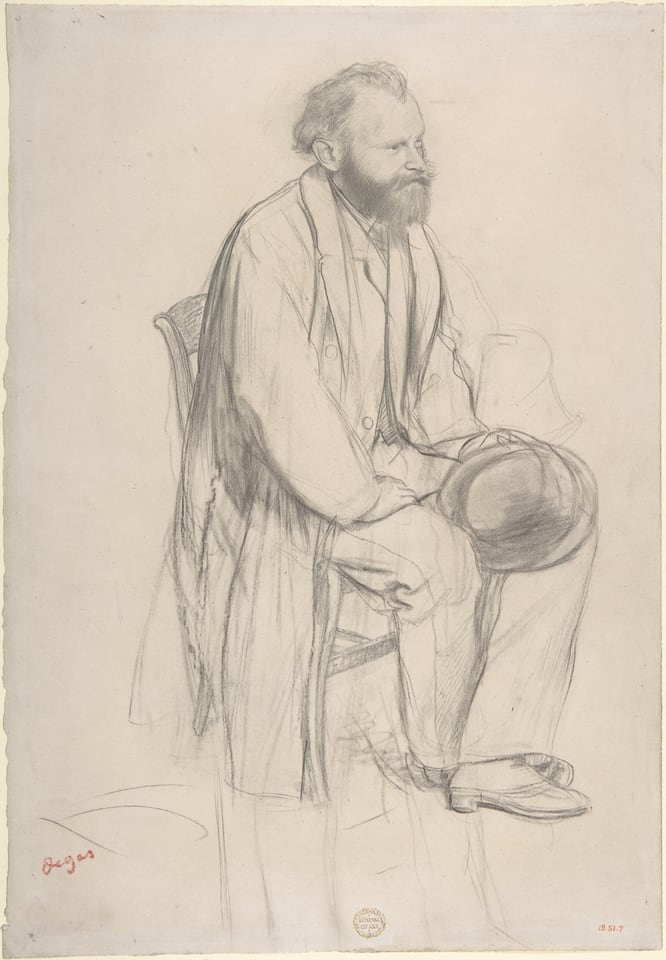
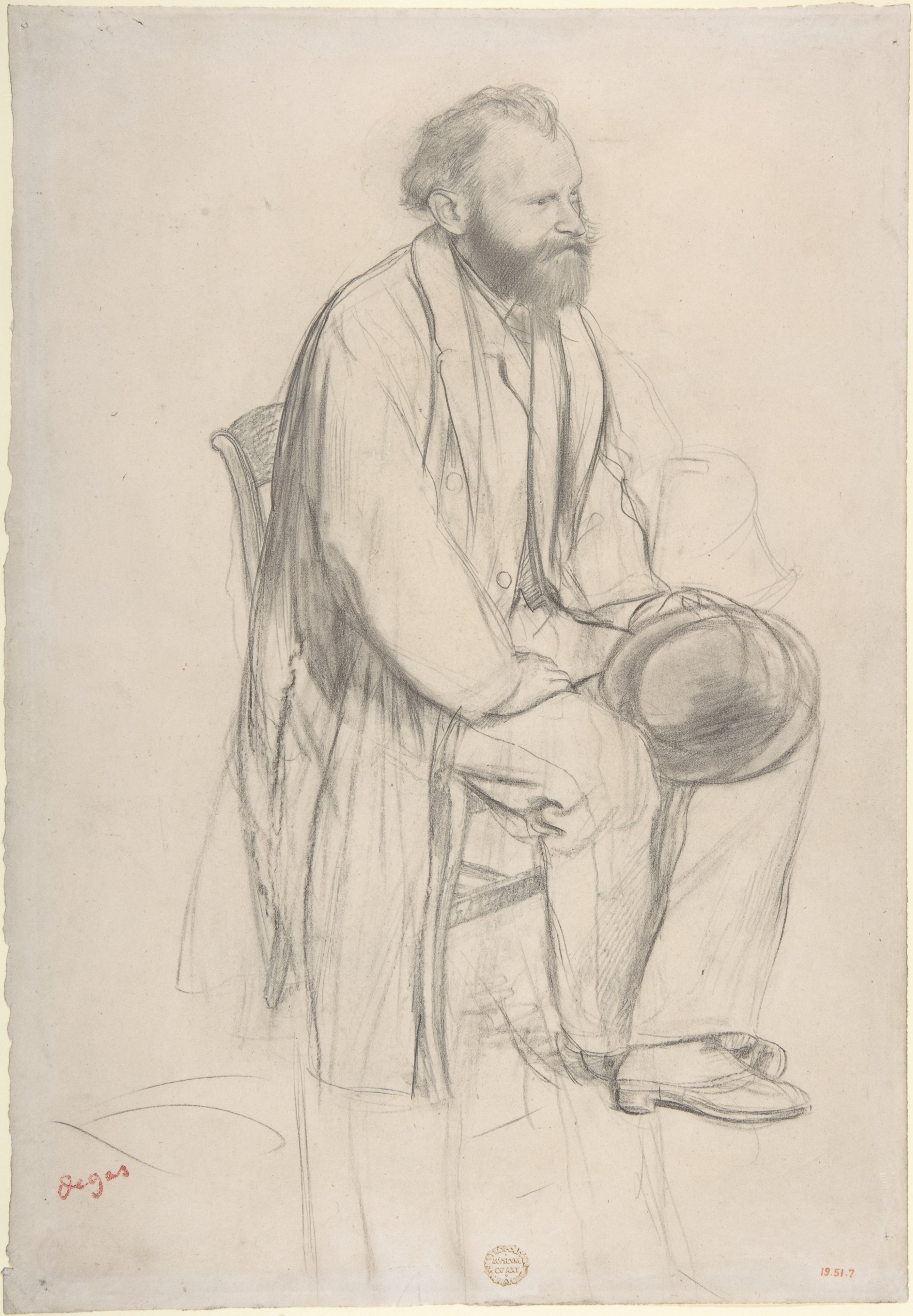
Édouard Manet, Seated, Holding His Hatca. 1868
Édouard Manet sits with his hat in his hand, caught by his friend and rival Edgar Degas in a few sure lines of graphite and black chalk. More about this work
About this work
Édouard Manet sits with his hat in his hand, caught by his friend and rival Edgar Degas in a few sure lines of graphite and black chalk. The two painters met in the early 1860s, reputedly while Degas was copying in the Louvre, and Degas drew and etched Manet several times later in that decade. The informal pose, as if the sitter had just arrived or was about to leave, is typical of Degas’s interest in passing, unguarded moments.
Written by Ochre Editions.
How it was made
- Chalk
- Natural black, red and white chalks. Used together on toned paper they could give the warmth of flesh with very little effort, and they were favourites for studies from life.
- Graphite
- Pencil. Graphite has been used for drawing since the 1500s; in 1795 Nicolas-Jacques Conté mixed it with clay, so its hardness could be graded.
Edgar Degas
French, 1834–1917 · Born and died in Paris.
Degas trained in the academic tradition, admired Ingres and spent three years in Italy copying earlier art, but turned to modern Paris for his subjects: dancers, racecourses, laundresses, milliners and café singers. He helped organise the Impressionist exhibitions and showed in all but one, yet preferred to call himself a realist. Working from drawing and memory rather than outdoors, he composed with unexpected cropping and viewpoints, and in later years worked mostly in pastel as his eyesight failed.
Written by Ochre Editions.
Impressionism
Painters in 1870s Paris who worked quickly, often outdoors, to catch light as it changed.
Rights and the museum’s record
Public domain. The Met has dedicated this image to the public domain under CC0, so anyone may copy, adapt and use it, for any purpose, without asking. Our prints and files are reproductions made from the museum’s image; the museum doesn’t endorse them.
- Object number
- 19.51.7
- Credit
- Courtesy of The Metropolitan Museum of Art
- Type
- Drawings
- Department
- Drawings and Prints
- Licence
- CC0 1.0 Universal
- Museum record
- See it on the museum’s site
Report this work
More by Edgar Degas
All their works
Close in colour