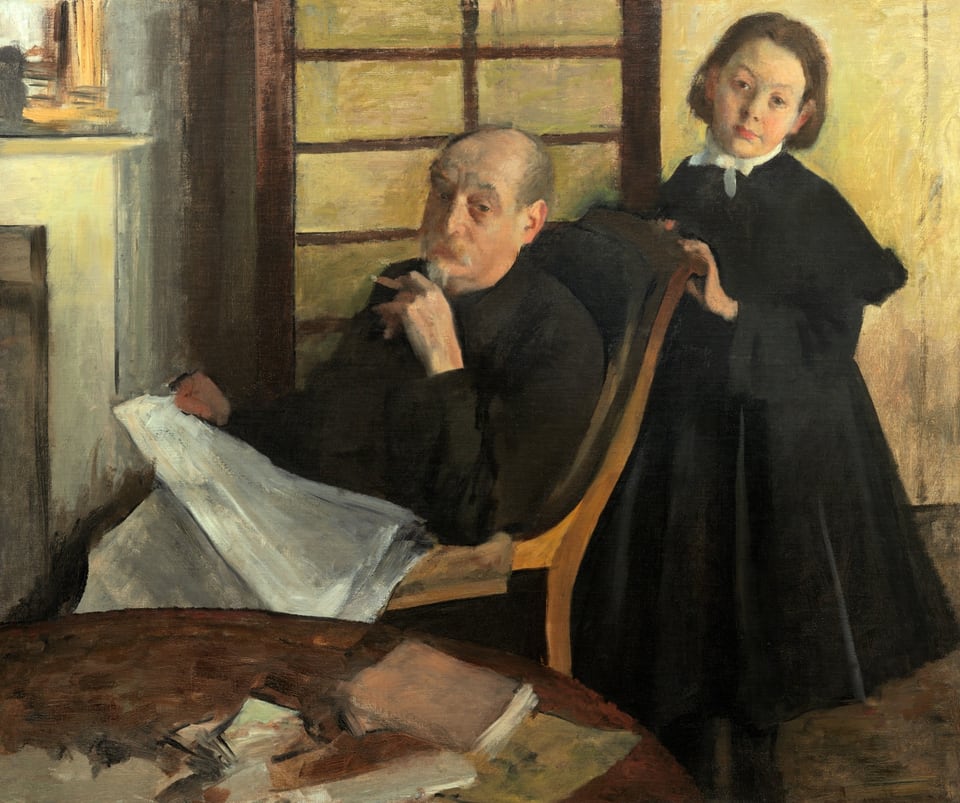
Henri Degas and His Niece Lucie Degas (The Artist's Uncle and Cousin)1875–76
Perhaps the most subtle portrait painter in the Impressionist group, Edgar Degas painted this double portrait in the mid-1970s. More about this work
About this work
Perhaps the most subtle portrait painter in the Impressionist group, Edgar Degas painted this double portrait in the mid-1970s. It shows his orphaned first cousin, Lucie, and their uncle Henri, in whose care the girl had recently been placed—two people who are tentatively accepting the circumstances of their new relationship. Having recently lost his own father, Degas addressed his subjects with awareness and sensitivity.
Text from the Art Institute of Chicago.
What you’re looking at
Impressionist painting of seated man, girl with brown, black hues.
Description from the Art Institute of Chicago.
How it was made
- Oil paint
- Pigment ground in a drying oil, usually linseed. It dries slowly, so painters could blend on the canvas, build up thin translucent glazes, and rework a picture over weeks. Canvas replaced wooden panels in the 1500s because it is lighter and can be rolled.
Edgar Degas
French, 1834–1917 · Born and died in Paris.
Degas trained in the academic tradition, admired Ingres and spent three years in Italy copying earlier art, but turned to modern Paris for his subjects: dancers, racecourses, laundresses, milliners and café singers. He helped organise the Impressionist exhibitions and showed in all but one, yet preferred to call himself a realist. Working from drawing and memory rather than outdoors, he composed with unexpected cropping and viewpoints, and in later years worked mostly in pastel as his eyesight failed.
Written by Ochre Editions.
Impressionism
Painters in 1870s Paris who worked quickly, often outdoors, to catch light as it changed.
Rights and the museum’s record
Public domain. The Art Institute of Chicago has dedicated this image to the public domain under CC0, so anyone may copy, adapt and use it, for any purpose, without asking. Our prints and files are reproductions made from the museum’s image; the museum doesn’t endorse them.
- Object number
- 1933.429
- Credit
- Courtesy of the Art Institute of Chicago
- Type
- Painting
- Department
- Painting and Sculpture of Europe
- Licence
- CC0 1.0 Universal
- Museum record
- See it on the museum’s site
Report this work
More by Edgar Degas
All their works