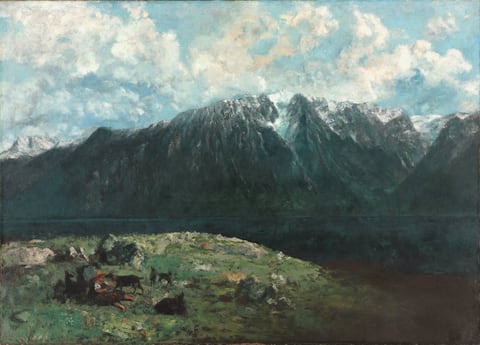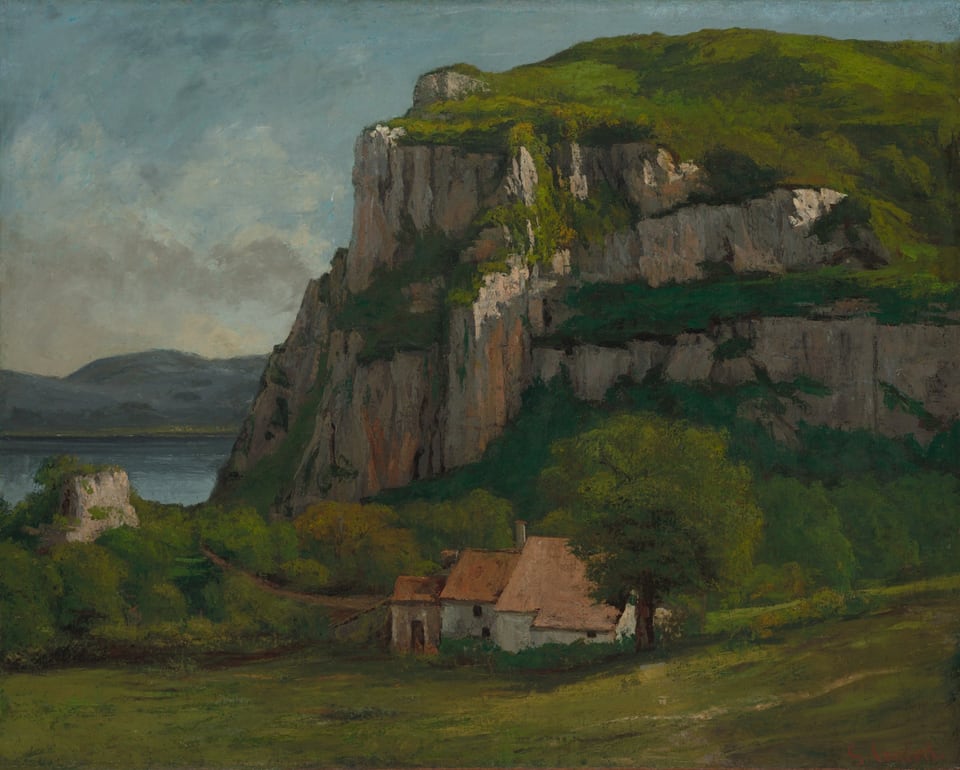
The Rock of Hautepierrec. 1869
A pale limestone cliff rises above a valley under a broad sky, a landscape of the Jura near Gustave Courbet’s native Ornans in eastern France. More about this work
About this work
A pale limestone cliff rises above a valley under a broad sky, a landscape of the Jura near Gustave Courbet’s native Ornans in eastern France. Courbet painted the rocks of his home region again and again, often building up their rough surfaces with a palette knife so that the paint itself seems to have the weight and texture of stone. The picture belongs to his later years, when landscapes made up a large share of his work and found a ready market.
Written by Ochre Editions.
What you’re looking at
A work made of oil on canvas.
Description from the Art Institute of Chicago.
How it was made
- Oil paint
- Pigment ground in a drying oil, usually linseed. It dries slowly, so painters could blend on the canvas, build up thin translucent glazes, and rework a picture over weeks. Canvas replaced wooden panels in the 1500s because it is lighter and can be rolled.
Gustave Courbet
French, 1819–1877 · Born in Ornans; died in La Tour-de-Peilz.
Courbet left his native Ornans for Paris and became the standard-bearer of Realism, painting ordinary people and his own region on the scale reserved for history painting, as in A Burial at Ornans. When works were refused for the 1855 Exposition Universelle, he showed them in his own Pavilion of Realism. He also painted landscapes, seascapes and hunting scenes. After the Paris Commune of 1871 he was held responsible for the toppling of the Vendôme Column and spent his last years in exile in Switzerland.
Written by Ochre Editions.
Rights and the museum’s record
Public domain. The Art Institute of Chicago has dedicated this image to the public domain under CC0, so anyone may copy, adapt and use it, for any purpose, without asking. Our prints and files are reproductions made from the museum’s image; the museum doesn’t endorse them.
- Object number
- 1967.140
- Credit
- Courtesy of the Art Institute of Chicago
- Type
- Painting
- Department
- Painting and Sculpture of Europe
- Licence
- CC0 1.0 Universal
- Museum record
- See it on the museum’s site