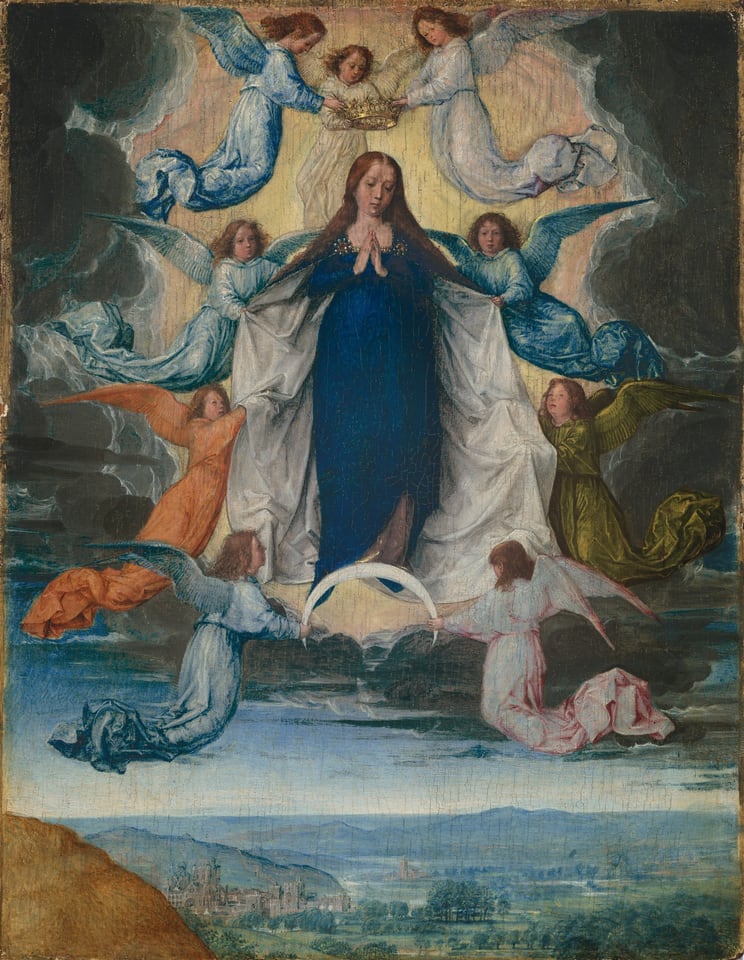
The Assumption of the Virginc. 1500
Michel Sittow painted this in about 1500, aged 31. It is now at the National Gallery of Art in Washington, DC. More about this work
About this work
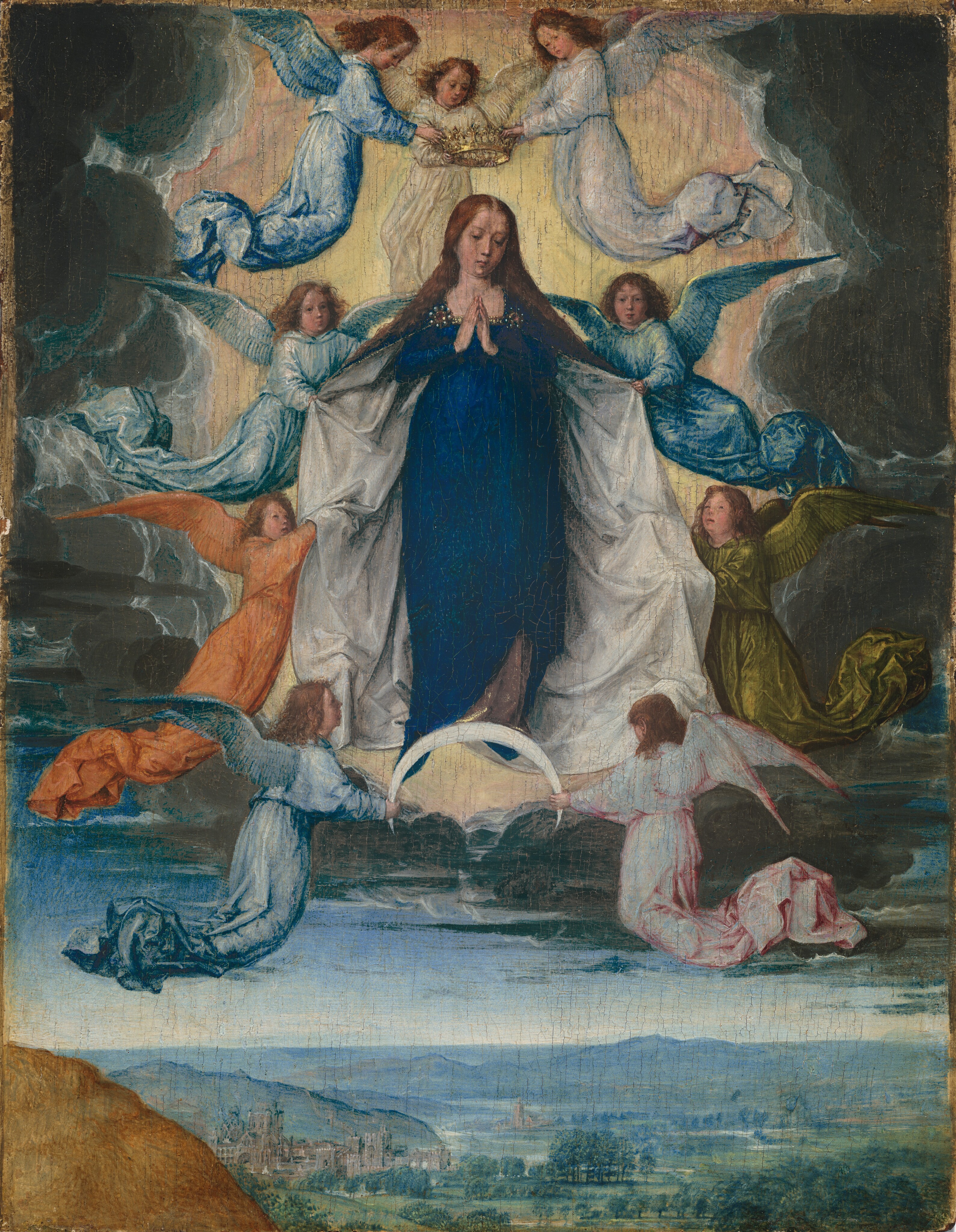
A woman wearing a long, royal-blue dress is surrounded by nine winged angels as she floats on a thin, bright white, downward-pointing crescent moon above a deep landscape with a town tucked into rolling hills in this vertical painting. The woman, Mary, and all the angels have pale, peachy skin and long, brown hair. Mary and the angels float against a pale yellow and pale peach field of light enclosed within a mass of steel-gray clouds. She presses her fingertips together in front of her chest and gazes down and to our right, her dark eyes almost closed. She has a delicate, straight nose, and her small mouth is closed. Her brown hair parts in the middle and flows down over her shoulders. The angels wear flowing gowns in sky or topaz blue, olive green, tangerine orange, white, or light pink, each with matching wings. Three angels place a gold crown on Mary's head. Four others hold up the edges of a silvery white cape, which is fastened across her shoulders with brooches of white pearls surrounding ruby-red stones. The final two angels hold up the downward-facing points of the crescent moon beneath her. In the landscape below, groupings of trees are dotted among the rolling hills, with a village in the distance to our left. The blue, hazy horizon comes about a sixth of the way up the composition. A brown boulder sits in the bottom left corner, closer to us. The paint is visibly cracked throughout.
Description from the National Gallery of Art.
Michel Sittow painted this in about 1500, aged 31. It is now at the National Gallery of Art in Washington, DC.
How it was made
- Oil on panel
- Oil paint on prepared wooden boards, usually oak in the north and poplar in Italy. The rigid, smooth surface suits fine detail and thin, glowing glazes.
- Oil paint
- Pigment ground in a drying oil, usually linseed. It dries slowly, so painters could blend on the canvas, build up thin translucent glazes, and rework a picture over weeks. Canvas replaced wooden panels in the 1500s because it is lighter and can be rolled.
Michel Sittow
Netherlandish, c. 1469–1525
Rights and the museum’s record
Public domain. The National Gallery of Art has dedicated this image to the public domain under CC0, so anyone may copy, adapt and use it, for any purpose, without asking. Our prints and files are reproductions made from the museum’s image; the museum doesn’t endorse them.
- Object number
- 1965.1.1
- Credit
- Courtesy National Gallery of Art, Washington
- Type
- Painting
- Licence
- CC0 1.0 Universal
- Museum record
- See it on the museum’s site
Report this work
Close in colour