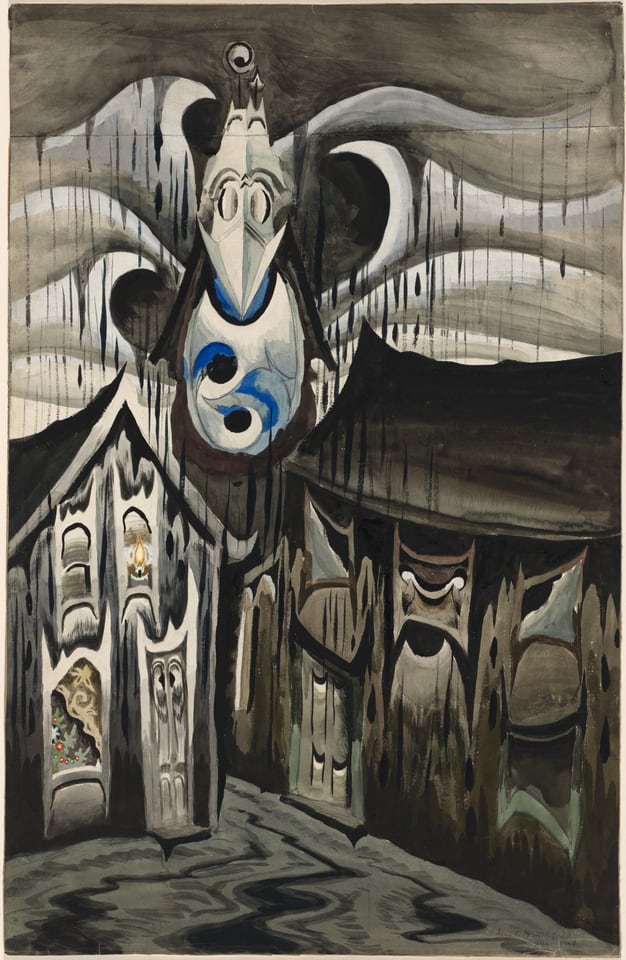
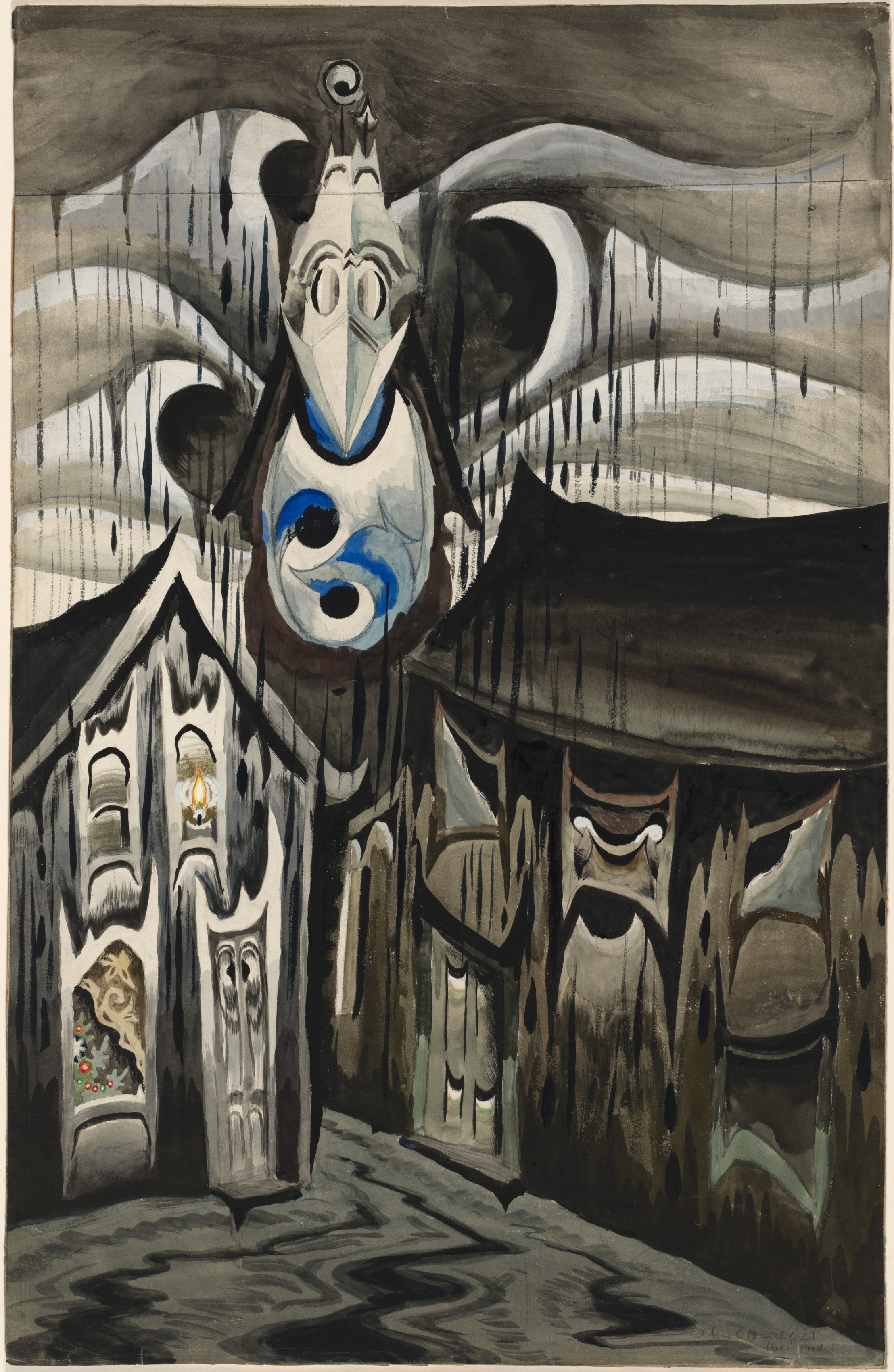
Church Bells Ringing, Rainy Winter NightDecember 1917
Burchfield considered this drawing among the greatest accomplishments of his “golden year.” More about this work
About this work
Burchfield considered this drawing among the greatest accomplishments of his “golden year.” This period followed a time of self-doubt and uncertainty: after graduating from the Cleveland School of Art, Burchfield enrolled in the National Academy of Design in New York City, but dropped out after one day, returning to Salem to work an office job. He painted inexhaustibly during his breaks and at night, depicting Salem and its environs in an increasingly abstract style. Church Bells Ringing, Rainy Winter Night shows the spire of Salem’s Baptist church rising up between two houses. Burchfield hoped to express his powerful childhood fear of the bell’s ominous ring—which he described as “a dull roar . . . dying slowly & with a growl.” Hearing it on stormy winter nights, he huddled in his bed and calmed himself by thinking of Christmas, a practice suggested by the tree visible through a window in the drawing. Burchfield carefully refined the composition throughout the sketches seen in this gallery. The drawing’s mood is conveyed through gray tones and the buildings’ hulking forms. Burchfield also created a complex language of symbols entitled “Conventions for Abstract Thoughts,” that recurred throughout his work and represented universal emotions. The hooked forms surrounding the tower stood for “Fear,” for example, and the shapes of the houses’ doors and windows symbolize “Morbidness” and “Evil.” Developed fully in this drawing, these symbols dominated Burchfield’s work during the remaining several years he spent in Ohio.
Text from the Cleveland Museum of Art.
How it was made
- Opaque watercolour
- Watercolour made opaque with white or chalk and laid in flat, even layers. Persian and Indian painters ground their colours from minerals, applied them with the finest brushes and burnished the finished page.
- Watercolour
- Pigment in gum arabic, thinned with water and laid in transparent washes. Nothing white is painted: the light is the paper showing through.
- Graphite
- Pencil. Graphite has been used for drawing since the 1500s; in 1795 Nicolas-Jacques Conté mixed it with clay, so its hardness could be graded.
Charles Burchfield
American, 1893–1967
Rights and the museum’s record
Public domain. The Cleveland Museum of Art has dedicated this image to the public domain under CC0, so anyone may copy, adapt and use it, for any purpose, without asking. Our prints and files are reproductions made from the museum’s image; the museum doesn’t endorse them.
- Object number
- 1949.544
- Credit
- Courtesy of the Cleveland Museum of Art
- Type
- Drawing
- Department
- Drawings
- Licence
- CC0 1.0 Universal
- Museum record
- See it on the museum’s site
Report this work
Close in colour