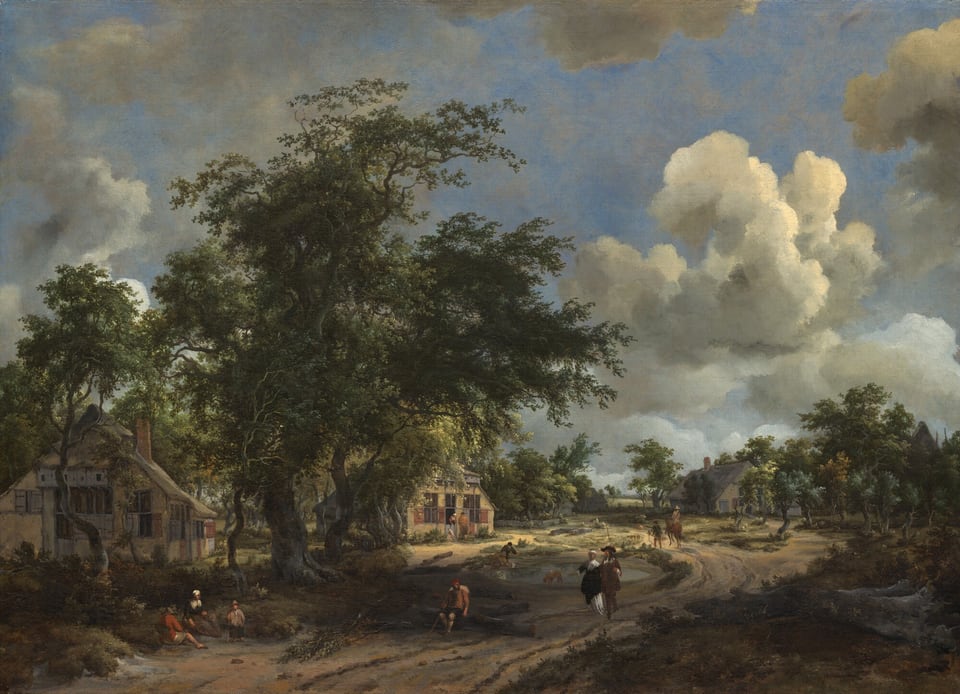
A View on a High Road1665
A sandy road winds past cottages and gnarled trees under a vivid, cloud-studded sky, alive with everyday incident: a traveller resting on a log with a bundle on his back, a well-dressed couple… More about this work
About this work
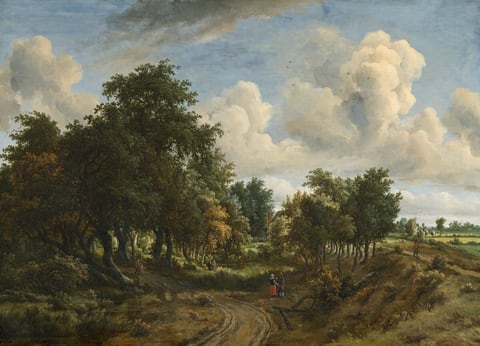
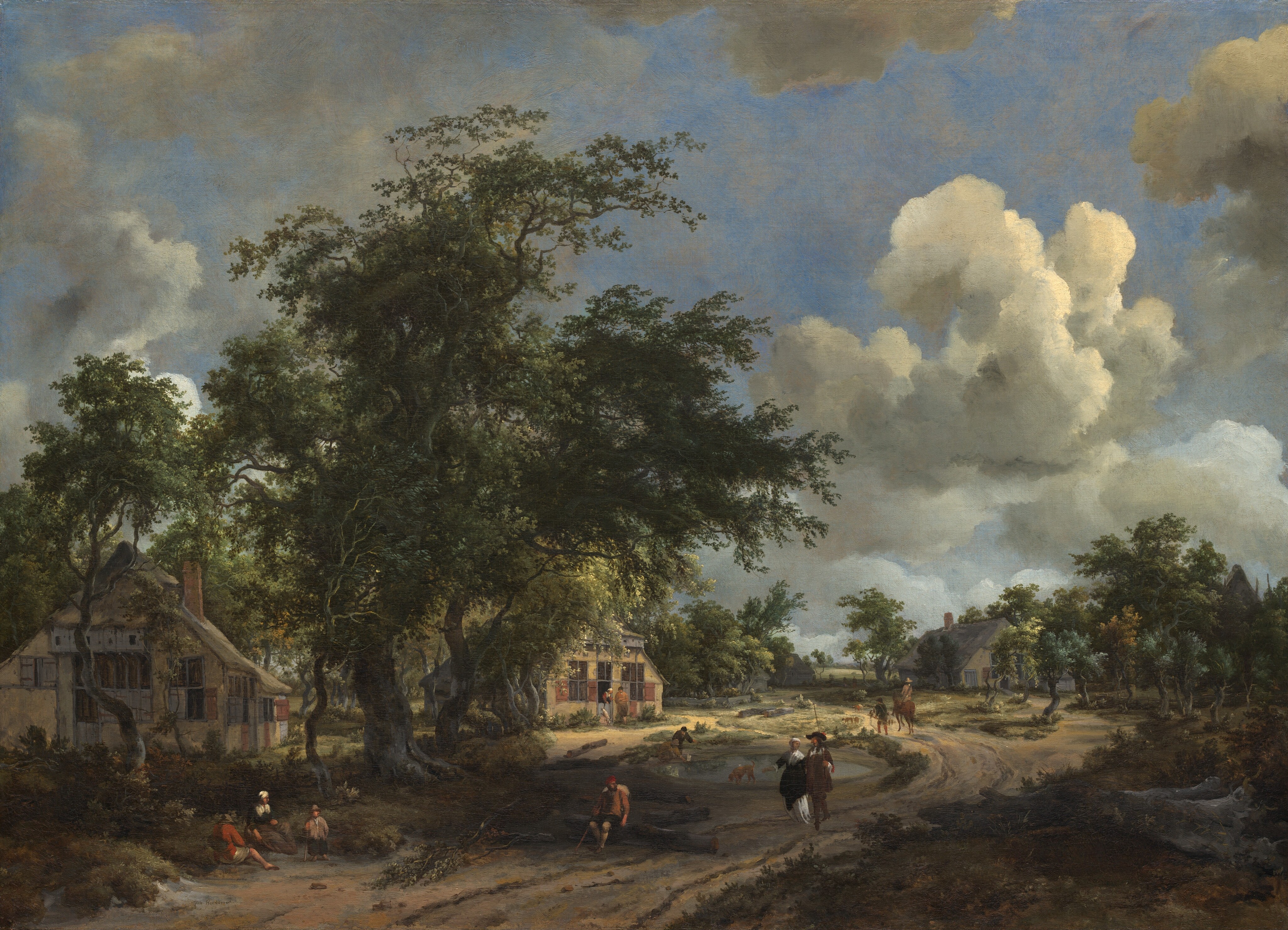
A sandy road winds past cottages and gnarled trees under a vivid, cloud-studded sky, alive with everyday incident: a traveller resting on a log with a bundle on his back, a well-dressed couple strolling towards us, children launching a toy sailboat on a pond while a dog sniffs nearby, and a rider further on. Hobbema painted it in 1665, at the height of his short career, and the shifting patches of sunlight and shadow lead the eye step by step into the distance.
Written by Ochre Editions.
What you’re looking at
Several people sit, stand, or stroll along a dirt road that winds from the lower left corner of this horizontal landscape painting into the distance, past trees and cottages under a vivid blue sky. The horizon line comes about a third of the way up the canvas, and the cloud studded, azure-blue sky fills the space above. Sunlight filtered through puffy white and steel-gray clouds illuminates the scene from the upper right, creating patches of light and shadow throughout. The road meanders through the center of the composition and is lined with dark and sage-green shrubs, scrubby growth, and gnarled, crooked trees. Closest to us and to our left, two tan cottages are tucked into deep shade created by a grove of several tall trees. The cottages have steeply pitched roofs and windows flanked by gray or brick-red shutters. Three people sit and stand near the path outside the closest building. A short distance to our right, a man sitting on a fallen log carries walking stick and a bundle on his back. His body faces us but his head is turned to our right to gaze toward the man and woman about to stroll past him, headed in our direction. The woman wears a black dress over a white skirt, and a white head covering and shawl. The man wears a brimmed hat with a red decoration, a brown coat with gold buttons down the front and a wide white collar, and heeled shoes. Beyond them, the road curves to our left around a small pond in front of the second cottage. Two people crouch to set a toy sailboat afloat by the edge of the pond, and a brown dog sniffs the ground nearby. Two more people stand talking at the doorway to the second cottage and another dog leaps up at the half-door. Further along the road, the light becomes stronger, illuminating a horse, rider, and another person walking alongside the horse. The road continues to curve around a butter-yellow cottage nestled in a grove of trees on the right. A sunny field is visible in the far distance.
Description from the National Gallery of Art.
How it was made
- Oil paint
- Pigment ground in a drying oil, usually linseed. It dries slowly, so painters could blend on the canvas, build up thin translucent glazes, and rework a picture over weeks. Canvas replaced wooden panels in the 1500s because it is lighter and can be rolled.
Meindert Hobbema
Dutch, 1638–1709
Hobbema studied with Jacob van Ruisdael in Amsterdam in the late 1650s and became the most accomplished of his followers, painting sunlit woodland, watermills, cottages and country roads. In 1668 he married and took a post as a wine gauger for the city of Amsterdam, after which he painted far less. Long overlooked, his work was keenly collected in Britain in the nineteenth century and influenced English landscape painting.
Written by Ochre Editions.
Rights and the museum’s record
Public domain. The National Gallery of Art has dedicated this image to the public domain under CC0, so anyone may copy, adapt and use it, for any purpose, without asking. Our prints and files are reproductions made from the museum’s image; the museum doesn’t endorse them.
- Object number
- 1937.1.62
- Credit
- Courtesy National Gallery of Art, Washington
- Type
- Painting
- Licence
- CC0 1.0 Universal
- Museum record
- See it on the museum’s site