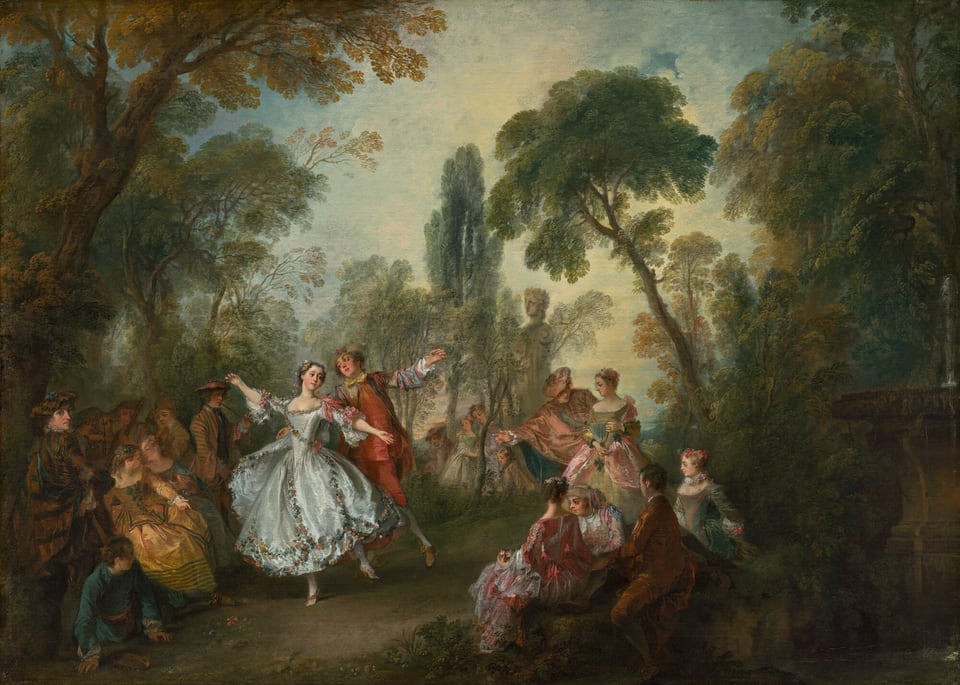
La Camargo Dancingc. 1730
Nicolas Lancret painted this in about 1730, aged 40. It is now at the National Gallery of Art in Washington, DC. More about this work
About this work
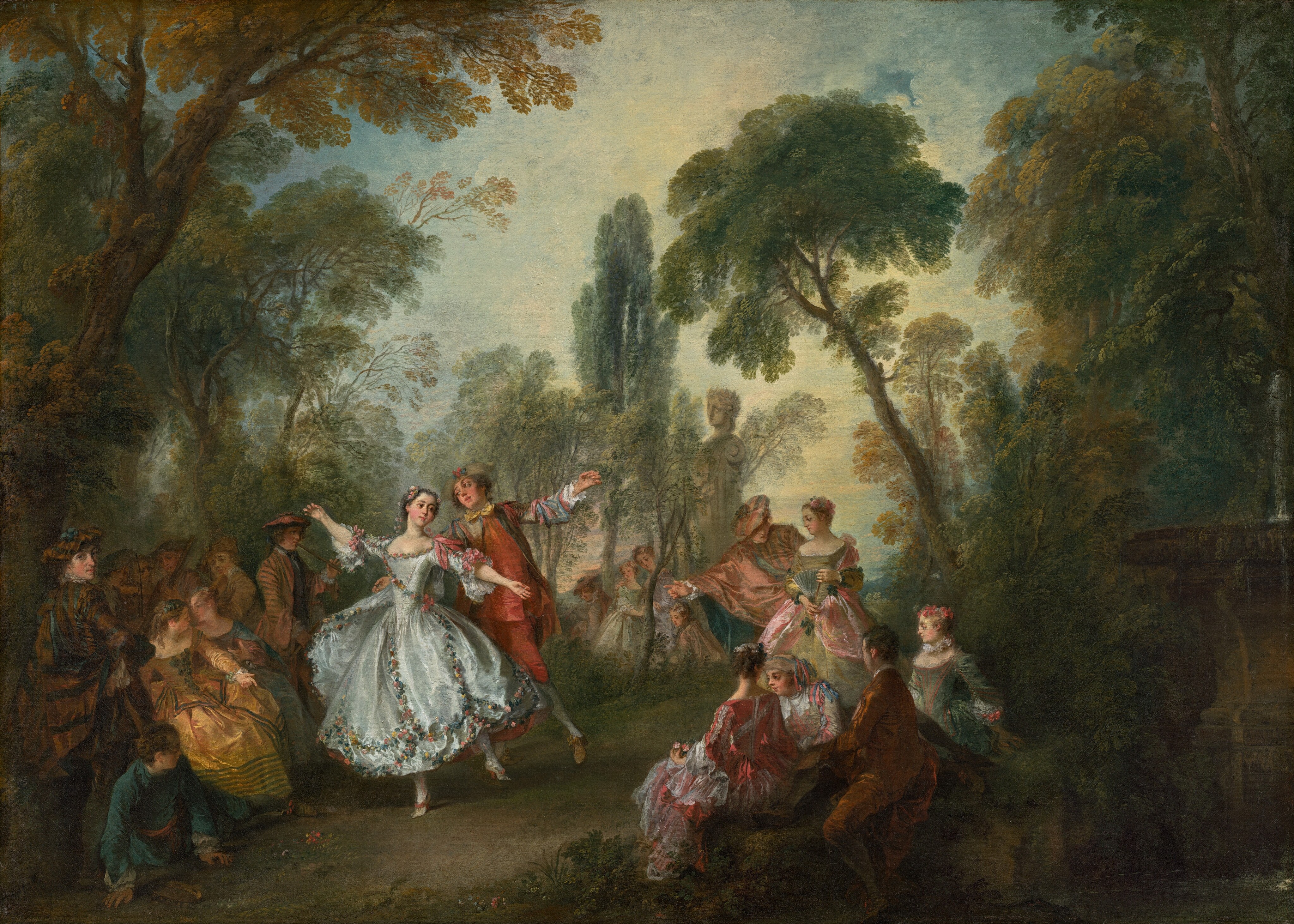
Twenty-one men in long waistcoats and women in elegantly trimmed gowns gather and dance within a verdant landscape in this horizontal painting. The men wear jackets and breeches in ginger brown, pale pink, or spruce blue. The women’s gowns have full sleeves, tight-fitting bodices, and full skirts in shades of bronze, teal blue, butterscotch gold, or rich pink edged with ribbons and lace. Some of them wear floral wreaths or ribbons in their upswept hair. Groups gather around a woman and man who dance together to our left in the scene. Some in the group of onlookers to our left hold musical instruments, including a violin and a pipe. Another group is nestled among trees just beyond the dancers, at the center of the painting, and more sit and stand to our right. The dancing woman wears a gleaming, ice-blue gown with rows of flowers in muted pink, blue, and gold down the full skirt and around the bottom hem, which falls short of her thin ankles. More garlands cross her chest and shoulders, and flowers are tucked into her dark gray hair. She faces us with her head turned to our right as she looks off in that direction with dark eyes under curving brows. She has a delicate nose, rosy, round cheeks, and pink lips. She holds her arms spread wide with the thumb touching the index finger of each hand. The man with whom she dances wears a coral-red tunic and breeches with sleeves decorated with pale pink and blue ribbons. The brim of his brown hat is turned up. His body faces us but he turns his head to look at the woman, his lips parted. The man and woman each have one gracefully pointed foot raised. The dancers and groups are enclosed within a park-like setting with tall trees to either side, and a screen of trees across the back of the space. The trees have slender trunks and canopies in shades of pine, sage, and moss green. Near the back middle of the scene, a stone column topped by a human head wearing a wreath of laurel leaves rises above the central group. A fountain with a vertical jet of water is tucked into the shadows within a grove of trees along the right edge of the painting. The water falls into a pool in the lower right corner.
Description from the National Gallery of Art.
Nicolas Lancret painted this in about 1730, aged 40. It is now at the National Gallery of Art in Washington, DC.
How it was made
- Oil paint
- Pigment ground in a drying oil, usually linseed. It dries slowly, so painters could blend on the canvas, build up thin translucent glazes, and rework a picture over weeks. Canvas replaced wooden panels in the 1500s because it is lighter and can be rolled.
Nicolas Lancret
French, 1690–1743
Rights and the museum’s record
Public domain. The National Gallery of Art has dedicated this image to the public domain under CC0, so anyone may copy, adapt and use it, for any purpose, without asking. Our prints and files are reproductions made from the museum’s image; the museum doesn’t endorse them.
- Object number
- 1937.1.89
- Credit
- Courtesy National Gallery of Art, Washington
- Type
- Painting
- Licence
- CC0 1.0 Universal
- Museum record
- See it on the museum’s site