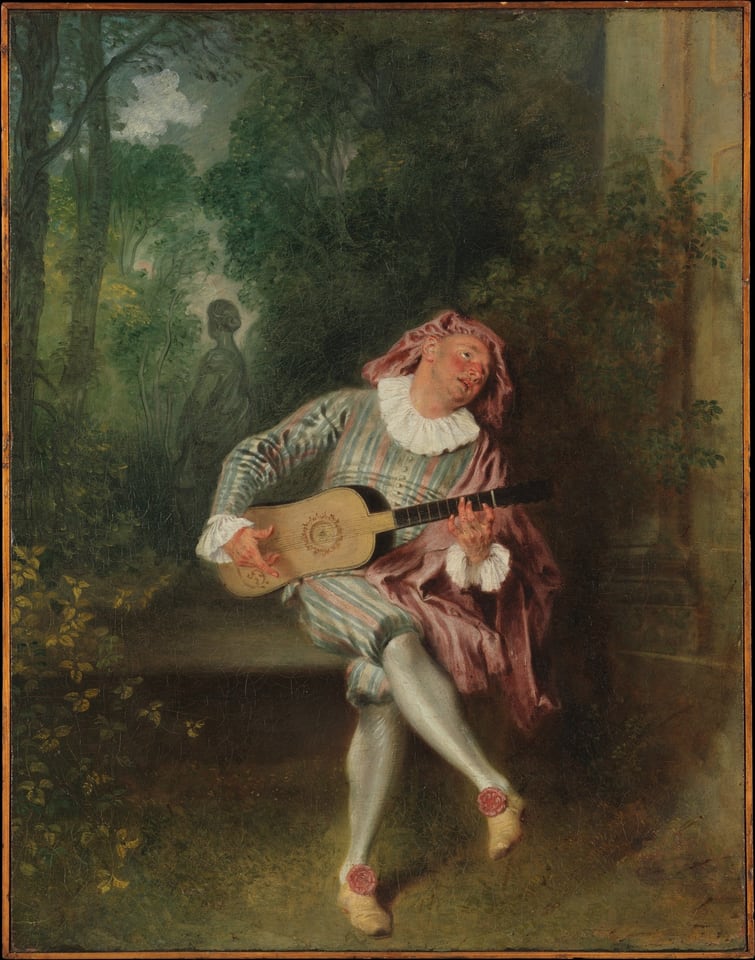
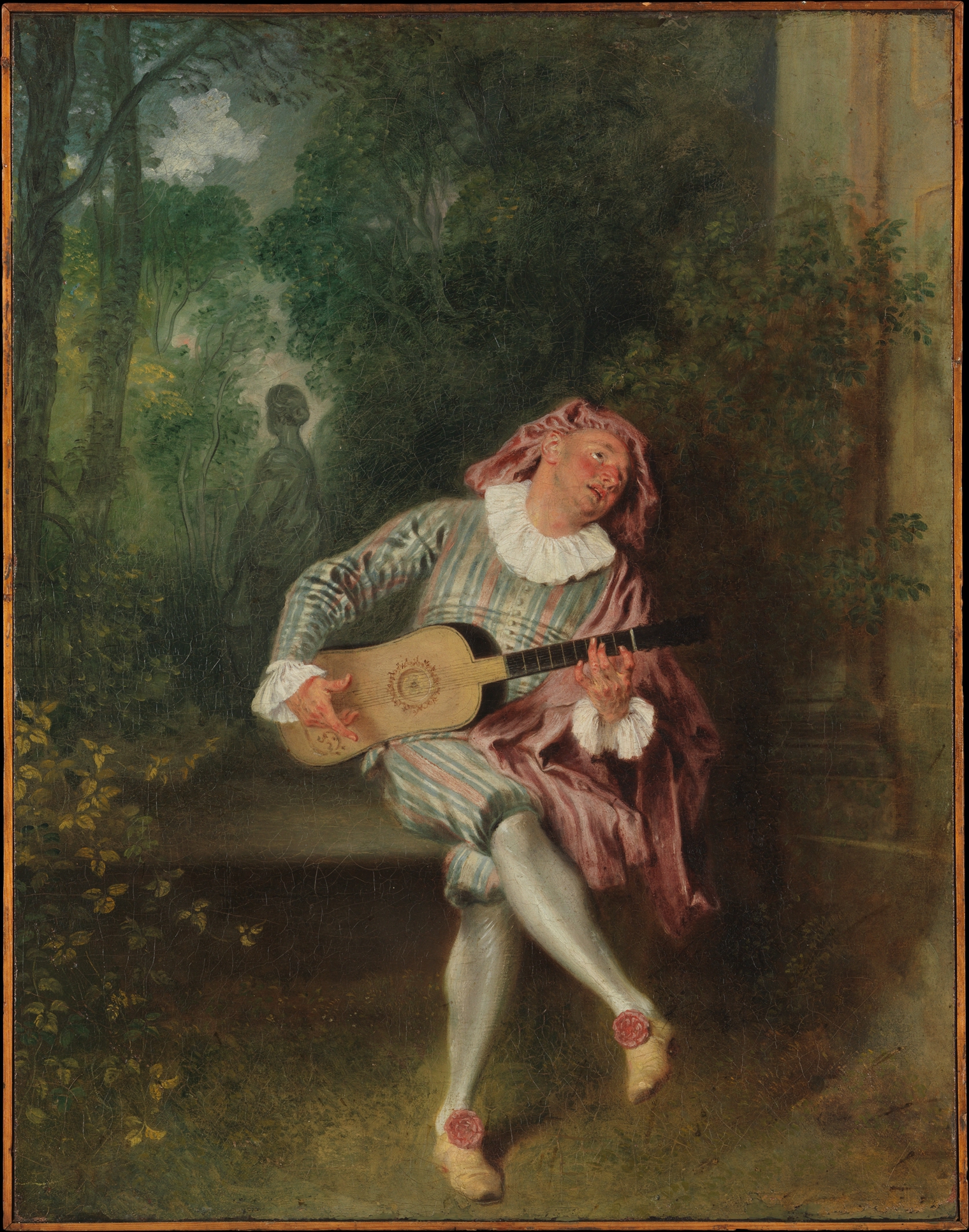
Mezzetinca. 1718–20
Mezzetin, a stock character of the Italian comedy, sits on a garden bench and sings to his guitar, head thrown back and eyes raised, his striped costume glowing against dark foliage. More about this work
About this work
Mezzetin, a stock character of the Italian comedy, sits on a garden bench and sings to his guitar, head thrown back and eyes raised, his striped costume glowing against dark foliage. Behind him a stone statue of a woman turns her back, an ironic reply to his lovesick serenade. Watteau, who died at thirty-six, made the world of the theatre central to a new kind of painting, the fête galante, in which music, costume and longing mingle. The tension in the strumming hands and the flicker of light on the silk show his close study of figures drawn from life.
Written by Ochre Editions.
How it was made
- Oil paint
- Pigment ground in a drying oil, usually linseed. It dries slowly, so painters could blend on the canvas, build up thin translucent glazes, and rework a picture over weeks. Canvas replaced wooden panels in the 1500s because it is lighter and can be rolled.
Antoine Watteau
French, 1684–1721 · Born in Valenciennes; died in Nogent-sur-Marne.
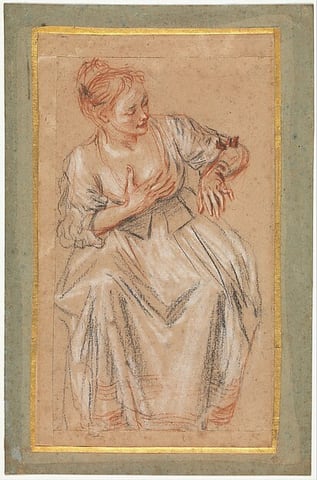
Watteau came to Paris from Valenciennes, worked with the theatre painter Claude Gillot and the decorator Claude Audran, and studied Rubens’s Medici cycle at the Luxembourg Palace. In 1717 the Academy received him with a new category, the fête galante, for his Pilgrimage to Cythera: elegant figures in parkland, often in theatre costume, touched with melancholy. His chalk drawings, frequently in red, black and white, are among the finest of the century. He died of tuberculosis at thirty-six.
Written by Ochre Editions.
Rights and the museum’s record
Public domain. The Met has dedicated this image to the public domain under CC0, so anyone may copy, adapt and use it, for any purpose, without asking. Our prints and files are reproductions made from the museum’s image; the museum doesn’t endorse them.
- Object number
- 34.138
- Credit
- Courtesy of The Metropolitan Museum of Art
- Type
- Paintings
- Department
- European Paintings
- Licence
- CC0 1.0 Universal
- Museum record
- See it on the museum’s site
Report this work
More by Antoine Watteau
All their works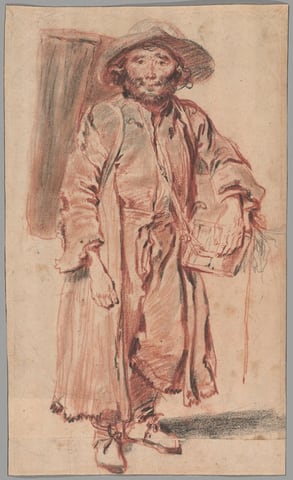
Close in colour