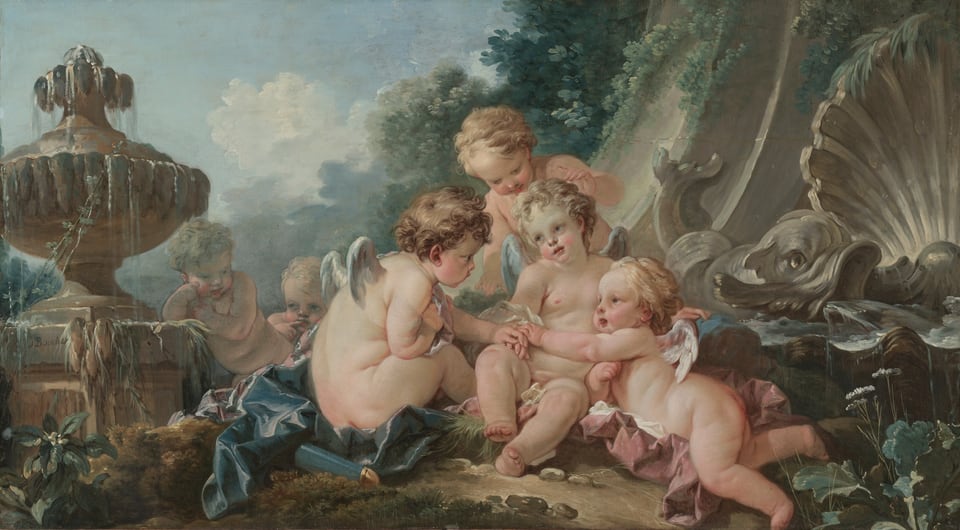
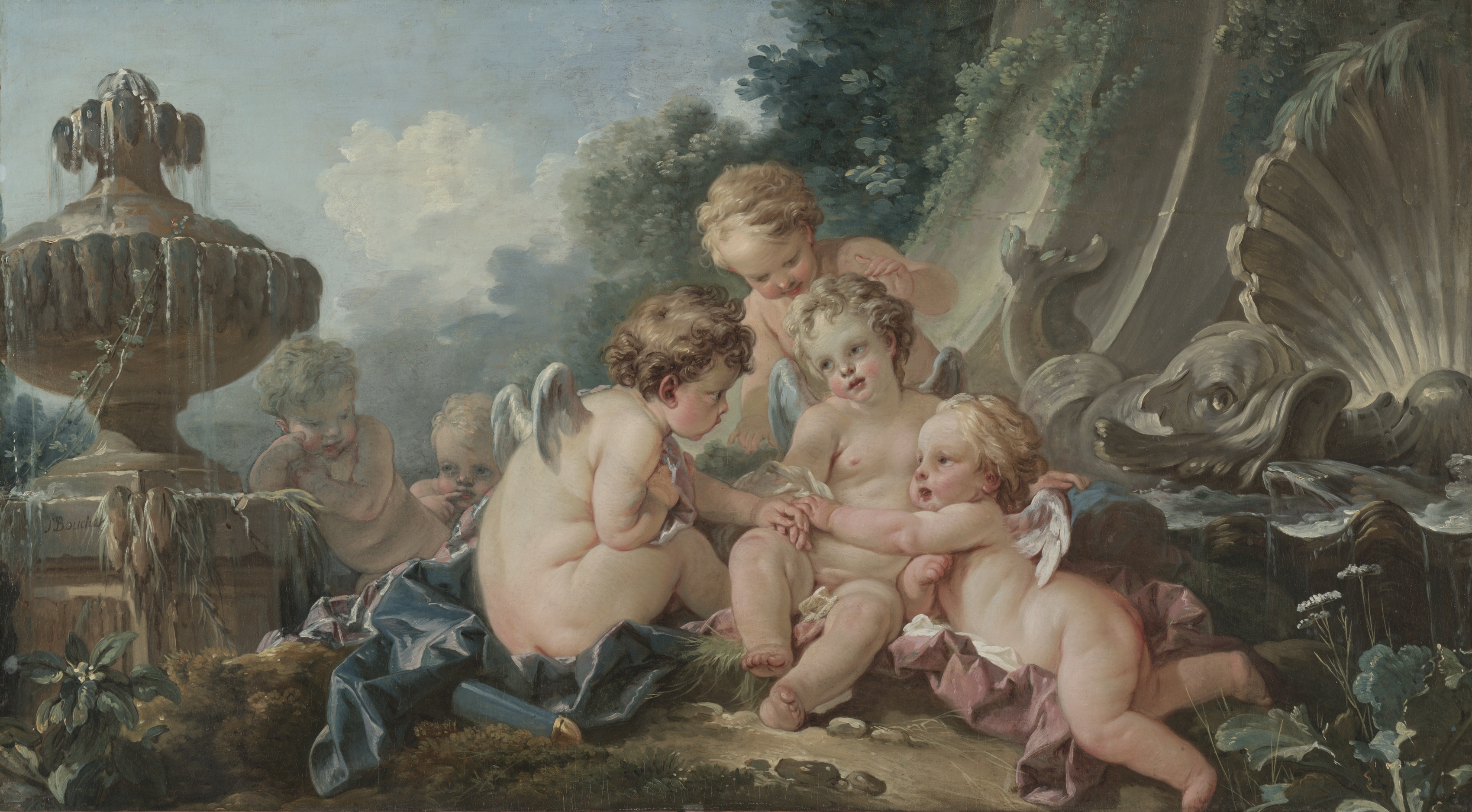
Cupids in Conspiracy1740s
Along with Music and Dance (1948.181.1), this work is surely part of a series of over-door paintings that would have been installed in a house. More about this work
About this work
Along with Music and Dance (1948.181.1), this work is surely part of a series of over-door paintings that would have been installed in a house. However, where the panels were originally installed or who commissioned them remains unknown. They exemplify the fusion of fine arts and decorative arts that was common in elite interior design in 18th-century France. Even though the paintings were part of the wall decoration of the room, the patrons chose François Boucher, a well-known painter of portraits and genre scenes, as well as mythological and religious subjects, to execute them. These two paintings reflect a style that was popular both at court and among other wealthy patrons through much of the eighteenth century: light, charming, pastoral scenes that mix classical elements with pure fantasy. Both of them feature putti, chubby baby characters that add a touch of humor to the images.
Text from the Cleveland Museum of Art.
How it was made
- Oil paint
- Pigment ground in a drying oil, usually linseed. It dries slowly, so painters could blend on the canvas, build up thin translucent glazes, and rework a picture over weeks. Canvas replaced wooden panels in the 1500s because it is lighter and can be rolled.
François Boucher
French, 1703–1770 · Born and died in Paris.
Boucher trained with François Lemoyne, won the Prix de Rome and spent several years in Italy before rising to become First Painter to Louis XV. Madame de Pompadour was his most important patron. He worked at every scale, from mythological canvases full of rosy nudes and cupids to designs for the Beauvais and Gobelins tapestry factories, porcelain and the opera. His light, decorative manner came to define the French Rococo.
Written by Ochre Editions.
Rights and the museum’s record
Public domain. The Cleveland Museum of Art has dedicated this image to the public domain under CC0, so anyone may copy, adapt and use it, for any purpose, without asking. Our prints and files are reproductions made from the museum’s image; the museum doesn’t endorse them.
- Object number
- 1948.181.2
- Credit
- Courtesy of the Cleveland Museum of Art
- Type
- Painting
- Department
- European Painting and Sculpture
- Licence
- CC0 1.0 Universal
- Museum record
- See it on the museum’s site
Report this work
More by François Boucher
All their works
Close in colour