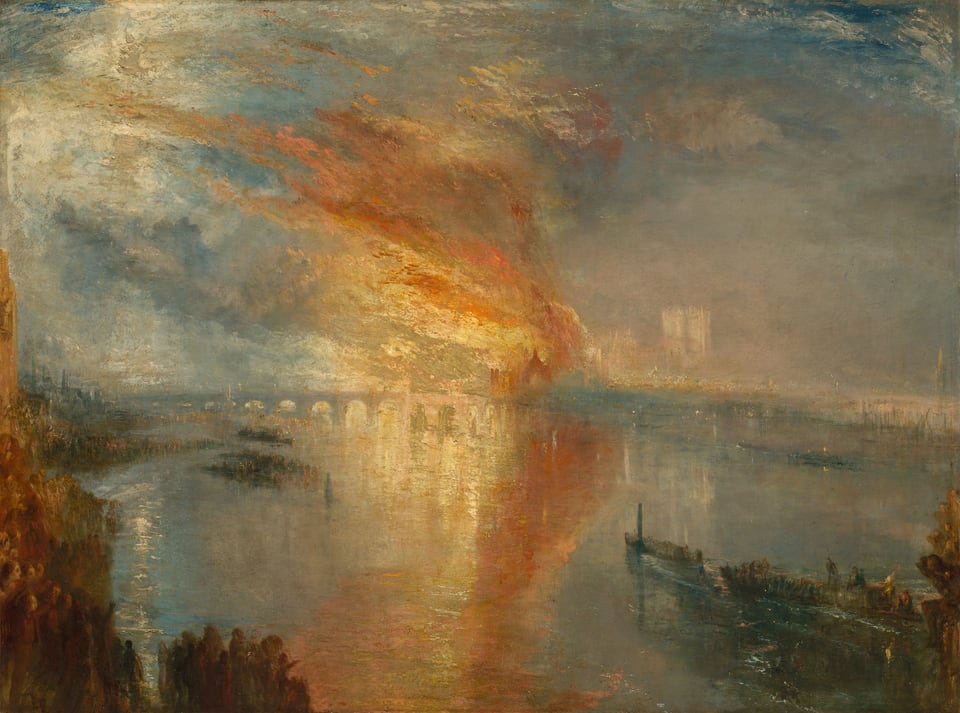
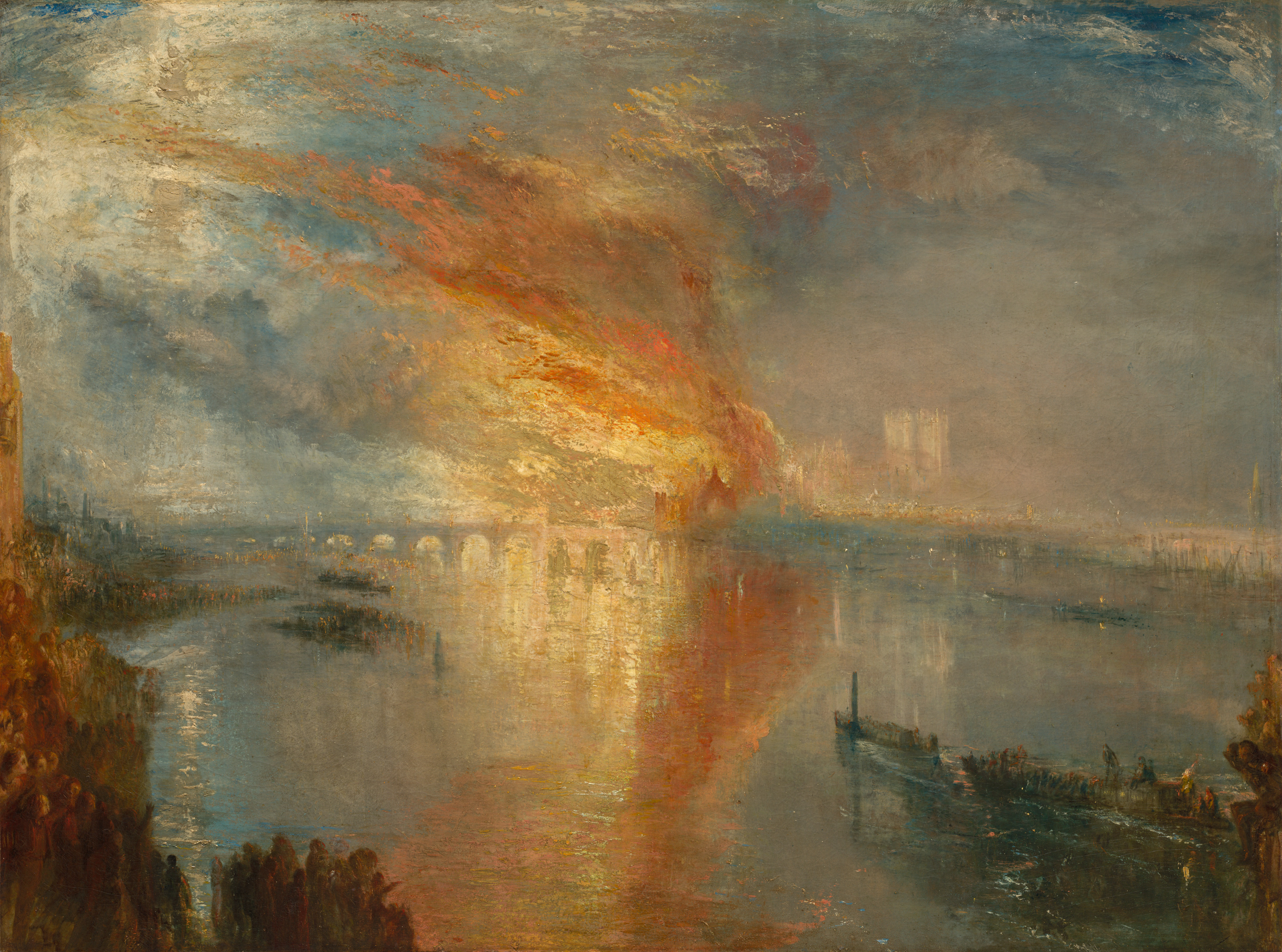
The Burning of the Houses of Lords and Commons, 16 October 18341835
Fire consumed London’s famous Houses of Parliament on the night of October 16, 1834, and people gathered along the banks of the river Thames to gaze in awe at the horrifying spectacle. More about this work
About this work
Fire consumed London’s famous Houses of Parliament on the night of October 16, 1834, and people gathered along the banks of the river Thames to gaze in awe at the horrifying spectacle. Initially, a low tide made it difficult to pump water to land and hampered steamers towing firefighting equipment along the river. The blaze burned uncontrollably for hours. J. M. W. Turner records the struggle as the boats in the lower-right corner head toward the flames. Although Turner based the painting on an actual event, he magnified the height of the flames, using the disaster as the starting point to express man’s helplessness when confronted with the destructive powers of nature. Brilliant swathes of color and variable atmospheric effects border on abstraction.
Text from the Cleveland Museum of Art.
How it was made
- Oil paint
- Pigment ground in a drying oil, usually linseed. It dries slowly, so painters could blend on the canvas, build up thin translucent glazes, and rework a picture over weeks. Canvas replaced wooden panels in the 1500s because it is lighter and can be rolled.
Joseph Mallord William Turner
English, 1775–1851 · Born and died in London.
Turner, a London barber’s son, entered the Royal Academy Schools at fourteen and was elected a full Academician at twenty-six. Travelling constantly in Britain and on the Continent, he filled hundreds of sketchbooks and made thousands of watercolours. His oils moved from classical landscapes in the manner of Claude towards vortices of light, steam and weather, as in The Burning of the Houses of Lords and Commons, a fire he witnessed in 1834. He left most of his work to the nation.
Written by Ochre Editions.
Rights and the museum’s record
Public domain. The Cleveland Museum of Art has dedicated this image to the public domain under CC0, so anyone may copy, adapt and use it, for any purpose, without asking. Our prints and files are reproductions made from the museum’s image; the museum doesn’t endorse them.
- Object number
- 1942.647
- Credit
- Courtesy of the Cleveland Museum of Art
- Type
- Painting
- Department
- Modern European Painting and Sculpture
- Licence
- CC0 1.0 Universal
- Museum record
- See it on the museum’s site
Report this work
More by Joseph Mallord William Turner
All their works
Close in colour