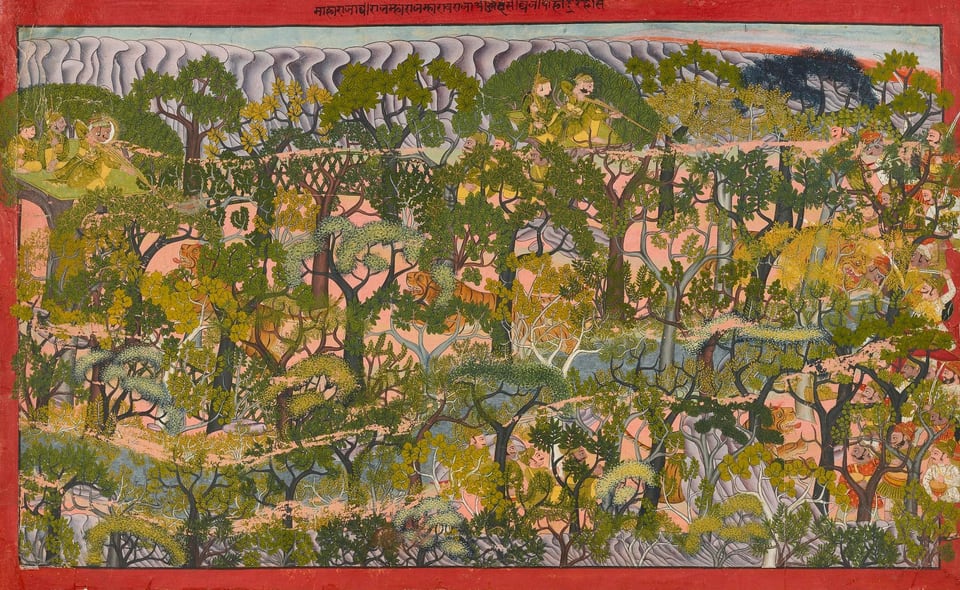
Maharao Umed Singh hunting tigers1787
Royal hunts were symbolically important expressions of kingship within the Ancient Near East, Persia and India. More about this work
About this work
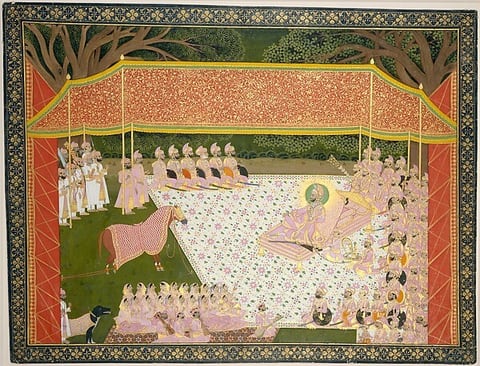
Royal hunts were symbolically important expressions of kingship within the Ancient Near East, Persia and India. Beginning around 1660, artists in Kota began creating extraordinary images of rulers hunting game, which through to the mid-eighteenth century deployed calligraphic contour lines to render animals with great vivacity in highly textured landscapes. This later hunt scene deploys solid blocks of color - lavender, salmon, orange and teal - that play off the textured sage greens of the forest. The composition demands that the viewer search through the foliage for a tiger represented multiple times in a way that perhaps evokes the act of looking for game in the jungle. On the right, a tiger mauls one of the servants of the hunt. At top center, a nobleman, probably the powerful Zalim Singh, shoots from a a hunting platform at the tiger. The tiger subsequently appears on the left, charging towards Umed Singh, with white halo and dressed in camouflage green, who shoots from a hunting platform. Visible above and below the tiger is the lattice-work enclosure that was built to drive game towards the ruler.
Text from the National Museum of Asian Art.
How it was made
- Opaque watercolour
- Watercolour made opaque with white or chalk and laid in flat, even layers. Persian and Indian painters ground their colours from minerals, applied them with the finest brushes and burnished the finished page.
- Watercolour
- Pigment in gum arabic, thinned with water and laid in transparent washes. Nothing white is painted: the light is the paper showing through.
Hans Raj Joshi
1750–1799
Rights and the museum’s record
Public domain. The National Museum of Asian Art has dedicated this image to the public domain under CC0, so anyone may copy, adapt and use it, for any purpose, without asking. Our prints and files are reproductions made from the museum’s image; the museum doesn’t endorse them.
- Object number
- S2018.1.39
- Credit
- Courtesy of the National Museum of Asian Art, Smithsonian Institution
- Type
- Painting
- Department
- National Museum of Asian Art
- Licence
- CC0 1.0 Universal
- Museum record
- See it on the museum’s site
Report this work
Close in colour