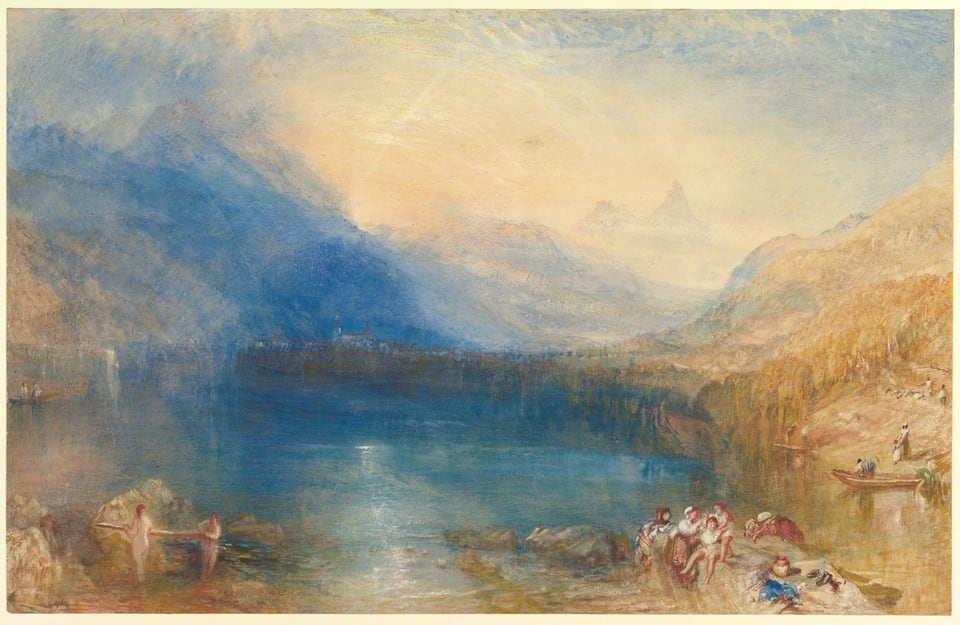
The Lake of Zug1843
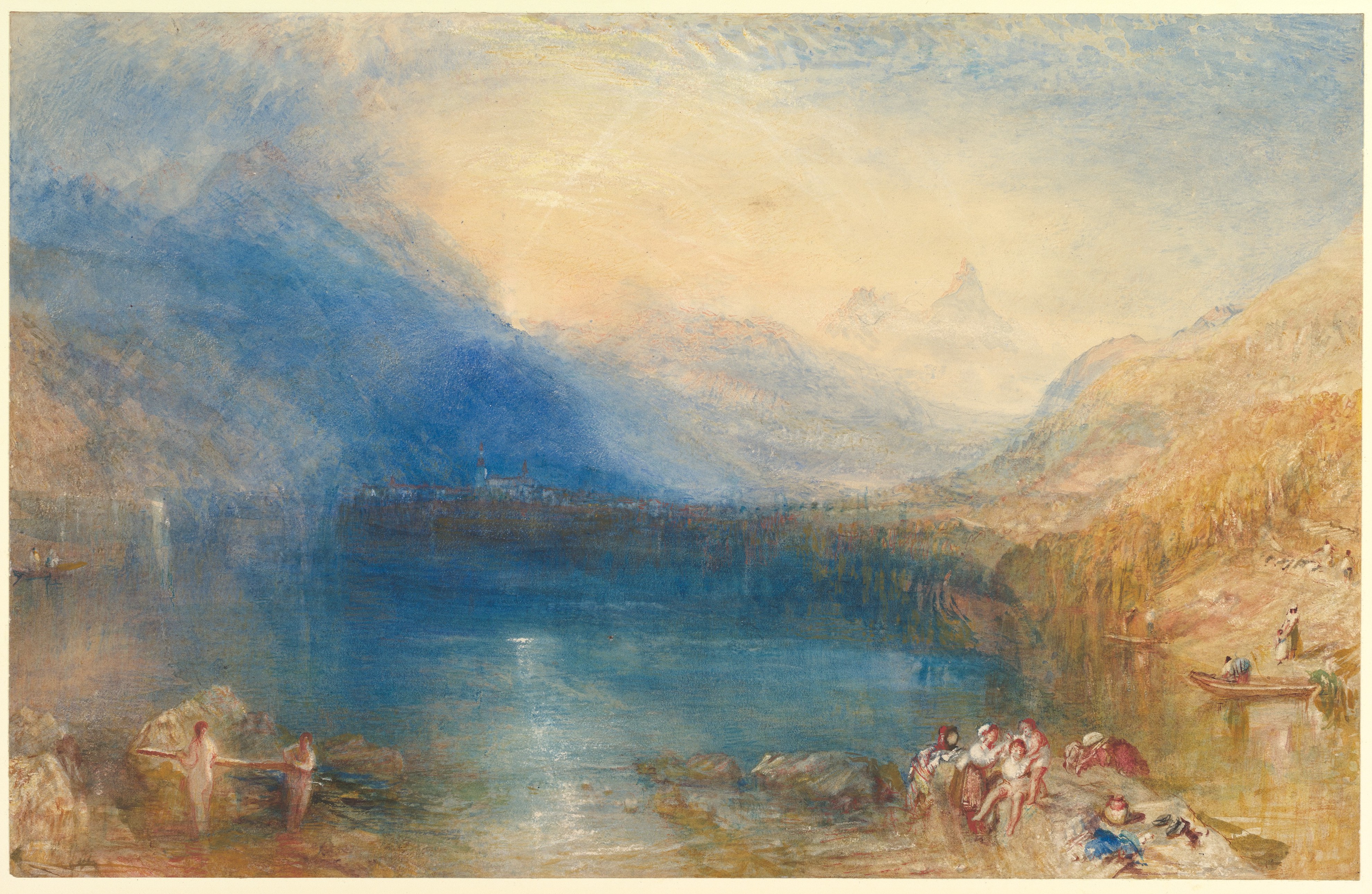
The Lake of Zug in central Switzerland lies beneath mountains that dissolve into luminous haze, with a few small boats on the water. More about this work
About this work
The Lake of Zug in central Switzerland lies beneath mountains that dissolve into luminous haze, with a few small boats on the water. Turner made this watercolour in 1843 as one of a group of late Swiss views based on sketches from his summer tours and offered to collectors through his agent. He worked the colour wet, then lifted, scraped and rubbed out highlights, so that light seems to rise from within the paper itself.
Written by Ochre Editions.
How it was made
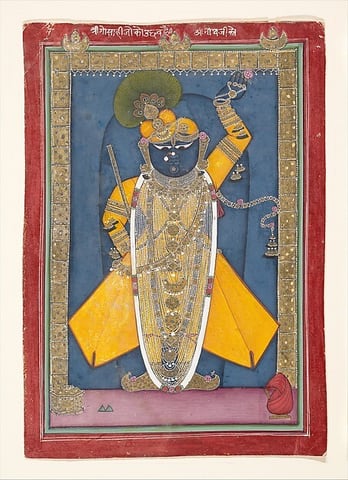
- Opaque watercolour
- Watercolour made opaque with white or chalk and laid in flat, even layers. Persian and Indian painters ground their colours from minerals, applied them with the finest brushes and burnished the finished page.
- Watercolour
- Pigment in gum arabic, thinned with water and laid in transparent washes. Nothing white is painted: the light is the paper showing through.
- Graphite
- Pencil. Graphite has been used for drawing since the 1500s; in 1795 Nicolas-Jacques Conté mixed it with clay, so its hardness could be graded.
Joseph Mallord William Turner
English, 1775–1851 · Born and died in London.
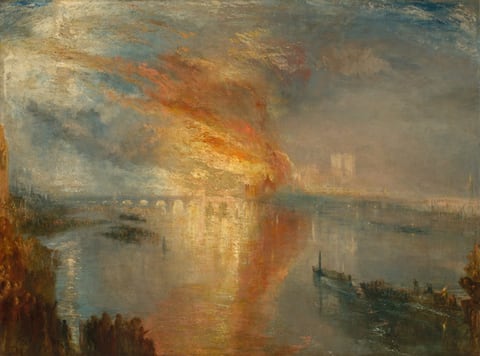
Turner, a London barber’s son, entered the Royal Academy Schools at fourteen and was elected a full Academician at twenty-six. Travelling constantly in Britain and on the Continent, he filled hundreds of sketchbooks and made thousands of watercolours. His oils moved from classical landscapes in the manner of Claude towards vortices of light, steam and weather, as in The Burning of the Houses of Lords and Commons, a fire he witnessed in 1834. He left most of his work to the nation.
Written by Ochre Editions.
Rights and the museum’s record
Public domain. The Met has dedicated this image to the public domain under CC0, so anyone may copy, adapt and use it, for any purpose, without asking. Our prints and files are reproductions made from the museum’s image; the museum doesn’t endorse them.
- Object number
- 59.120
- Credit
- Courtesy of The Metropolitan Museum of Art
- Type
- Drawings
- Department
- Drawings and Prints
- Licence
- CC0 1.0 Universal
- Museum record
- See it on the museum’s site
Report this work
More by Joseph Mallord William Turner
All their works
Close in colour