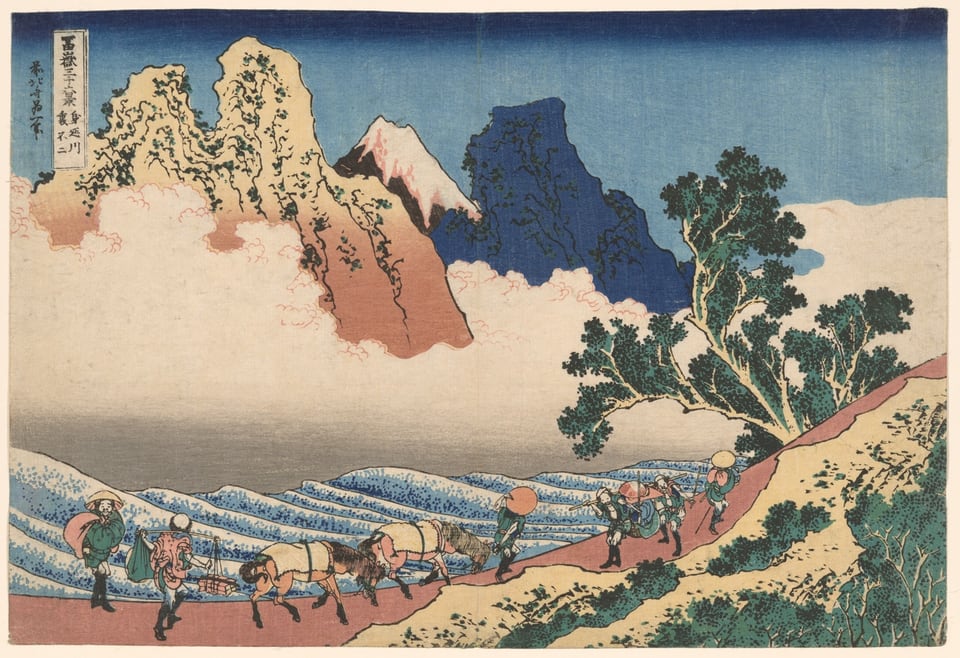
The Back of Mount Fuji Seen from Minobu River (Minobugawa Urafuji), from the series Thirty-Six Views of Mount Fuji (Fugaku sanjūrokkei)1830-33
A string of travellers and packhorses picks its way along a narrow hillside path, dwarfed by craggy mountains in beige and deep blue, while between them, beyond a bank of cream-coloured cloud, rises the snow-covered peak of Mount Fuji. More about this work
About this work
A string of travellers and packhorses picks its way along a narrow hillside path, dwarfed by craggy mountains in beige and deep blue, while between them, beyond a bank of cream-coloured cloud, rises the snow-covered peak of Mount Fuji. The Minobu River below churns in rounded, patterned ripples. Hokusai liked to show Fuji from unexpected sides; here it is the ‘back’ of the mountain, seen from the road towards Minobu, home of an important temple of the Nichiren school of Buddhism. The print belongs to Thirty-Six Views of Mount Fuji.
Written by Ochre Editions.
What you’re looking at
Print showing a string of travelers with horses walking along a narrow hillside path beneath an enormous craggy beige mountain at left and an equally massive and craggy deep-blue mountain at right. A brown snow-covered peak appears between these mountains. A mass of cream-colored clouds and a river with rounded ripples fill the middle plane of the composition.
Description from the Art Institute of Chicago.
How it was made
- Colour woodblock print
- In Japan these were a team effort. The artist drew the design, a carver cut it into cherry-wood blocks, one block for each colour, and a printer brushed on the pigment and rubbed each sheet by hand. Full-colour prints of this kind were called nishiki-e, “brocade pictures”, from the 1760s on.
- Ōban
- The standard large Japanese print size, about 38 × 25 cm.
Katsushika Hokusai
Japanese, 1760–1849
Hokusai trained in the studio of the actor-portraitist Katsukawa Shunshō and went on to work under more than thirty names across a career of some seventy years. Alongside book illustration, paintings and the sketch volumes known as Hokusai Manga, he made landscape a leading subject of ukiyo-e with Thirty-six Views of Mount Fuji, issued around 1830–33, in which the mountain appears from city, coast and countryside, often in the newly imported Prussian blue.
Written by Ochre Editions.
Ukiyo-e
Japanese woodblock prints of the floating world: actors, courtesans, landscapes and the sea.
Rights and the museum’s record
Public domain. The Art Institute of Chicago has dedicated this image to the public domain under CC0, so anyone may copy, adapt and use it, for any purpose, without asking. Our prints and files are reproductions made from the museum’s image; the museum doesn’t endorse them.
- Object number
- 1932.19
- Credit
- Courtesy of the Art Institute of Chicago
- Type
- Department
- Arts of Asia
- Licence
- CC0 1.0 Universal
- Museum record
- See it on the museum’s site
Report this work
More by Katsushika Hokusai
All their works
Close in colour