Allegory of Music1764
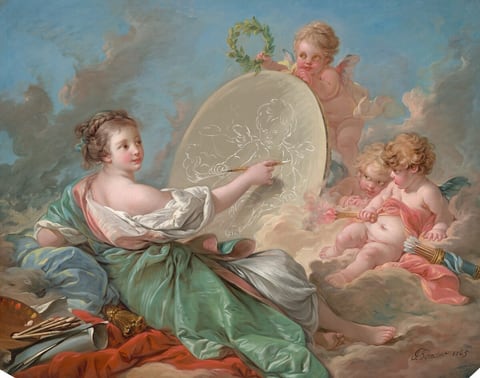
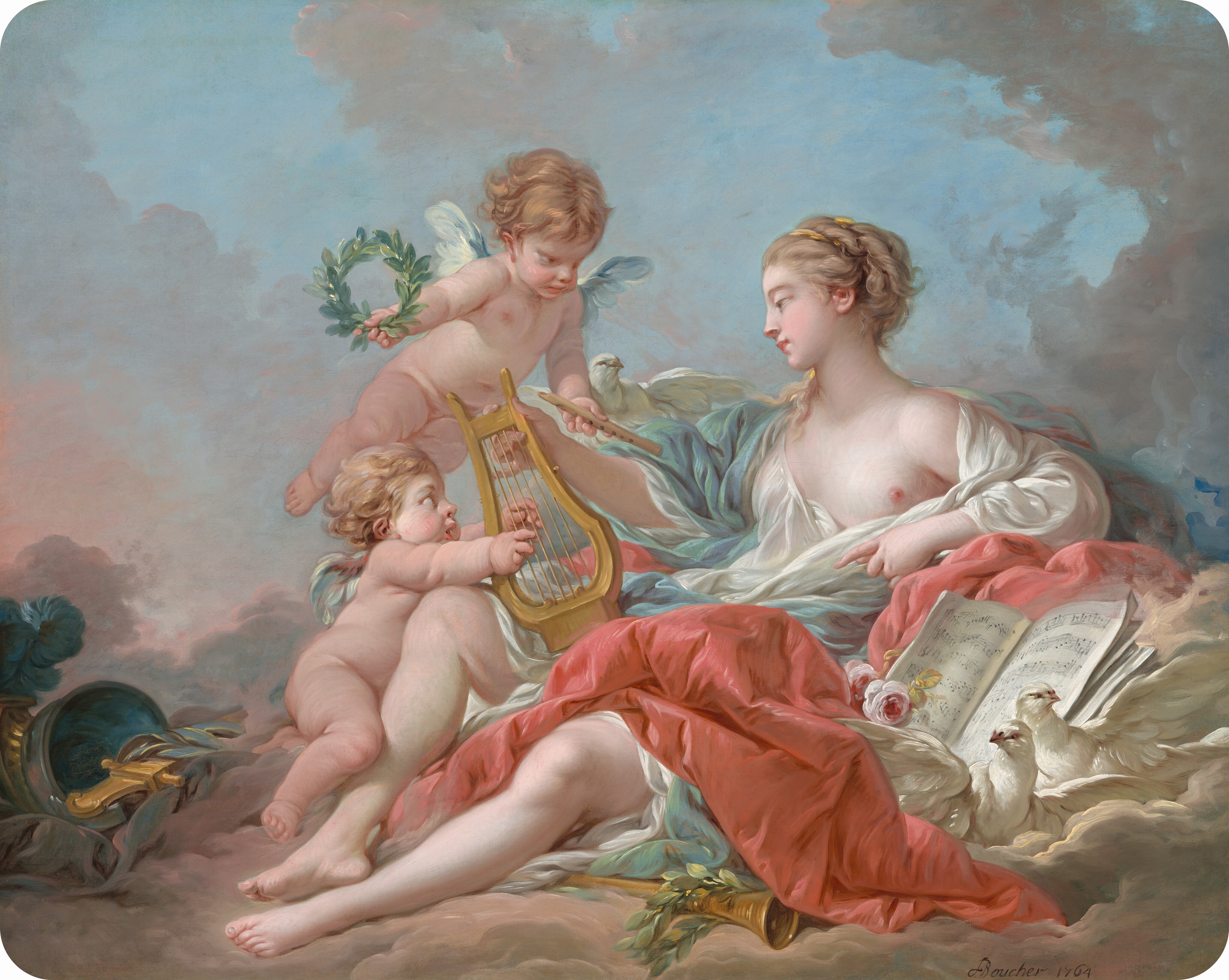
Seated on clouds, a woman personifying Music points to a lyre propped on her knee, which a putto reaches out to strum, while another hovers above with a flute and a laurel wreath. More about this work
About this work
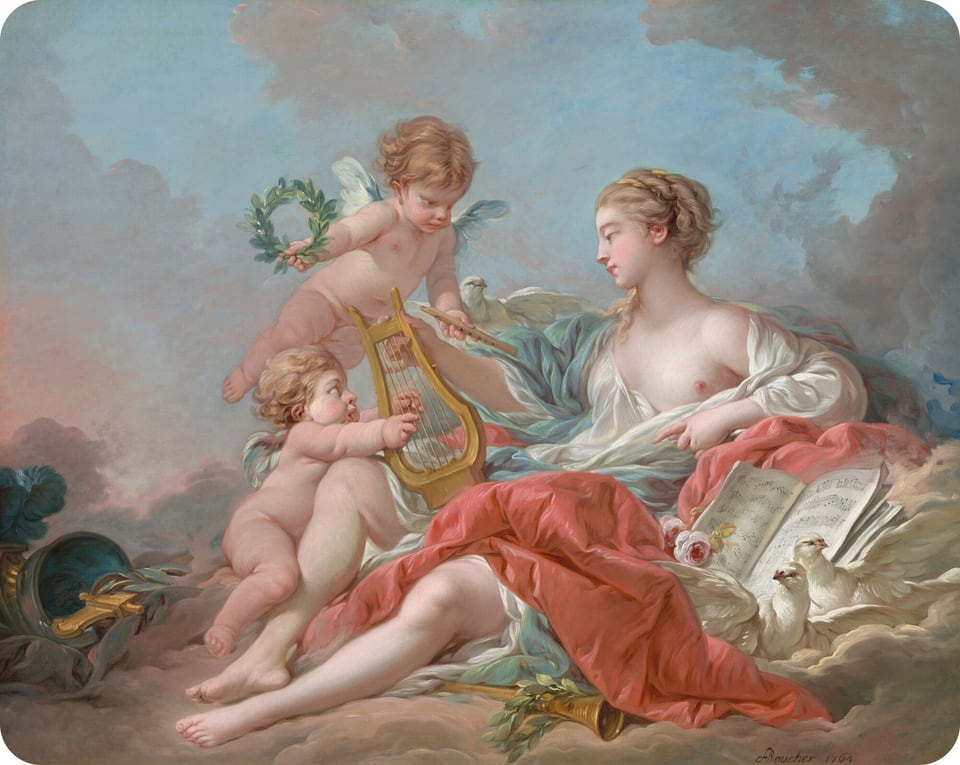
Seated on clouds, a woman personifying Music points to a lyre propped on her knee, which a putto reaches out to strum, while another hovers above with a flute and a laurel wreath. Around her lie a horn wrapped in laurel, a plumed helmet and a sword, and two white doves support an open book of music. Boucher signed and dated the canvas in 1764, and its pastel palette and floating, weightless figures are typical of the decorative allegories he produced for French interiors. The white corners show that the picture was designed with rounded corners.
Written by Ochre Editions.
What you’re looking at
A woman wearing flowing, pastel-colored robes and two, winged, child-like putti gather on a bank of clouds among musical instruments and sheet music in this horizontal painting. The people all have pale, pink-tinged skin. The woman sits to our right of center, facing our left in profile. She has straight nose, a rounded chin, and her small, pink lips are closed. Her ash-blond hair is pulled back under a yellow band. A voluminous white robe falls away over her left shoulder, to our right, to reveal a firm breast and small pink nipple. Sky-blue drapery wraps over her far arm, and deep rose-pink cloth falls across her lap and onto the clouds around her. Her legs extend to our left, her toes pointed. She leans back on her left elbow, closer to us, and points with that index finger to a lyre she props against her knee with her other hand. One chubby, nude putto reaches forward to strum the strings. The other putto hovers above, holding a ring of laurel leaves up in one hand and a flute in the other. Both putti have chubby limbs and torsos, blond curls lifted as if in a breeze, and short, ice-blue wings. Both look at the woman. In the lower left corner, a helmet with a topaz-blue feather and the gold hilt of a sword sit near the woman’s feet. Beneath the woman’s lower leg, at the bottom center of the painting, is a gold horn encircled by another wreath of laurel leaves. Two white doves with wings spread support an open book of sheet music and two pink roses tucked under the woman’s bent elbow. Fog-gray clouds billow up both sides of the scene against a pale blue sky. The clouds on which the trio gathers are parchment brown shaded with mauve pink. The outer corners of the image are white, indicating that the corners of the canvas were rounded. The artist signed and dated the painting in the lower right corner, “F Boucher 1764.”
Description from the National Gallery of Art.
How it was made
- Oil paint
- Pigment ground in a drying oil, usually linseed. It dries slowly, so painters could blend on the canvas, build up thin translucent glazes, and rework a picture over weeks. Canvas replaced wooden panels in the 1500s because it is lighter and can be rolled.
François Boucher
French, 1703–1770 · Born and died in Paris.
Boucher trained with François Lemoyne, won the Prix de Rome and spent several years in Italy before rising to become First Painter to Louis XV. Madame de Pompadour was his most important patron. He worked at every scale, from mythological canvases full of rosy nudes and cupids to designs for the Beauvais and Gobelins tapestry factories, porcelain and the opera. His light, decorative manner came to define the French Rococo.
Written by Ochre Editions.
Rights and the museum’s record
Public domain. The National Gallery of Art has dedicated this image to the public domain under CC0, so anyone may copy, adapt and use it, for any purpose, without asking. Our prints and files are reproductions made from the museum’s image; the museum doesn’t endorse them.
- Object number
- 1946.7.2
- Credit
- Courtesy National Gallery of Art, Washington
- Type
- Painting
- Licence
- CC0 1.0 Universal
- Museum record
- See it on the museum’s site