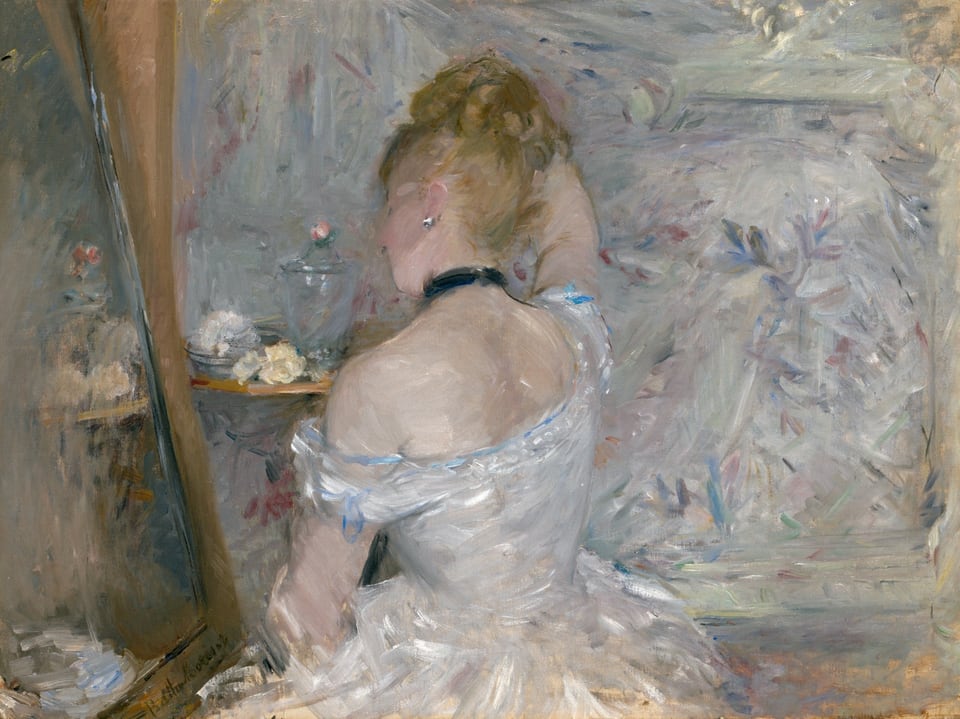
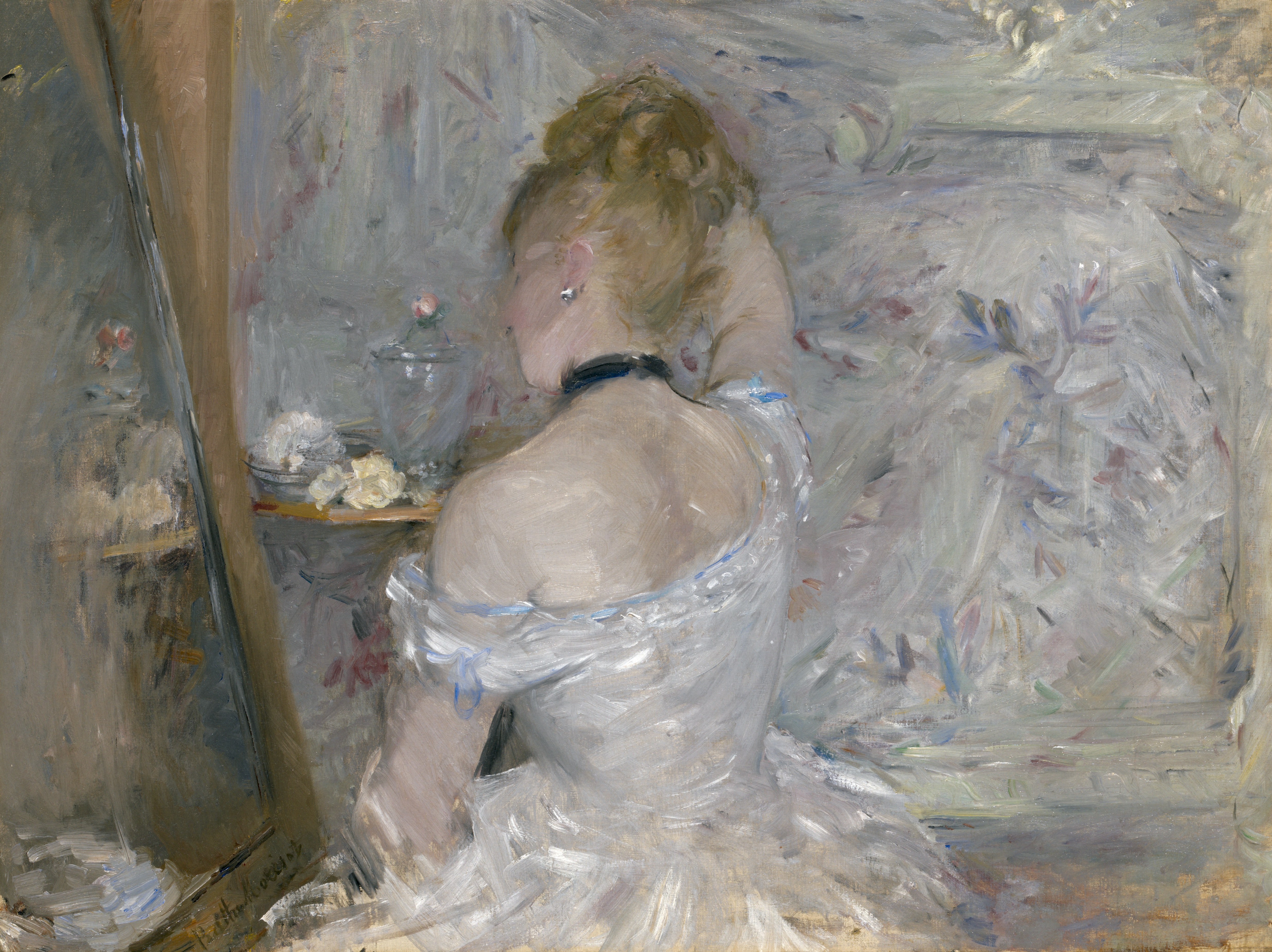
Woman at Her Toilette1875–80
Rendered with feathery brushstrokes in shades of lavender, pink, blue, white, and gray, this Impressionist painting captures a subject often explored by male artists of the day but seldom broached by the period's few women artists. More about this work
About this work
Rendered with feathery brushstrokes in shades of lavender, pink, blue, white, and gray, this Impressionist painting captures a subject often explored by male artists of the day but seldom broached by the period's few women artists. Morisot presents a decidely female perspective, intimate yet not eroticized. She signed her name along the bottom of the mirror, as if to suggest that the image in her painting is as ephemeral as a silvery reflection.
Text from the Art Institute of Chicago.
What you’re looking at
Painted portrait dominated by loose, large brushstrokes of a woman, seen from the back, wearing a gauzy white off-the-shoulder dress and black choker, blond hair swept up, examining herself in a mirror at left. The background is a feathered swirl suggesting floral pattern in cool pale tones of gray, purple, pink, and blue.
Description from the Art Institute of Chicago.
How it was made
- Oil paint
- Pigment ground in a drying oil, usually linseed. It dries slowly, so painters could blend on the canvas, build up thin translucent glazes, and rework a picture over weeks. Canvas replaced wooden panels in the 1500s because it is lighter and can be rolled.
Berthe Morisot
French, 1841–1895 · Born in Bourges; died in Paris.
Morisot studied with Corot and was a founding member of the Impressionist group, exhibiting in seven of its eight exhibitions. Barred as a woman from much of public life, she painted the world open to her: mothers and children, women at their toilette, gardens and interiors, with brushwork among the freest of the movement. She married Eugène Manet, brother of the painter Édouard, and their daughter Julie appears in many of her later works.
Written by Ochre Editions.
Impressionism
Painters in 1870s Paris who worked quickly, often outdoors, to catch light as it changed.
Rights and the museum’s record
Public domain. The Art Institute of Chicago has dedicated this image to the public domain under CC0, so anyone may copy, adapt and use it, for any purpose, without asking. Our prints and files are reproductions made from the museum’s image; the museum doesn’t endorse them.
- Object number
- 1924.127
- Credit
- Courtesy of the Art Institute of Chicago
- Type
- Painting
- Department
- Painting and Sculpture of Europe
- Licence
- CC0 1.0 Universal
- Museum record
- See it on the museum’s site
Report this work
More by Berthe Morisot
All their works
Close in colour