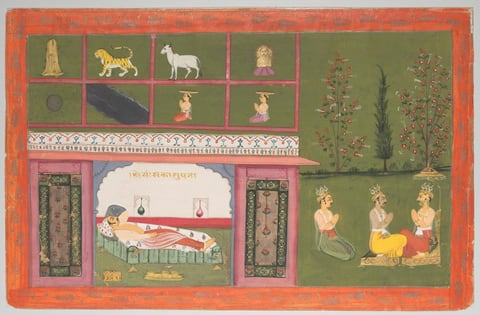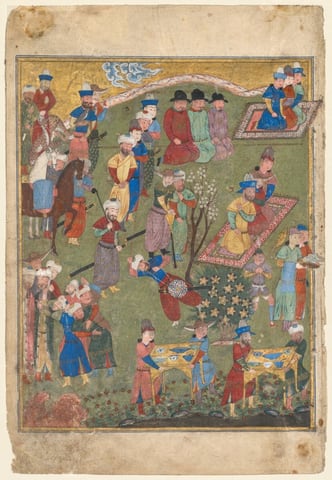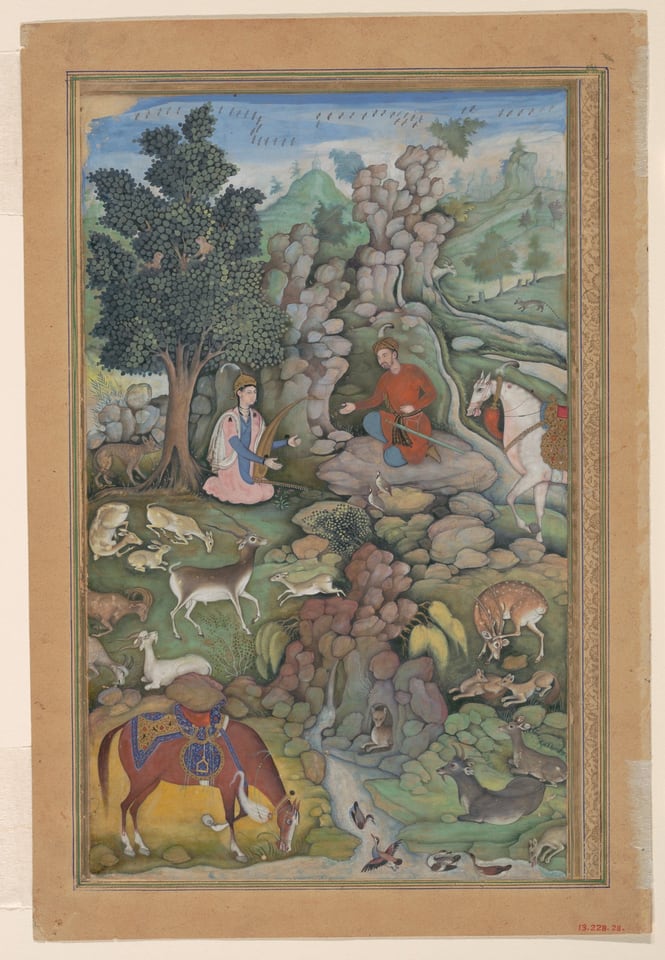
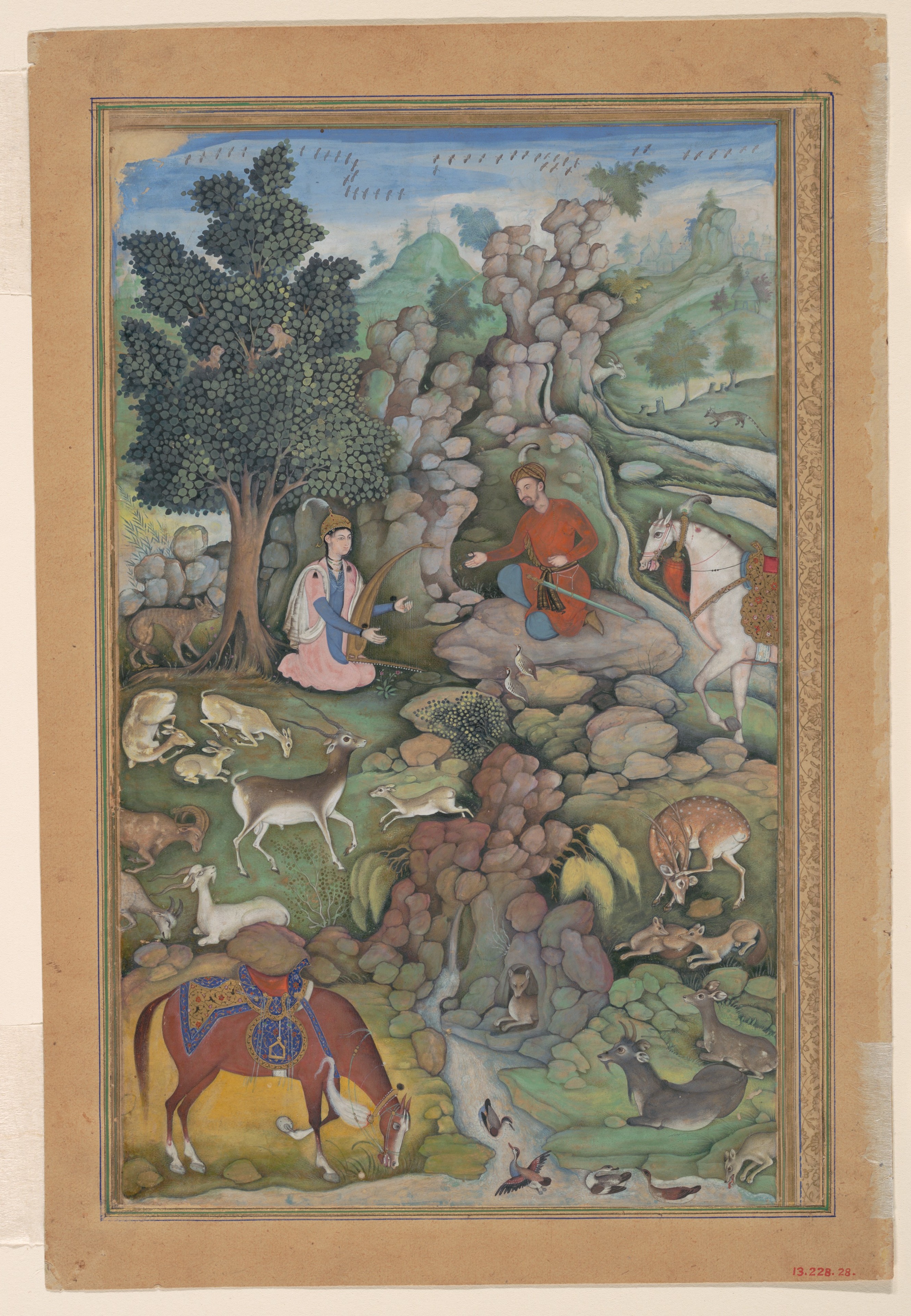
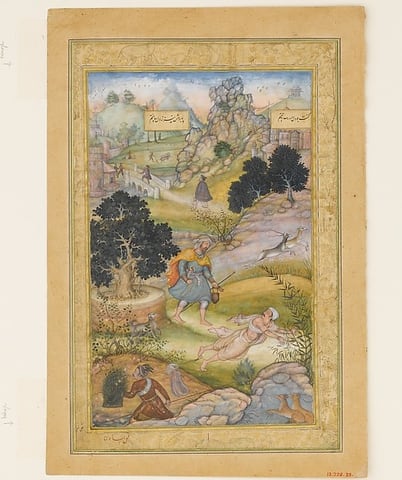
"Bahram Gur Sees a Herd of Deer Mesmerized by Dilaram' s Music", Folio from a Khamsa (Quintet) of Amir Khusrau Dihlavi1597–98
In Amir Khusrau’s retelling of the story of the hunter-king Bahram Gur, his harpist Dilaram plays so beautifully that a herd of deer stands spellbound, and the king comes upon the scene. More about this work
About this work
In Amir Khusrau’s retelling of the story of the hunter-king Bahram Gur, his harpist Dilaram plays so beautifully that a herd of deer stands spellbound, and the king comes upon the scene. Amir Khusrau, the great poet of the Delhi Sultanate, composed his Khamsa, or Quintet, around 1300 in answer to the five poems of Nizami. This page comes from a copy made for the Mughal emperor Akbar in 1597–98, illustrated by painters of the imperial workshop and set within margins of gold on dyed paper.
Written by Ochre Editions.
How it was made
- Opaque watercolour
- Watercolour made opaque with white or chalk and laid in flat, even layers. Persian and Indian painters ground their colours from minerals, applied them with the finest brushes and burnished the finished page.
- Watercolour
- Pigment in gum arabic, thinned with water and laid in transparent washes. Nothing white is painted: the light is the paper showing through.
- Ink on paper
- Ink made from soot and animal glue, ground with water on an inkstone. A single brush can give a hair-fine line or a broad wash, and nothing can be corrected.
Amir Khusrau Dihlavi
Indian, died 1350 · Born in Patiyali; died in Delhi.
Amir Khusrau was a poet, scholar and musician who served a succession of sultans at the Delhi court and was a devoted follower of the Sufi saint Nizamuddin Auliya, beside whose shrine he is buried. Writing chiefly in Persian, he composed a Khamsa, five verse romances answering those of Nizami, which became a classic of Persian literature. Later courts commissioned richly illustrated copies of his poems, among them the Mughal court of Akbar.
Written by Ochre Editions.
Rights and the museum’s record
Public domain. The Met has dedicated this image to the public domain under CC0, so anyone may copy, adapt and use it, for any purpose, without asking. Our prints and files are reproductions made from the museum’s image; the museum doesn’t endorse them.
- Object number
- 13.228.28
- Credit
- Courtesy of The Metropolitan Museum of Art
- Type
- Codices
- Department
- Islamic Art
- Licence
- CC0 1.0 Universal
- Museum record
- See it on the museum’s site
Report this work
More by Amir Khusrau Dihlavi
All their works
Close in colour