Unknown maker
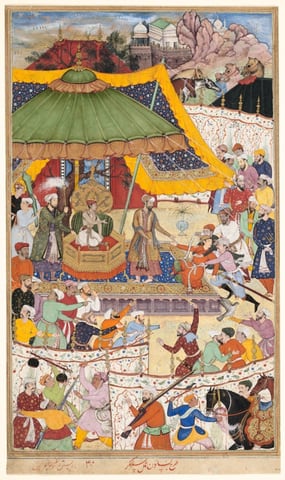
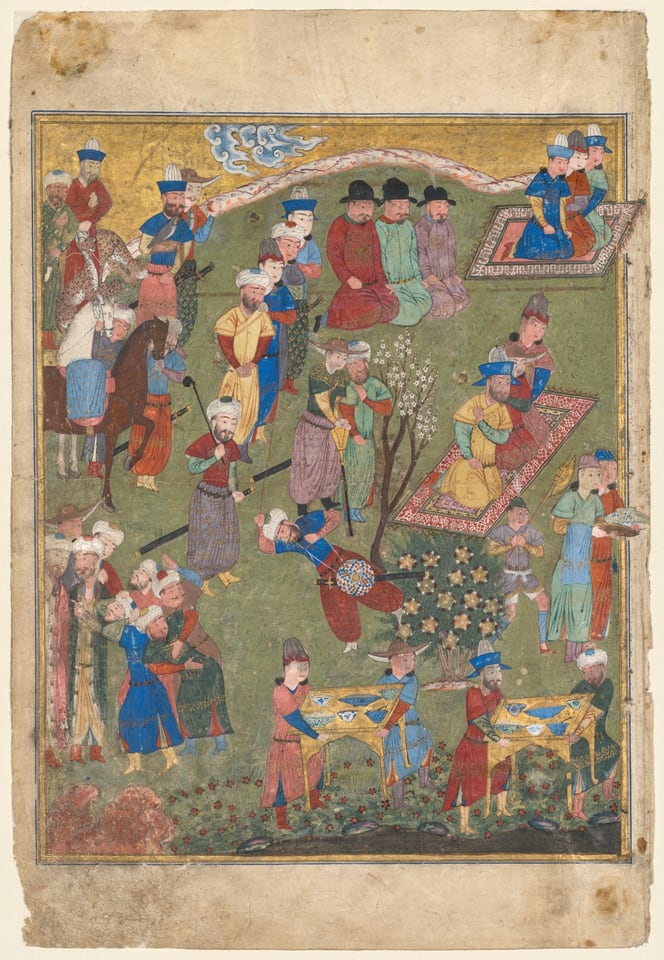
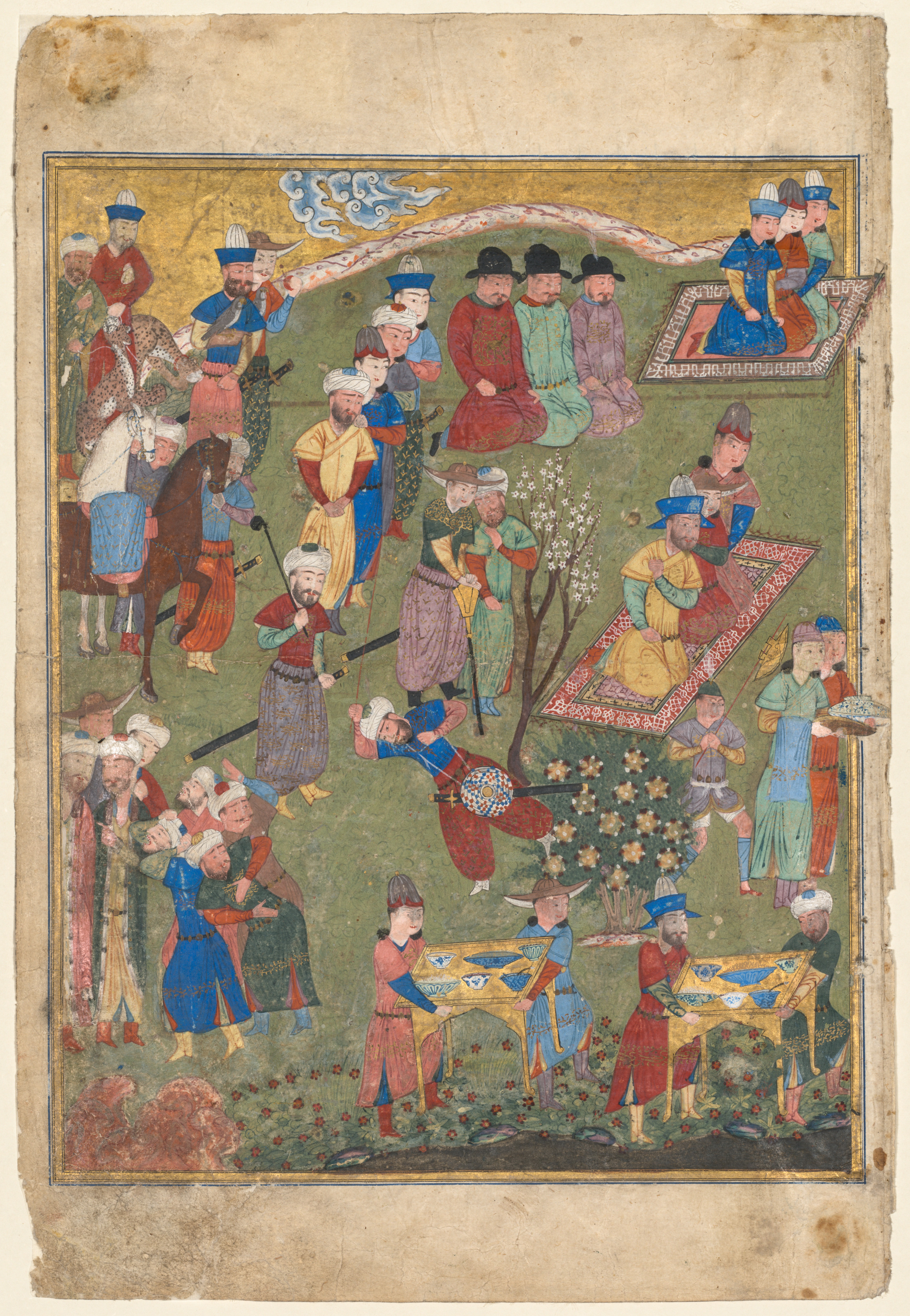
Royal Reception in a Landscape, left folio from the double frontispiece of a Shahnama (Book of Kings) of Firdausi (Persian, about 940–1019 or 1025)1444
The royal feast is set in a green landscape dotted with flowers and blossoming bushes against a gold sky with wisps of blue and white clouds. More about this work
About this work
The royal feast is set in a green landscape dotted with flowers and blossoming bushes against a gold sky with wisps of blue and white clouds. The group of figures in the upper left includes a falconer, horses, attendants, and two hunting cheetahs, while servers transport food and drink in gold and ceramic vessels, some presumably Chinese blue and white porcelain. Possibly this banquet was offered after a courtly hunt, a prestigious symbol of power and wealth. Among the groups of men sitting on elaborate carpets are three Chinese officials, identifiable by their black hats, kneeling together on the ground. Although their presence indicates the presence of foreign cultures within the Timurid court, the painting also reveals that not all are welcome to the feast; in the bottom half of the page a guard wields a stick to drive a group of men out of the garden.
Text from the Cleveland Museum of Art.
How it was made
- Opaque watercolour
- Watercolour made opaque with white or chalk and laid in flat, even layers. Persian and Indian painters ground their colours from minerals, applied them with the finest brushes and burnished the finished page.
- Watercolour
- Pigment in gum arabic, thinned with water and laid in transparent washes. Nothing white is painted: the light is the paper showing through.
- Ink on paper
- Ink made from soot and animal glue, ground with water on an inkstone. A single brush can give a hair-fine line or a broad wash, and nothing can be corrected.
Rights and the museum’s record
Public domain. The Cleveland Museum of Art has dedicated this image to the public domain under CC0, so anyone may copy, adapt and use it, for any purpose, without asking. Our prints and files are reproductions made from the museum’s image; the museum doesn’t endorse them.
- Object number
- 1956.10.a
- Credit
- Courtesy of the Cleveland Museum of Art
- Type
- Manuscript
- Department
- Islamic Art
- Licence
- CC0 1.0 Universal
- Museum record
- See it on the museum’s site
Report this work
Close in colour