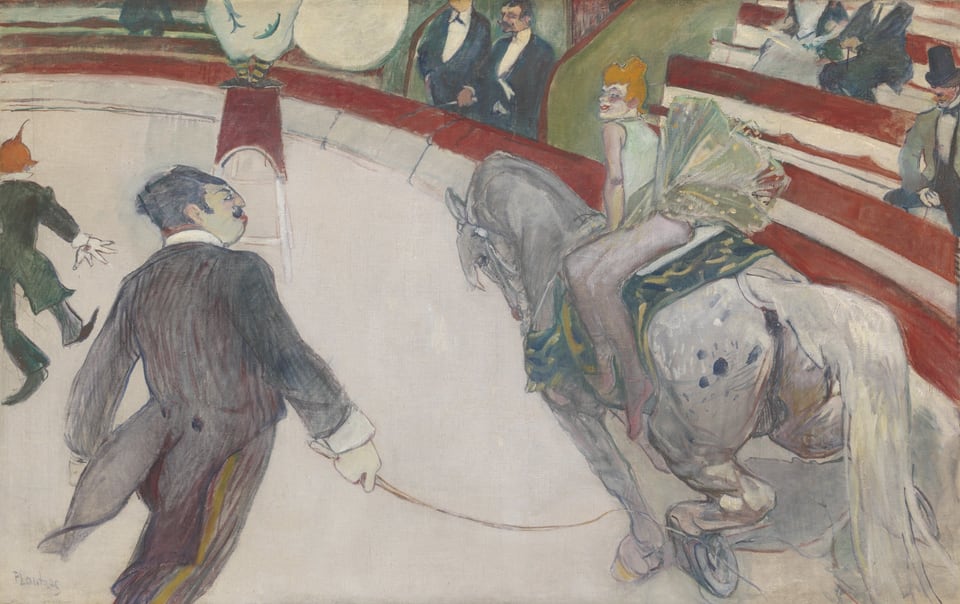
Equestrienne (At the Cirque Fernando)1887–88
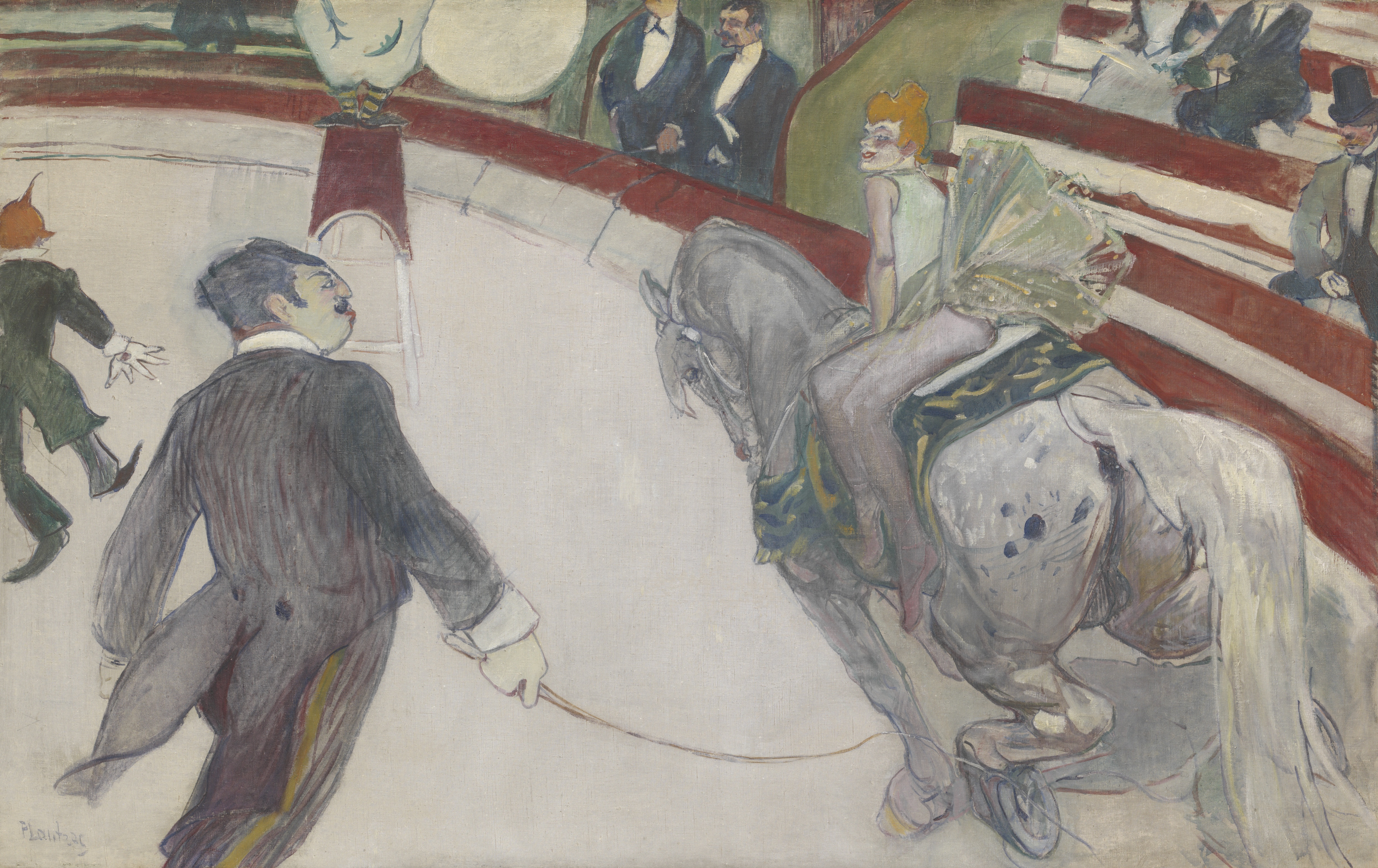
This work, set at a circus, captures the tense moment in which a female trick rider prepares to stand up on her horse and leap through a paper hoop held by a clown. More about this work
About this work
This work, set at a circus, captures the tense moment in which a female trick rider prepares to stand up on her horse and leap through a paper hoop held by a clown. Henri de Toulouse-Lautrec may have based the rider, dressed in a tutu of gauze and sequins, on Suzanne Valadon, a former circus performer, model, and artist with whom he had a relationship.
Text from the Art Institute of Chicago.
What you’re looking at
Painting of a performance inside a circus ring. A man wearing a suit holds a whip in his hand and looks towards a woman with red hair riding a gray horse and wearing a green dress. Audience members wearing suits and top hats watch from red and white benches on the side.
Description from the Art Institute of Chicago.
How it was made
- Oil paint
- Pigment ground in a drying oil, usually linseed. It dries slowly, so painters could blend on the canvas, build up thin translucent glazes, and rework a picture over weeks. Canvas replaced wooden panels in the 1500s because it is lighter and can be rolled.
Henri de Toulouse-Lautrec
French, 1864–1901 · Born in Albi; died in Saint-André-du-Bois.
Toulouse-Lautrec came from an aristocratic family in Albi; after two leg fractures in his teens his legs stopped growing, and he turned to art. Trained in Paris under Léon Bonnat and Fernand Cormon, he settled in Montmartre and recorded its dance halls, cabarets, circuses and brothels with quick, incisive line. His colour lithograph posters for the Moulin Rouge and its performers transformed the street poster. He died at the family’s Château de Malromé at the age of thirty-six.
Written by Ochre Editions.
Post-Impressionism
Artists who kept Impressionism's colour but pushed towards structure, symbol and feeling.
Rights and the museum’s record
Public domain. The Art Institute of Chicago has dedicated this image to the public domain under CC0, so anyone may copy, adapt and use it, for any purpose, without asking. Our prints and files are reproductions made from the museum’s image; the museum doesn’t endorse them.
- Object number
- 1925.523
- Credit
- Courtesy of the Art Institute of Chicago
- Type
- Painting
- Department
- Painting and Sculpture of Europe
- Licence
- CC0 1.0 Universal
- Museum record
- See it on the museum’s site
Report this work
More by Henri de Toulouse-Lautrec
All their works
Close in colour