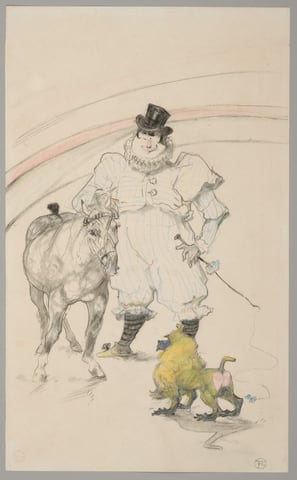
At the Circus: The Spanish Walk (Au Cirque: Le Pas espagnol)1899
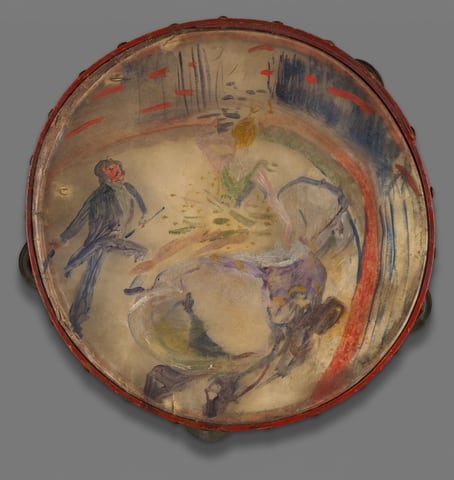
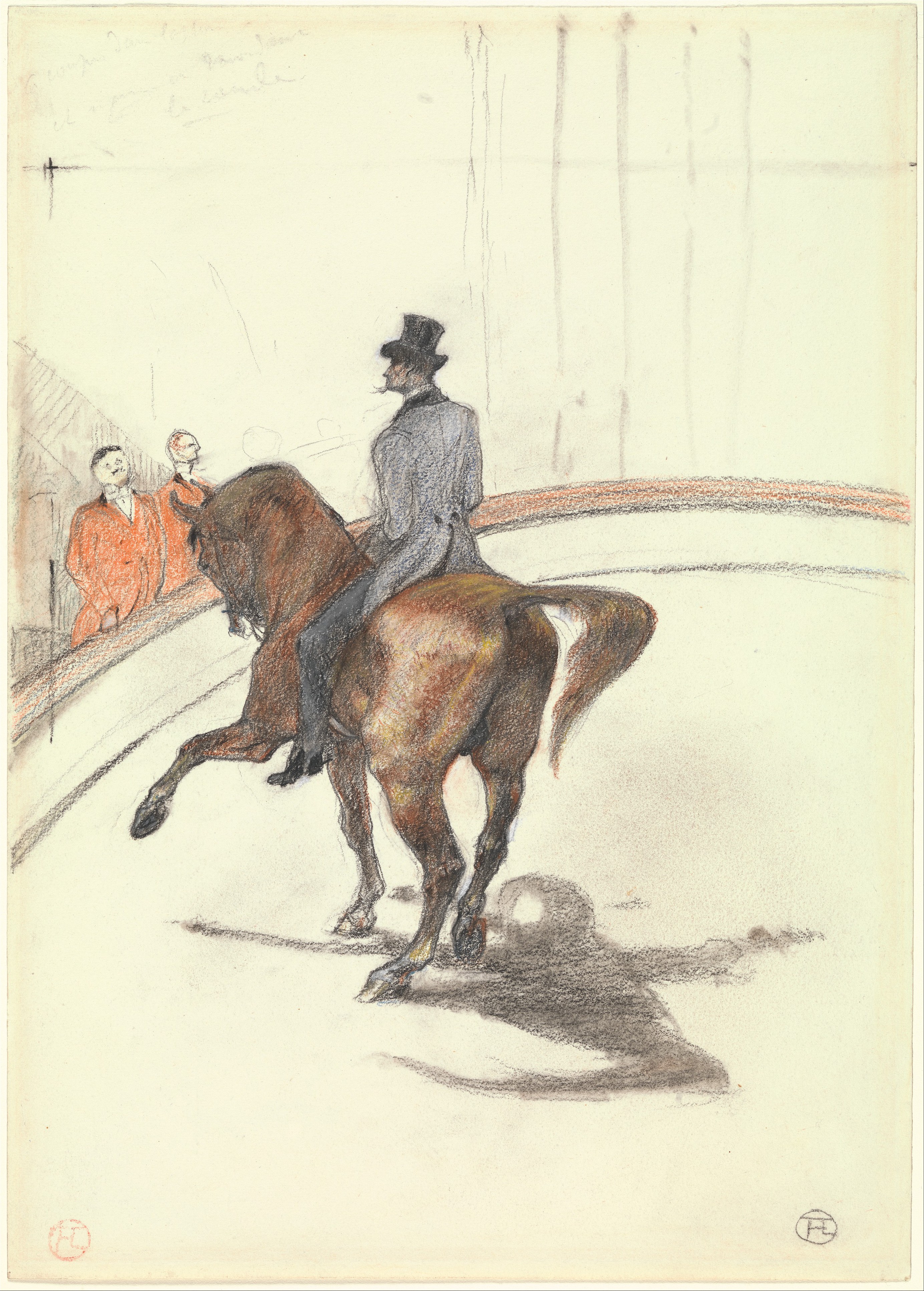
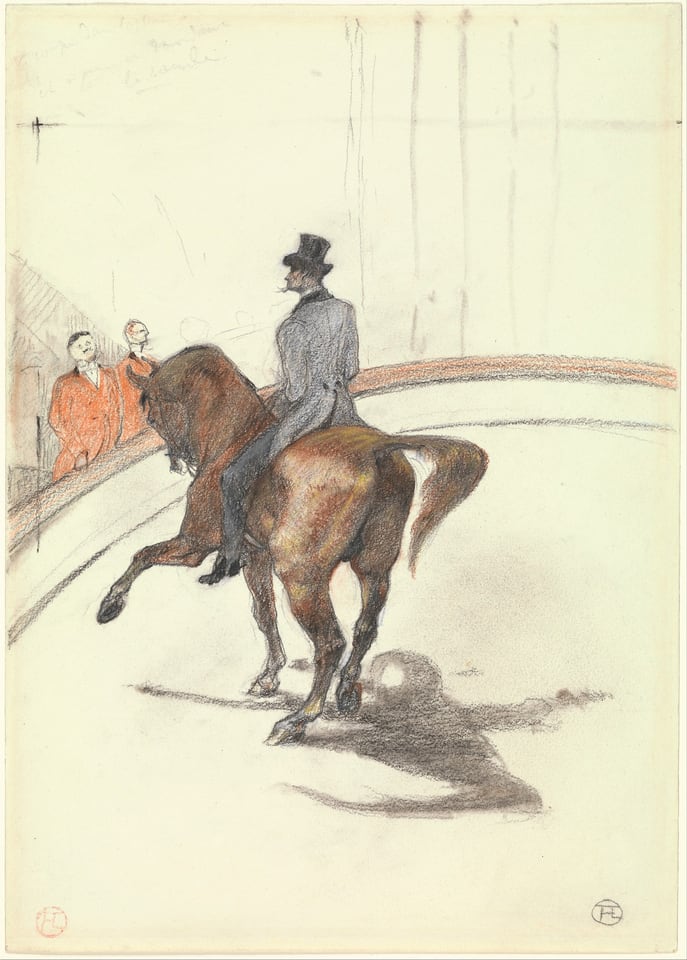
A circus horse performs the Spanish walk, lifting each foreleg high in an exaggerated stride under the control of its rider. More about this work
About this work
A circus horse performs the Spanish walk, lifting each foreleg high in an exaggerated stride under the control of its rider. Toulouse-Lautrec drew it in 1899 during his confinement in a clinic at Neuilly, part of a series of circus scenes recalled from memory to convince his doctors that he was fit to be released, as he soon was. Working in graphite, charcoal and coloured pastel, he captures the horse’s rhythm and the strange, theatrical poise of the act with spare, assured lines.
Written by Ochre Editions.
How it was made
- Pastel
- Sticks of almost pure pigment with very little binder. The colour sits on the paper as powder: bright, matte and fragile.
- Charcoal
- Burnt willow or vine. It smudges and wipes away easily, which made it the natural tool for working out a composition.
- Graphite
- Pencil. Graphite has been used for drawing since the 1500s; in 1795 Nicolas-Jacques Conté mixed it with clay, so its hardness could be graded.
Henri de Toulouse-Lautrec
French, 1864–1901 · Born in Albi; died in Saint-André-du-Bois.
Toulouse-Lautrec came from an aristocratic family in Albi; after two leg fractures in his teens his legs stopped growing, and he turned to art. Trained in Paris under Léon Bonnat and Fernand Cormon, he settled in Montmartre and recorded its dance halls, cabarets, circuses and brothels with quick, incisive line. His colour lithograph posters for the Moulin Rouge and its performers transformed the street poster. He died at the family’s Château de Malromé at the age of thirty-six.
Written by Ochre Editions.
Post-Impressionism
Artists who kept Impressionism's colour but pushed towards structure, symbol and feeling.
Rights and the museum’s record
Public domain. The Met has dedicated this image to the public domain under CC0, so anyone may copy, adapt and use it, for any purpose, without asking. Our prints and files are reproductions made from the museum’s image; the museum doesn’t endorse them.
- Object number
- 1975.1.731
- Credit
- Courtesy of The Metropolitan Museum of Art
- Type
- Drawings
- Department
- Robert Lehman Collection
- Licence
- CC0 1.0 Universal
- Museum record
- See it on the museum’s site